Tompkins, Daniel A., Company Machine Shop, Former
Tompkins, Daniel A., Company Machine Shop, Former is a building in Charlotte, Mecklenburg County, North Carolina, listed on the National Register of Historic Places on May 8, 2001 (reference number 01000422). The National Park Service records its significance in Industry at the local level.
Facts from the NPS National Register database (); nomination summary October 2026. Last updated . Sources for each fact.

Approximate location: the National Park Service places this pin arbitrarily within the property, not at a surveyed point (stated accuracy ±12 m).
Why it's listed
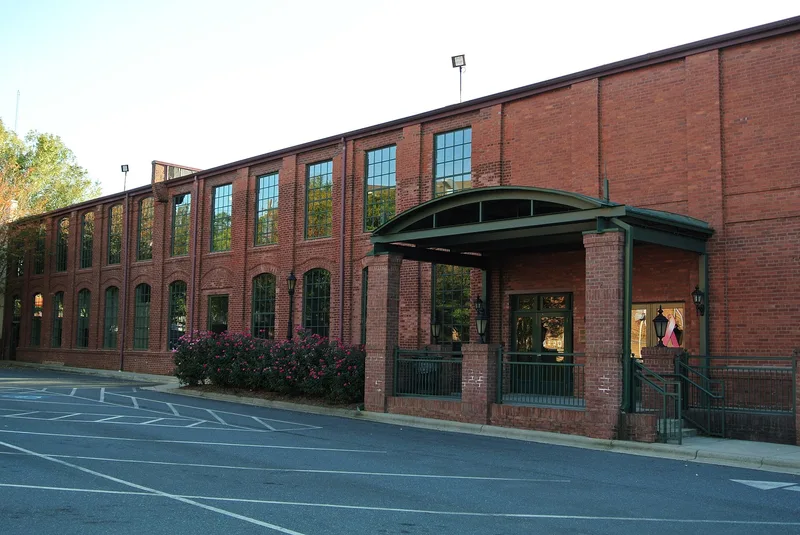
Built in 1904 and 1905 at 1900 South Boulevard in Charlotte's Dilworth neighborhood, this two-story brick building served as the principal machine shop of the D.A. Tompkins Company. The firm made textile machinery and equipment, and it dominated that field in the Southeast as cotton mills multiplied across the Piedmont. The shop was among the earliest factories in Dilworth's industrial district along the Southern Railway corridor. It originally stood with a foundry and boiler house, but it is now the only survivor of the company's manufacturing facilities. Its founder, Daniel A. Tompkins (1852-1914), was an engineer, mill builder, newspaper owner, author and promoter of Southern industrialization and technical education. The building has mill-construction interior framing, open production rooms, brick pilasters and corbelled cornices. Later changes include an office section added across the front, a rear freight platform, infilled windows and a rebuilt boiler house. At the time of listing it was undergoing certified rehabilitation.
Significance in brief: It is an important example of the textile-related industries that made Charlotte the Southeast's leading producer of textile machinery. It is also tied to founder Daniel A. Tompkins, an industrialist, New South promoter, newspaper owner and author. It is the only surviving building of the Tompkins Company's manufacturing facilities.
Machine-generated summary. This summary was generated by a language model from the official nomination document and has not been reviewed line by line by an editor. It may contain errors. Check the source document before relying on any detail. Source: nomination document (PDF) · National Archives catalog entry. NRHP reference 01000422, listed May 8, 2001. Summary generated October 2026 (model claude-sonnet-5-5, prompt v1.0-2026-10-29, confidence high).
Key facts
| Official database NPS National Register database, ref. 01000422 , checked | |
|---|---|
| Address | 1900 South Boulevard, Charlotte |
| County | Mecklenburg County |
| Listed | May 8, 2001 |
| Reference number | 01000422 |
| Resource type | Building |
| Areas of significance | Industry |
| Level of significance | Local |
| National Historic Landmark | No |
| Acreage | 1.4 |
| Official document, machine-extracted Nomination form (National Archives) , checked | |
| Period of significance | 1905-1929 |
| Architect / builder | Unknown |
| Architectural style | No style |
| Criteria |
|
| Status (as stated in the nomination) | Undergoing certified rehabilitation at the time of nomination; the interior was most recently used for commercial purposes, and the modern ell is scheduled for removal. |
| Official dataset NPS cultural-resource GIS (NRHP locations) | |
| Coordinates | 35.21102, -80.85982 |
What listing means for this property
For an income-producing building, listing (individually or as a contributing building in a district) is the gateway to the 20% federal rehabilitation tax credit on qualified rehabilitation costs, often stackable with state credits. Work claiming the credit must follow the Secretary of the Interior's Standards and be approved in advance.
Listing does not restrict a private owner acting without federal money or permits; where federal funding or licensing is involved, Section 106 review applies.
General information, not legal or tax advice. Rules change; confirm with your State Historic Preservation Office or a qualified adviser.
Questions about Tompkins, Daniel A., Company Machine Shop, Former
When was Tompkins, Daniel A., Company Machine Shop, Former added to the National Register of Historic Places?
Tompkins, Daniel A., Company Machine Shop, Former was listed on May 8, 2001. Its National Register reference number is 01000422.
Is Tompkins, Daniel A., Company Machine Shop, Former a National Historic Landmark?
No. The National Park Service database (snapshot of May 2026) lists Tompkins, Daniel A., Company Machine Shop, Former on the National Register but does not record it as a National Historic Landmark.
Where is Tompkins, Daniel A., Company Machine Shop, Former?
1900 South Boulevard, Charlotte, Mecklenburg County, North Carolina; coordinates 35.21102, -80.85982.
Why is Tompkins, Daniel A., Company Machine Shop, Former historically significant?
According to a machine-generated summary of its nomination form: It is an important example of the textile-related industries that made Charlotte the Southeast's leading producer of textile machinery. It is also tied to founder Daniel A. Tompkins, an industrialist, New South promoter, newspaper owner and author. It is the only surviving building of the Tompkins Company's manufacturing facilities. Check the nomination document before relying on any detail.
Who designed or built Tompkins, Daniel A., Company Machine Shop, Former?
The nomination form names Unknown as architect or builder (extracted by machine from the nomination; check the source document).
Where can I read the original nomination for Tompkins, Daniel A., Company Machine Shop, Former?
The nomination form is a public record held by the National Archives: nomination document (PDF).
Sources and further reading
- National Park Service, National Register of Historic Places database (snapshot May 2026), reference 01000422.
- Nomination form (PDF, National Archives) — catalog entry
- Wikipedia article (used for cross-checking only; text not reproduced here)
- Wikidata Q20745519
- This listing as JSON
Last updated November 2026. Found an error? See the editorial policy for how to report it.