Southern Asbestos Company Mills
Also known as: Fiber Mills

Why it's listed
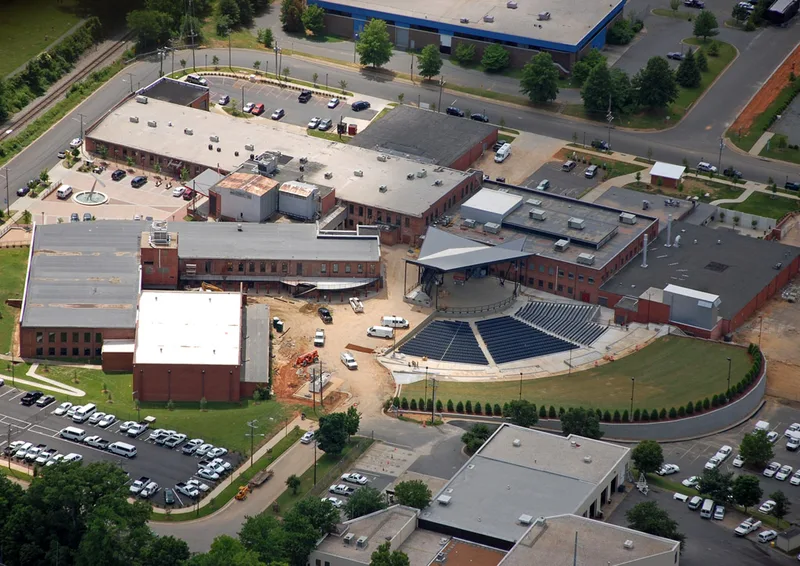
Two connected red brick mill buildings at 1000 Seaboard Street in Uptown Charlotte make up this former textile plant, built in phases between 1904 and about 1960. Mill #1 began in 1904 as part of a cotton bag factory, and Mill #2 followed around 1920. Later wings, dust collectors and a bridge section were added through the mid-twentieth century. The Southern Asbestos Manufacturing Company, organized in 1919, began operating here in 1920, and it was renamed Southern Asbestos Company in 1928. Thermoid Company of Trenton, New Jersey, bought a controlling interest in 1929. The plant became the largest producer of asbestos textiles, yarn, thread and cord in Mecklenburg County and an important local employer. Although tied to asbestos, its machinery and operations resembled those of other Charlotte textile mills. Asbestos manufacturing continued until 2001, when a developer bought the property. After extensive decontamination, rehabilitation began for arts and music uses, including a performance stage, a landscaped courtyard, new windows and loft-style offices.
Significance in brief: The mills were the largest producer of asbestos textiles, yarn, thread and cord in Mecklenburg County and an important source of local employment and industry. The plant contributed to Charlotte's textile industry and worked much like other Charlotte textile mills, despite its link to asbestos.
Machine-generated summary. This summary was generated by a language model from the official nomination document and has not been reviewed line by line by an editor. It may contain errors. Check the source document before relying on any detail. Source: nomination document (PDF) · National Archives catalog entry. NRHP reference 07001500, listed January 30, 2008. Summary generated October 2026 (model claude-sonnet-5-5, prompt v1.0-2026-10-29, confidence medium).
Key facts
| Address | 1000 Seaboard St., Charlotte |
|---|---|
| County | Mecklenburg County |
| Listed | January 30, 2008 |
| Reference number | 07001500 |
| Resource type | Building |
| Architectural style | Late Victorian / Late Italianate |
| Criteria |
|
| Areas of significance | Industry |
| Level of significance | Local |
| Status (as stated in the nomination) | Listed as vacant/not in use; the owner has begun rehabilitating the buildings for art galleries, recording studios and other arts and music uses, with offices installed in the upper level of Mill #2. |
| Acreage | 7.4 |
| Coordinates | 35.23932, -80.84455 (NPS GIS) |
What listing means for this property
For an income-producing building, listing (individually or as a contributing building in a district) is the gateway to the 20% federal rehabilitation tax credit on qualified rehabilitation costs, often stackable with state credits. Work claiming the credit must follow the Secretary of the Interior's Standards and be approved in advance.
Listing does not restrict a private owner acting without federal money or permits; where federal funding or licensing is involved, Section 106 review applies.
Noted as vacant in the nomination. Nomination documents can be decades old; current status may differ. If you are considering buying an empty listed property, read the due-diligence checklist.
General information, not legal or tax advice. Rules change; confirm with your State Historic Preservation Office or a qualified adviser.
Sources and further reading
- National Park Service, National Register of Historic Places database (snapshot May 2026), reference 07001500.
- Nomination form (PDF, National Archives) — catalog entry
- Wikipedia article (used for cross-checking only; text not reproduced here)
- Wikidata Q21016208
- This listing as JSON
Last updated October 2026. Found an error? See the editorial policy for how to report it.