Williamston Commercial Historic District
Williamston Commercial Historic District is a historic district in Williamston, Martin County, North Carolina, listed on the National Register of Historic Places on March 9, 1995 (reference number 95000174). The National Park Service records its significance in Commerce, Community Planning and Development and Architecture at the local level.
Facts from the NPS National Register database (); nomination summary October 2026. Last updated . Sources for each fact.

The pin is a point inside the NPS boundary polygon, not a surveyed location.
Why it's listed
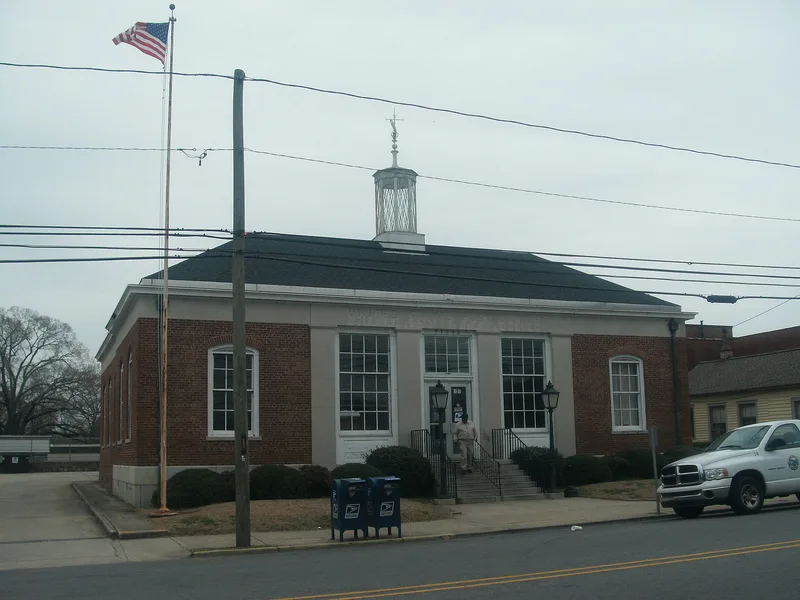
Williamston's downtown business district lies along Main Street, with Washington Street and two shorter cross streets, in the northern coastal plain of North Carolina. Its roughly forty-three resources are mostly brick one- to three-story commercial buildings, many of them with corbeled brickwork on their upper facades and rows of arched second-story windows. The oldest buildings are two frame offices from about 1850, one of which, the Docton W. Bagley Building, has a pedimented Greek Revival front with fluted pilasters. Two Colonial Revival buildings with stone veneer, the former People's Bank and the Tar Heel Apartments, are dated 1917 and 1920 respectively. The district developed as a trading center after the Atlantic Coast Line route reached the town in 1882, when rail freight replaced river steamers as the main link to outside markets. Its range of styles, from Greek Revival to Art Deco and International, is unusually broad for a town of this size.
Significance in brief: The district is presented as typical of small rural trading centers in eastern North Carolina while also containing an unusually wide range of architectural styles for a town of its size, including Greek Revival, Italianate, Romanesque, Colonial Revival, Art Deco, Art Moderne and International styles. It is noted for its high level of architectural integrity and its cohesive corbeled brickwork. It is also associated with the town's commercial development after the railroad arrived in 1882 and with the growth of peanut and tobacco culture from 1890 to 1920.
Machine-generated summary. This summary was generated by a language model from the official nomination document and has not been reviewed line by line by an editor. It may contain errors. Check the source document before relying on any detail. Source: nomination document (PDF) · National Archives catalog entry. NRHP reference 95000174, listed March 9, 1995. Summary generated October 2026 (model claude-haiku-5-5, prompt v1.1-2026-10-29, confidence medium).
Key facts
| Official database NPS National Register database, ref. 95000174 , checked | |
|---|---|
| Address | Roughly, areas surrounding the 100 blocks of E. Main, W. Main and S. Smithwick Sts. and the 200 block of Washington St., Williamston |
| County | Martin County |
| Listed | March 9, 1995 |
| Reference number | 95000174 |
| Resource type | District |
| Areas of significance | Commerce, Community Planning and Development, Architecture |
| Level of significance | Local |
| National Historic Landmark | No |
| Acreage | 11.5 |
| Official document, machine-extracted Nomination form (National Archives) , checked | |
| Period of significance | ca. 1850 to 1945 |
| Architect / builder | Benton, Charles Collins; Bishop, Fred A. |
| Architectural style | Greek Revival, Italianate, Romanesque, Colonial Revival, Art Deco, Art Moderne, International |
| Criteria |
|
| Status (as stated in the nomination) | Most resources are described as occupied, housing commercial, professional and governmental establishments. |
| Official dataset NPS cultural-resource GIS (NRHP locations) | |
| Coordinates | 35.85626, -77.05491 |
| Computed Computed from NPS GIS district boundaries | |
| Within district | Williamston Historic District |
What listing means for this property
This is a historic district. Buildings within its boundary are either contributing (they add to the district's significance) or non-contributing. Owners of contributing income-producing buildings can claim the 20% federal rehabilitation tax credit; homeowners should look at state credits. National Register districts impose no design review by themselves; a local historic district ordinance, if one exists, does (the difference explained).
General information, not legal or tax advice. Rules change; confirm with your State Historic Preservation Office or a qualified adviser.
Questions about Williamston Commercial Historic District
When was Williamston Commercial Historic District added to the National Register of Historic Places?
Williamston Commercial Historic District was listed on March 9, 1995. Its National Register reference number is 95000174.
Is Williamston Commercial Historic District a National Historic Landmark?
No. The National Park Service database (snapshot of May 2026) lists Williamston Commercial Historic District on the National Register but does not record it as a National Historic Landmark.
Where is Williamston Commercial Historic District?
Roughly, areas surrounding the 100 blocks of E. Main, W. Main and S. Smithwick Sts. and the 200 block of Washington St., Williamston, Martin County, North Carolina; coordinates 35.85626, -77.05491.
Why is Williamston Commercial Historic District historically significant?
According to a machine-generated summary of its nomination form: The district is presented as typical of small rural trading centers in eastern North Carolina while also containing an unusually wide range of architectural styles for a town of its size, including Greek Revival, Italianate, Romanesque, Colonial Revival, Art Deco, Art Moderne and International styles. It is noted for its high level of architectural integrity and its cohesive corbeled brickwork. It is also associated with the town's commercial development after the railroad arrived in 1882 and with the growth of peanut and tobacco culture from 1890 to 1920. Check the nomination document before relying on any detail.
Who designed or built Williamston Commercial Historic District?
The nomination form names Benton, Charles Collins; Bishop, Fred A. as architect or builder (extracted by machine from the nomination; check the source document).
Is Williamston Commercial Historic District in a historic district?
Yes. Its location falls within the Williamston Historic District, itself listed on the National Register. (Computed from National Park Service boundary data; the district nomination's own list of contributing resources may differ.)
Where can I read the original nomination for Williamston Commercial Historic District?
The nomination form is a public record held by the National Archives: nomination document (PDF).
Sources and further reading
- National Park Service, National Register of Historic Places database (snapshot May 2026), reference 95000174.
- Nomination form (PDF, National Archives) — catalog entry
- Wikipedia article (used for cross-checking only; text not reproduced here)
- Wikidata Q22061142
- This listing as JSON
Last updated November 2026. Found an error? See the editorial policy for how to report it.