Skewarkey Primitive Baptist Church

Why it's listed
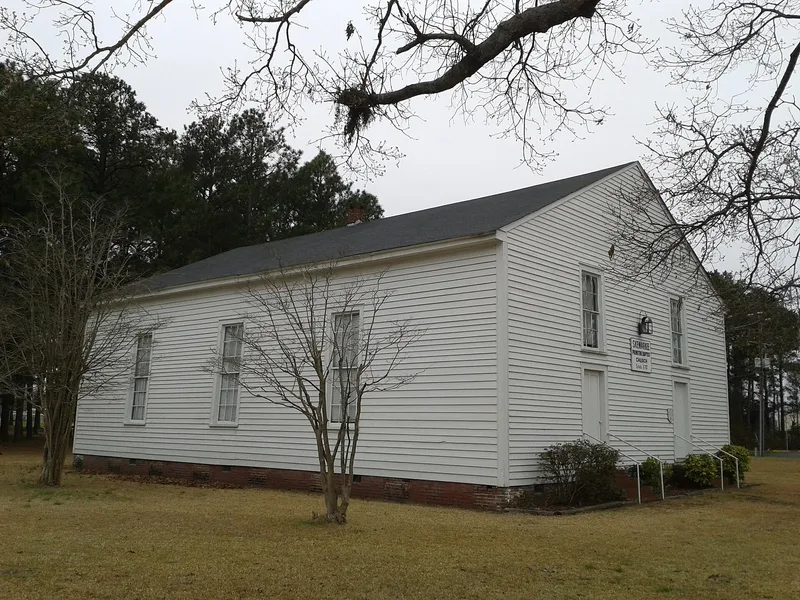
Built between 1858 and 1859 on a two-acre tract in Williamston, this one-story, front-gable timber-frame church sits on low handmade brick piers and is clad in plain weatherboard. Its interior is an open sanctuary with a gallery, and three tall posts divided seating by gender, a practice the congregation kept until about 1950. The building is regarded as the oldest ecclesiastical building in the county and a restrained example of Greek Revival design, with its exterior kept deliberately undecorated. Its church records document the congregation's founding in 1785, its place in the Kehukee Association, and the role of enslaved and African American members who sat in the gallery. The church's furnishings, pews and plaster-free ceiling boards remain largely as built, giving the building unusual integrity among regional Primitive Baptist houses of worship.
Significance in brief: The nomination argues the church is the oldest ecclesiastical building in Martin County and a simply rendered Greek Revival example whose structural intactness and interior arrangement reflect traditional Primitive Baptist meeting house design. It also cites the congregation's African American members and its role in the Kehukee Association as part of its importance.
Machine-generated summary. This summary was generated by a language model from the official nomination document and has not been reviewed line by line by an editor. It may contain errors. Check the source document before relying on any detail. Source: nomination document (PDF) · National Archives catalog entry. NRHP reference 05000355, listed April 28, 2005. Summary generated October 2026 (model claude-haiku-5-5, prompt v1.1-2026-10-29, confidence medium).
Key facts
| Address | W side of US 17, 0.04 mi. S. of jct. with US 64, Williamston |
|---|---|
| County | Martin County |
| Listed | April 28, 2005 |
| Reference number | 05000355 |
| Resource type | Building |
| Period of significance | 1859 |
| Architectural style | Mid-19th Century: Greek Revival |
| Criteria |
|
| Areas of significance | Architecture |
| Level of significance | Local |
| Status (as stated in the nomination) | Used as a church; two cast iron wood stoves were retired from service in the past five years and the interior has changed little since 1935. |
| Acreage | 4.9 |
| Coordinates | 35.84033, -77.06473 (NPS GIS) |
What listing means for this property
Religious properties are listed for their architectural or historical significance, not their religious use. Listing is honorary and does not restrict the congregation's use of the building. The federal rehabilitation credit is generally unavailable unless part of the building is income-producing; some state programmes and preservation grants do cover religious buildings. Federal funding or permits trigger Section 106 review.
General information, not legal or tax advice. Rules change; confirm with your State Historic Preservation Office or a qualified adviser.
Sources and further reading
- National Park Service, National Register of Historic Places database (snapshot May 2026), reference 05000355.
- Nomination form (PDF, National Archives) — catalog entry
- Wikipedia article (used for cross-checking only; text not reproduced here)
- Wikidata Q7534807
- This listing as JSON
Last updated October 2026. Found an error? See the editorial policy for how to report it.