Green Hill Cemetery Gatekeeper's House

Why it's listed
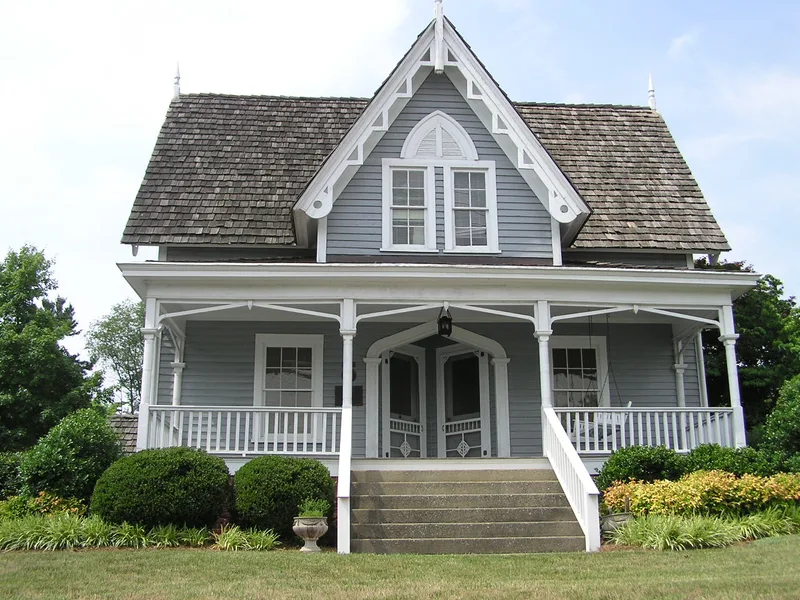
Built in 1888-1889 for Greensboro's first public cemetery, this cross-shaped, one-and-one-half story frame cottage served as both home and office for the Green Hill Cemetery keeper. Judge David Schenk, a leading figure in the city's civic improvements, urged the city to fund it at a cost of no more than $600 and selected the Gothic style. Features include a steep cross-gable roof, sawnwork bargeboards with kingposts, pointed-arch window labels, and a full porch with ogee-arch spandrels. The interior had separate doors to the office and living quarters, with corner fireplaces and molded trim largely intact. The house was moved roughly 500 feet in the early 1890s and was sold by the city in 1978 to owners planning restoration. It was listed as the only surviving Gothic Cottage in Greensboro and the last known Victorian cemetery gatekeeper's house in North Carolina, reflecting the influence of A. J. Downing's pattern books.
Significance in brief: The nomination calls it the only surviving Gothic Cottage in Greensboro and the last known Victorian cemetery gatekeeper's house in North Carolina. It is tied to Greensboro's late nineteenth-century civic improvements and to Judge David Schenk, who pushed for its construction and chose the Gothic style. Its design resembles plans in A. J. Downing's Cottage Residences (1853).
Machine-generated summary. This summary was generated by a language model from the official nomination document and has not been reviewed line by line by an editor. It may contain errors. Check the source document before relying on any detail. Source: nomination document (PDF) · National Archives catalog entry. NRHP reference 79001713, listed May 29, 1979. Summary generated October 2026 (model claude-sonnet-5-5, prompt v1.0-2026-10-29, confidence high).
Key facts
| Address | 700 Battleground Ave., Greensboro |
|---|---|
| County | Guilford County |
| Listed | May 29, 1979 |
| Reference number | 79001713 |
| Resource type | Building |
| Period of significance | 1888-1889 |
| Architect / builder | Wm. G. W. Jackson (contract bid, per Schenk's diary); design style chosen by Judge David Schenk |
| Architectural style | Gothic Cottage (Gothic Revival) |
| Criteria |
|
| Areas of significance | Community Planning and Development, Architecture |
| Level of significance | State, Local |
| Status (as stated in the nomination) | Described as in excellent condition and altered, with present owners making modest alterations and planning restoration; the form says the cottage was abandoned as a residence in 1961 and the last keeper left in 1975. The form also marks the property as unoccupied. |
| Acreage | 0.9 |
| Coordinates | 36.07975, -79.79497 (NPS GIS) |
What listing means for this property
For a publicly owned building or structure, listing mainly matters when federal funds, permits or licences are involved: projects then go through Section 106 review so effects on the property are considered. Listing also strengthens applications for preservation grants and, for leased income-producing uses, can enable the federal rehabilitation tax credit.
Noted as vacant in the nomination. Nomination documents can be decades old; current status may differ. If you are considering buying an empty listed property, read the due-diligence checklist.
General information, not legal or tax advice. Rules change; confirm with your State Historic Preservation Office or a qualified adviser.
Sources and further reading
- National Park Service, National Register of Historic Places database (snapshot May 2026), reference 79001713.
- Nomination form (PDF, National Archives) — catalog entry
- Wikipedia article (used for cross-checking only; text not reproduced here)
- Wikidata Q19462072
- This listing as JSON
Last updated October 2026. Found an error? See the editorial policy for how to report it.