Watts and Yuille Warehouses
Also known as: Brightleaf Square
Watts and Yuille Warehouses is a building in Durham, Durham County, North Carolina, listed on the National Register of Historic Places on April 5, 1984 (reference number 84002259). The National Park Service records its significance in Industry and Architecture at the national, state and local levels.
Facts from the NPS National Register database (); nomination summary October 2026. Last updated . Sources for each fact.

Approximate location: the National Park Service places this pin arbitrarily within the property, not at a surveyed point (stated accuracy ±12 m).
Why it's listed
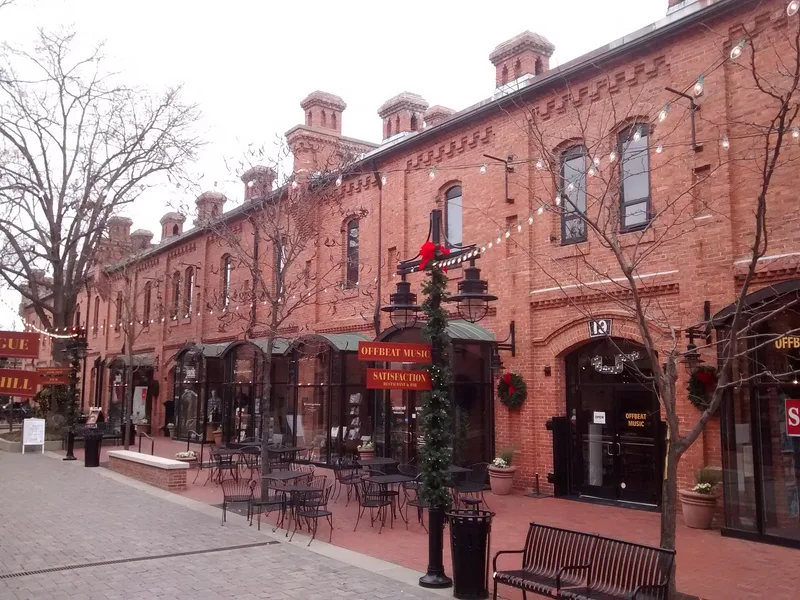
Watts and Yuille Warehouses are a pair of identical two-story brick buildings erected in 1904 in Durham by the American Tobacco Company to age tobacco. Each is seven bays wide and twenty bays long, divided by thick firewalls into four units, with pilasters, stringcourses, corbelled cornices, stepped parapets and 72 decorative chimneys. The style recalls medieval architecture and has been called Romanesque or Norman Revival. Heavy timber framing and brick walls provided slow-burning, fire-resistant storage for hogsheads of tobacco. The buildings are tied to James B. Duke's consolidation of the cigarette industry into the American Tobacco Company, and to businessmen George W. Watts and Thomas B. Yuille. After sitting idle, they were sold in 1980 and converted into a shopping and office complex called Brightleaf Square. The renovation kept structural changes minimal, exposed the original columns and beams, and added a redesigned courtyard between the two buildings.
Significance in brief: The warehouses are argued to be outstanding examples of turn-of-the-century industrial architecture, combining heavy-timber "slow burn" construction with an elaborate medieval-inspired brick decorative scheme. They are also symbols of the American Tobacco Company trust and its link to James B. Duke, George W. Watts and Thomas B. Yuille, who shaped Durham's growth and the nation's tobacco industry.
Machine-generated summary. This summary was generated by a language model from the official nomination document and has not been reviewed line by line by an editor. It may contain errors. Check the source document before relying on any detail. Source: nomination document (PDF) · National Archives catalog entry. NRHP reference 84002259, listed April 5, 1984. Summary generated October 2026 (model claude-sonnet-5-5, prompt v1.0-2026-10-29, confidence high).
Key facts
| Official database NPS National Register database, ref. 84002259 , checked | |
|---|---|
| Address | 905 W. Main St., Durham |
| County | Durham County |
| Listed | April 5, 1984 |
| Reference number | 84002259 |
| Resource type | Building |
| Areas of significance | Industry, Architecture |
| Level of significance | National, State, Local |
| National Historic Landmark | No |
| Acreage | 2.4 |
| Official document, machine-extracted Nomination form (National Archives) , checked | |
| Period of significance | 1900- |
| Architect / builder | W. J. Hicks, Albert F. Hunt initial plan and refinements; Samuel Linton Leary (?) - design of brickwork |
| Architectural style | Romanesque Revival or Norman Revival |
| Criteria |
|
| Status (as stated in the nomination) | Sold in 1980 after standing idle for a few years and renovated as Brightleaf Square, a complex of shops and offices; described as occupied, in excellent condition and altered. |
| Official dataset NPS cultural-resource GIS (NRHP locations) | |
| Coordinates | 36.00044, -78.91010 |
What listing means for this property
National Register listing is honorary: it recognises significance and does not restrict what a private owner may do without federal money or permits. It unlocks the 20% federal rehabilitation tax credit for income-producing buildings, state credits in many states, and Section 106 review when federal agencies are involved. See what listing means in practice.
General information, not legal or tax advice. Rules change; confirm with your State Historic Preservation Office or a qualified adviser.
Questions about Watts and Yuille Warehouses
When was Watts and Yuille Warehouses added to the National Register of Historic Places?
Watts and Yuille Warehouses was listed on April 5, 1984. Its National Register reference number is 84002259.
Is Watts and Yuille Warehouses a National Historic Landmark?
No. The National Park Service database (snapshot of May 2026) lists Watts and Yuille Warehouses on the National Register but does not record it as a National Historic Landmark.
Where is Watts and Yuille Warehouses?
905 W. Main St., Durham, Durham County, North Carolina; coordinates 36.00044, -78.91010.
Why is Watts and Yuille Warehouses historically significant?
According to a machine-generated summary of its nomination form: The warehouses are argued to be outstanding examples of turn-of-the-century industrial architecture, combining heavy-timber "slow burn" construction with an elaborate medieval-inspired brick decorative scheme. They are also symbols of the American Tobacco Company trust and its link to James B. Duke, George W. Watts and Thomas B. Yuille, who shaped Durham's growth and the nation's tobacco industry. Check the nomination document before relying on any detail.
Who designed or built Watts and Yuille Warehouses?
The nomination form names W. J. Hicks, Albert F. Hunt initial plan and refinements; Samuel Linton Leary (?) - design of brickwork as architect or builder (extracted by machine from the nomination; check the source document).
Where can I read the original nomination for Watts and Yuille Warehouses?
The nomination form is a public record held by the National Archives: nomination document (PDF).
Sources and further reading
- National Park Service, National Register of Historic Places database (snapshot May 2026), reference 84002259.
- Nomination form (PDF, National Archives) — catalog entry
- Wikipedia article (used for cross-checking only; text not reproduced here)
- Wikidata Q18739502
- This listing as JSON
Last updated November 2026. Found an error? See the editorial policy for how to report it.