Bassett House

Why it's listed
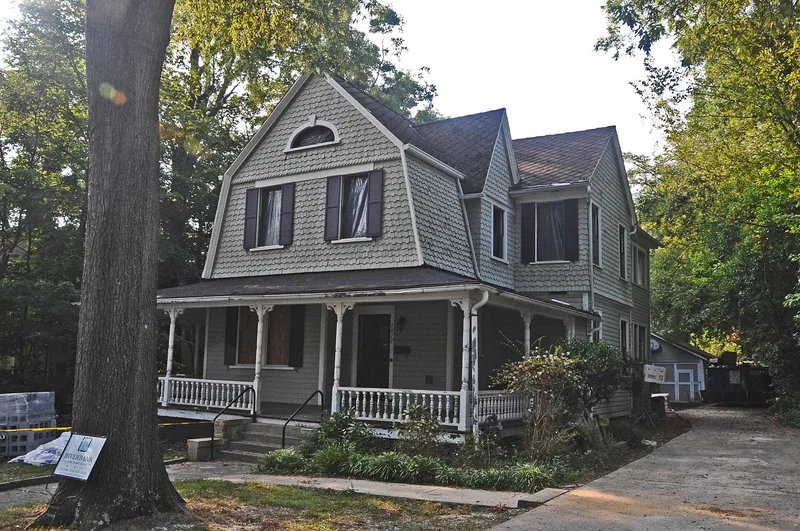
Built in 1891 by T. S. Christian, this two-and-one-half-story cottage at 1017 West Trinity Avenue in Durham was one of the Faculty Row houses serving Trinity College. It has a gambrel roof with projecting cross gables, German siding below and overlapping square shingles above, and a U-shaped hip-roofed porch with turned spindles and brackets. A sunburst fanlight with a keystone adds a classical touch to the asymmetrical Victorian design. The house was moved from the area of today's Duke East Campus to Trinity Avenue in about 1918. Its first occupant was historian John Spencer Bassett, whose 1903 magazine article on race relations set off a storm of criticism from the state's Democratic press. The college trustees voted 18 to 7 to support him, issuing a statement that became a classic document of academic freedom. Later faculty families, including the Webbs, lived in the house, and it was in excellent condition when nominated.
Significance in brief: The house was the original home of Professor John Spencer Bassett and later housed several generations of Trinity College faculty, making it a typical Faculty Avenue dwelling. Bassett's 1903 article and the controversy that followed became a landmark case for academic freedom in the United States. The house also has distinctive architectural features, including a gambrel roof and a U-shaped wrap-around porch.
Machine-generated summary. This summary was generated by a language model from the official nomination document and has not been reviewed line by line by an editor. It may contain errors. Check the source document before relying on any detail. Source: nomination document (PDF) · National Archives catalog entry. NRHP reference 79003330, listed November 29, 1979. Summary generated October 2026 (model claude-sonnet-5-5, prompt v1.0-2026-10-29, confidence medium).
Key facts
| Address | 1017 W. Trinity Ave., Durham |
|---|---|
| County | Durham County |
| Listed | November 29, 1979 |
| Reference number | 79003330 |
| Resource type | Building |
| Period of significance | 1800-1899 |
| Architect / builder | T. S. Christian, Builder |
| Architectural style | Victorian |
| Areas of significance | Education, Architecture |
| Level of significance | Local |
| Status (as stated in the nomination) | Listed in excellent condition and occupied; it has a rear two-story addition, and the form records it as moved c. 1918. |
| Acreage | 0.9 |
| Coordinates | 36.00567, -78.91019 (NPS GIS) |
What listing means for this property
National Register listing is honorary for a privately owned home: it does not by itself restrict what an owner may do with their own money, and it does not require public access. Restrictions come from local landmark or historic-district ordinances, which are separate (how they differ).
Owner-occupied houses are not eligible for the 20% federal rehabilitation tax credit, which applies to income-producing buildings, but many states offer credits for homeowners. Listing also opens the door to preservation easements and to buying a plaque. Start with what listing means for homeowners, renovating a listed house and selling one.
General information, not legal or tax advice. Rules change; confirm with your State Historic Preservation Office or a qualified adviser.
Sources and further reading
- National Park Service, National Register of Historic Places database (snapshot May 2026), reference 79003330.
- Nomination form (PDF, National Archives) — catalog entry
- Wikipedia article (used for cross-checking only; text not reproduced here)
- Wikidata Q4868115
- This listing as JSON
Last updated October 2026. Found an error? See the editorial policy for how to report it.