Greeley House

Why it's listed
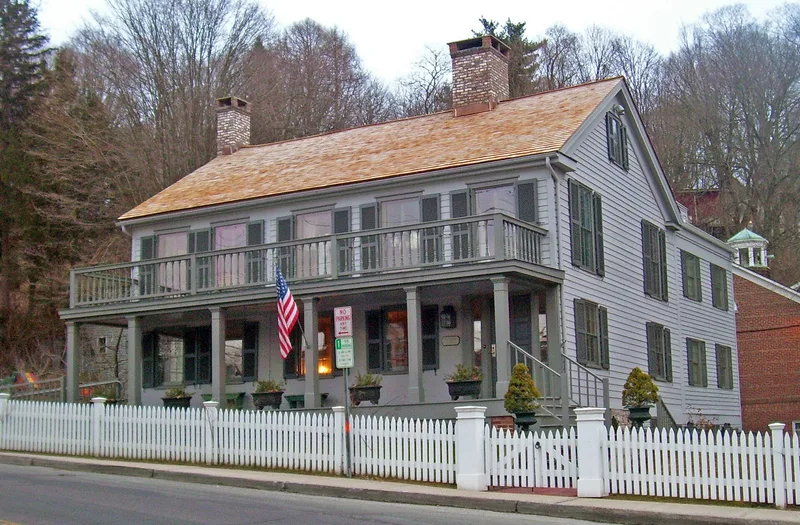
Greeley House is a modest farmhouse at 100 King Street in Chappaqua, built around 1820 as part of the old Haviland farm. It began as a rectangular building with a center chimney, a corner sidelighted entrance and low ceilings. About the middle of the century it was lengthened at the north end, given a second chimney, and fitted with a full-width piazza, French windows, carved door frames and early Victorian wooden mantels. Horace Greeley bought it in 1864, and his family lived here until 1872, after his wife Mary pressed for a move from their isolated first Chappaqua home. By 1940 the house was so run down that demolition threatened, but two local citizens bought and restored it. Both of the other Greeley family homes in Chappaqua burned, in 1875 and 1890, so this is the only one left. It is valued as a surviving part of the Greeley heritage, and it now operates as a shop.
Significance in brief: The house was the Greeley family home from 1864 to 1872, when Horace Greeley, the newspaper editor and anti-slavery crusader, lived here. It is the only one of the three original Greeley family homes in Chappaqua still standing, since the other two burned. It was restored in 1940 after falling into disrepair and looks much as it did in Greeley's day.
Machine-generated summary. This summary was generated by a language model from the official nomination document and has not been reviewed line by line by an editor. It may contain errors. Check the source document before relying on any detail. Source: nomination document (PDF) · National Archives catalog entry. NRHP reference 79003212, listed April 19, 1979. Summary generated October 2026 (model claude-sonnet-5-5, prompt v1.0-2026-10-29, confidence medium).
Key facts
| Address | 100 King St., Chappaqua |
|---|---|
| County | Westchester County |
| Listed | April 19, 1979 |
| Reference number | 79003212 |
| Resource type | Building |
| Areas of significance | Politics/Government |
| Level of significance | National |
| Status (as stated in the nomination) | In good condition; restored in 1940 and now used as a gift shop, with some interior changes made for commercial use. |
| Acreage | 0.3 |
| Coordinates | 41.15907, -73.77148 (NPS GIS) |
What listing means for this property
National Register listing is honorary for a privately owned home: it does not by itself restrict what an owner may do with their own money, and it does not require public access. Restrictions come from local landmark or historic-district ordinances, which are separate (how they differ).
Owner-occupied houses are not eligible for the 20% federal rehabilitation tax credit, which applies to income-producing buildings, but many states offer credits for homeowners. Listing also opens the door to preservation easements and to buying a plaque. Start with what listing means for homeowners, renovating a listed house and selling one.
General information, not legal or tax advice. Rules change; confirm with your State Historic Preservation Office or a qualified adviser.
Sources and further reading
- National Park Service, National Register of Historic Places database (snapshot May 2026), reference 79003212.
- Nomination form (PDF, National Archives) — catalog entry
- Wikipedia article (used for cross-checking only; text not reproduced here)
- Wikidata Q5602135
- This listing as JSON
Last updated October 2026. Found an error? See the editorial policy for how to report it.