Cooperstown Historic District

Why it's listed
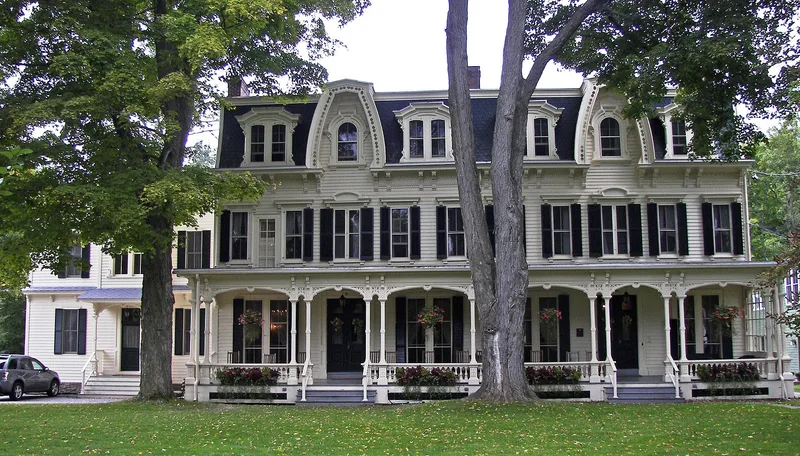
Cooperstown Historic District takes in about three-quarters of the village of Cooperstown, the Otsego County seat, where Lake Otsego meets the Susquehanna River. It includes roughly 566 structures: 38 built between 1786 and 1825, 111 from 1825 to 1860, 228 from 1860 to 1900, 114 from 1900 to 1930 and 74 since 1930. The oldest houses cluster in the northeast corner, on a street grid based on William Cooper's 1786 survey. Main Street holds a commercial district with a full range of 19th-century styles and some of the village's finest buildings. Nearby are the county government buildings, including the County Court House, and institutions such as the National Baseball Hall of Fame, a hospital, a library and the New York State Historical Association. Residential areas fall into three groups: Greek Revival houses from 1825 to 1850, Italianate houses from 1860 to 1895, and early twentieth century houses. Together they show how the village developed from its founding.
Significance in brief: The surviving text only partly covers the significance statement, which is not included in the excerpt. The description shows a district that takes in virtually all of the area settled before 1900 and preserves the street grid from William Cooper's 1786 survey. It holds a full range of 19th-century architectural styles and several nationally important museums.
Machine-generated summary. This summary was generated by a language model from the official nomination document and has not been reviewed line by line by an editor. It may contain errors. Check the source document before relying on any detail. Source: nomination document (PDF) · National Archives catalog entry. NRHP reference 80002742, listed November 18, 1980. Summary generated October 2026 (model claude-sonnet-5-5, prompt v1.0-2026-10-29, confidence medium).
Key facts
| Address | NY 28, NY 80 and Main St., Cooperstown |
|---|---|
| County | Otsego County |
| Listed | November 18, 1980 |
| Reference number | 80002742 |
| Resource type | District |
| Architectural style | Greek Revival, Italianate, Queen Anne, Federal, Colonial Revival and other 19th- and early 20th-century styles |
| Areas of significance | Industry, Commerce, Military, Agriculture, Transportation, Literature, Exploration/Settlement, Law, Politics/Government, Architecture |
| Level of significance | State |
| Status (as stated in the nomination) | Condition is marked excellent and good, with some alteration. The district is occupied and has modern intrusions, including automobile-related ones on Chestnut Street. |
| Acreage | 410 |
| Within district | Glimmerglass Historic District |
| Coordinates | 42.70589, -74.92473 (NPS GIS) |
What listing means for this property
This is a historic district. Buildings within its boundary are either contributing (they add to the district's significance) or non-contributing. Owners of contributing income-producing buildings can claim the 20% federal rehabilitation tax credit; homeowners should look at state credits. National Register districts impose no design review by themselves; a local historic district ordinance, if one exists, does (the difference explained).
General information, not legal or tax advice. Rules change; confirm with your State Historic Preservation Office or a qualified adviser.
Sources and further reading
- National Park Service, National Register of Historic Places database (snapshot May 2026), reference 80002742.
- Nomination form (PDF, National Archives) — catalog entry
- Wikipedia article (used for cross-checking only; text not reproduced here)
- Wikidata Q5167957
- This listing as JSON
Last updated October 2026. Found an error? See the editorial policy for how to report it.