Orange Mill Historic District
Also known as: Orange Powder Mill; Algonquin Powder Mill Park

Why it's listed
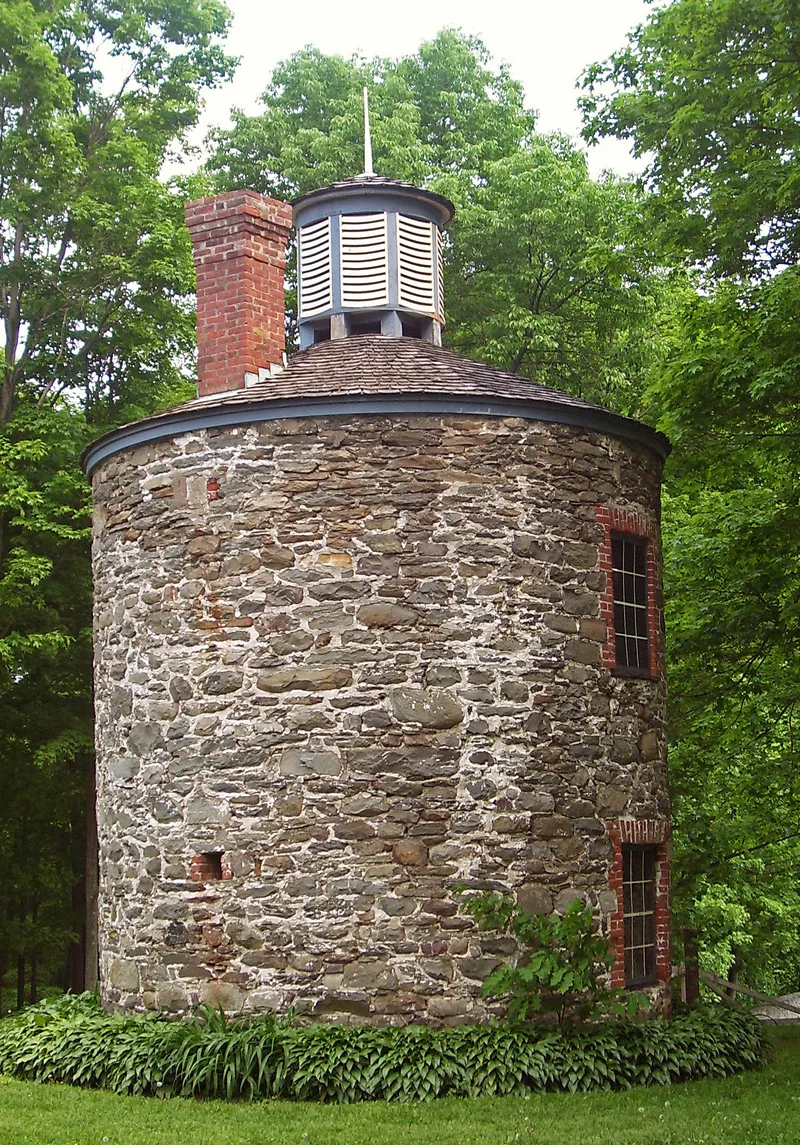
Powder Mill Road in Newburgh, New York, leads to the remains of a black powder works that operated from 1815 into the early twentieth century. Much of the site now lies within Algonquin Park. Stone ruins of wheel mills, a charge house, a saltpeter building and a cylindrical wash and change house sit among three mill ponds fed by Quassiac Creek, linked by sluiceways that once drove turbines. The buildings were spaced apart to limit damage from explosions. Daniel Rogers acquired the mill in 1818 after earlier explosions, and Smith and Rand later expanded it to 190 acres. Its Orange brand sporting powders gained a strong reputation, and production peaked in the 1890s. The district was listed because few powder mills of this scale survive, and the ruins and water system show how the technology worked. In the 1930s the site became a park, and fireplaces and a shelter house were added. Some ruins stand three walls high.
Significance in brief: The nomination argues the site is one of very few surviving powder mills of this size and reputation, and that its ruins show early black powder technology and water-power engineering. Orange powder was widely endorsed in the sporting world, and the layout of ponds, sluiceways and widely spaced buildings illustrates the manufacturing process and its safety design.
Machine-generated summary. This summary was generated by a language model from the official nomination document and has not been reviewed line by line by an editor. It may contain errors. Check the source document before relying on any detail. Source: nomination document (PDF) · National Archives catalog entry. NRHP reference 97000357, listed May 1, 1997. Summary generated October 2026 (model claude-sonnet-5-5, prompt v1.0-2026-10-29, confidence medium).
Key facts
| Address | Powder Mill Rd., near jct. with NY 52, Newburgh |
|---|---|
| County | Orange County |
| Listed | May 1, 1997 |
| Reference number | 97000357 |
| Resource type | District |
| Period of significance | 1815-1908 |
| Architect / builder | Rogers and Company (built the first wheel mills, 1818) |
| Architectural style | Early Republic/Federal; Mid-19th Century/Greek Revival |
| Areas of significance | Architecture, Engineering, Industry |
| Level of significance | National |
| Status (as stated in the nomination) | Mostly ruins and archaeological remains, used as a public park; some sluiceways, ponds and buildings are deteriorated and need masonry repairs. |
| Acreage | 20 |
| Coordinates | 41.52335, -74.05952 (NPS GIS) |
What listing means for this property
This is a historic district. Buildings within its boundary are either contributing (they add to the district's significance) or non-contributing. Owners of contributing income-producing buildings can claim the 20% federal rehabilitation tax credit; homeowners should look at state credits. National Register districts impose no design review by themselves; a local historic district ordinance, if one exists, does (the difference explained).
General information, not legal or tax advice. Rules change; confirm with your State Historic Preservation Office or a qualified adviser.
Sources and further reading
- National Park Service, National Register of Historic Places database (snapshot May 2026), reference 97000357.
- Nomination form (PDF, National Archives) — catalog entry
- Wikipedia article (used for cross-checking only; text not reproduced here)
- Wikidata Q7099672
- This listing as JSON
Last updated October 2026. Found an error? See the editorial policy for how to report it.