Bridge Street Historic District

Why it's listed
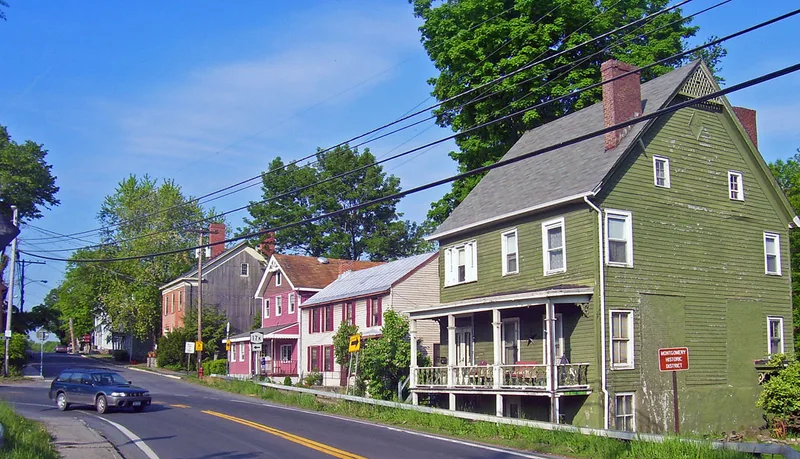
Bridge Street Historic District is a compact residential area of about 13 acres beside the Wallkill River in the Village of Montgomery, New York. It is the older and smaller of two districts nominated in the village, and it lies close to where the community first developed. Its 28 buildings include small Federal-period houses, most of them simple vernacular structures, along with a few Greek Revival homes and Victorian-era houses. Only two buildings were built for commerce, and the district also has one barn, a small hotel and two row houses. Notable buildings include the 1780 Isaac Jennings House, the 1792 Lindsay-Morrison House, home of the first mayor, and the Minnehaha Hotel of 1790. Many buildings have been altered with modern siding or windows, yet the streetscapes remain consistent in scale and character. The district was listed because it preserves the modest look of an early rural crossroads village, with its architecture reflecting several periods of the 19th century.
Significance in brief: The form describes it as the smaller and older of the village's two historic districts, set where the first development occurred near the river. Its significance rests on homogeneous streetscapes of small, mostly vernacular Federal-period homes. A staff review note calls it a residential grouping of small-scale vernacular 19th-century dwellings that retains integrity as a district.
Machine-generated summary. This summary was generated by a language model from the official nomination document and has not been reviewed line by line by an editor. It may contain errors. Check the source document before relying on any detail. Source: nomination document (PDF) · National Archives catalog entry. NRHP reference 80002736, listed November 21, 1980. Summary generated October 2026 (model claude-sonnet-5-5, prompt v1.0-2026-10-29, confidence medium).
Key facts
| Address | Bridge St., Montgomery |
|---|---|
| County | Orange County |
| Listed | November 21, 1980 |
| Reference number | 80002736 |
| Resource type | District |
| Architect / builder | Abner Bookstaver is named as builder of Wade the Tinsmith's House (77 Ward Street); no architect is named for the district. |
| Architectural style | Federal, Greek Revival and vernacular |
| Areas of significance | Architecture |
| Level of significance | Local |
| Status (as stated in the nomination) | Condition is marked good and altered; many buildings have modern siding, windows or additions. |
| Acreage | 13 |
| Coordinates | 41.52882, -74.23940 (NPS GIS) |
What listing means for this property
This is a historic district. Buildings within its boundary are either contributing (they add to the district's significance) or non-contributing. Owners of contributing income-producing buildings can claim the 20% federal rehabilitation tax credit; homeowners should look at state credits. National Register districts impose no design review by themselves; a local historic district ordinance, if one exists, does (the difference explained).
General information, not legal or tax advice. Rules change; confirm with your State Historic Preservation Office or a qualified adviser.
Sources and further reading
- National Park Service, National Register of Historic Places database (snapshot May 2026), reference 80002736.
- Nomination form (PDF, National Archives) — catalog entry
- Wikipedia article (used for cross-checking only; text not reproduced here)
- Wikidata Q4966306
- This listing as JSON
Last updated October 2026. Found an error? See the editorial policy for how to report it.