Mackay Estate Gate Lodge

Why it's listed
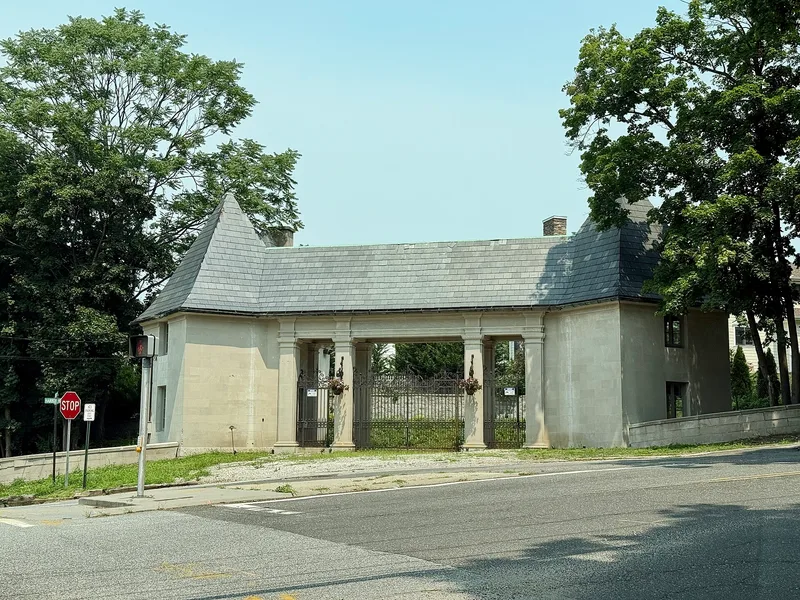
Guarding the northeast corner of Harbor Hill Road and Roslyn Road in East Hills, this small limestone gate lodge once marked the entrance to Clarence Mackay's Harbor Hill estate. Stanford White of McKim, Mead & White designed it in 1899, and it was built in 1900-02 with the same stone and slate roofing as the main house. From the road it appears symmetrical, with a central carriage entrance, Doric piers, ornate wrought-iron gates and two lodges under steep mansard and pyramidal slate roofs. The north wing housed the gatekeeper. The lodge was conceived as a miniature of the French Baroque mansion behind it, announcing the estate's grandeur from the public road. The mansion was demolished in 1947, and the land became the East Hills subdivision after 1954. The lodge survives as a rare example of a once common Long Island estate building and is now used by a swim club.
Significance in brief: The nomination argues it is architecturally significant as a fine example of Stanford White's country estate work and as a rare survivor of a once common estate building type. It was designed as a miniature version of the demolished Harbor Hill mansion, in French Baroque style. It is one of three surviving outbuildings from one of Long Island's largest estates.
Machine-generated summary. This summary was generated by a language model from the official nomination document and has not been reviewed line by line by an editor. It may contain errors. Check the source document before relying on any detail. Source: nomination document (PDF) · National Archives catalog entry. NRHP reference 91000240, listed March 14, 1991. Summary generated October 2026 (model claude-sonnet-5-5, prompt v1.0-2026-10-29, confidence high).
Key facts
| Address | Jct. of Harbor Hill and Roslyn Rds., East Hills |
|---|---|
| County | Nassau County |
| Listed | March 14, 1991 |
| Reference number | 91000240 |
| Resource type | Building |
| Period of significance | 1899-1902 |
| Architect / builder | Stanford White (McKim, Mead & White) |
| Architectural style | Late 19th and 20th century revivals (French Baroque) |
| Criteria |
|
| Areas of significance | Architecture |
| Level of significance | Local |
| Status (as stated in the nomination) | Now part of a private swimming club; a non-contributing swimming pool stands behind it. The building retains its integrity to a high degree. |
| Acreage | 0.9 |
| Coordinates | 40.79306, -73.64123 (NPS GIS) |
What listing means for this property
National Register listing is honorary for a privately owned home: it does not by itself restrict what an owner may do with their own money, and it does not require public access. Restrictions come from local landmark or historic-district ordinances, which are separate (how they differ).
Owner-occupied houses are not eligible for the 20% federal rehabilitation tax credit, which applies to income-producing buildings, but many states offer credits for homeowners. Listing also opens the door to preservation easements and to buying a plaque. Start with what listing means for homeowners, renovating a listed house and selling one.
General information, not legal or tax advice. Rules change; confirm with your State Historic Preservation Office or a qualified adviser.
Sources and further reading
- National Park Service, National Register of Historic Places database (snapshot May 2026), reference 91000240.
- Nomination form (PDF, National Archives) — catalog entry
- Wikipedia article (used for cross-checking only; text not reproduced here)
- Wikidata Q14706859
- This listing as JSON
Last updated October 2026. Found an error? See the editorial policy for how to report it.