Gates-Livermore Cobblestone

Why it's listed
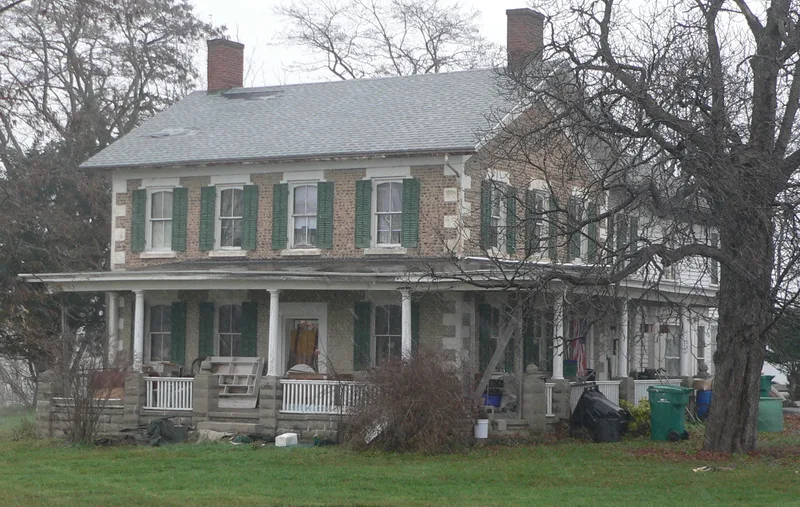
Built around 1833, this cobblestone farmhouse sits on a 95-acre farmstead at the corner of Clover Street and Rush-Mendon Road in Mendon. The two-story house is made of variously colored field cobbles, with limestone quoins and stone trim around its openings. Its original east front has a side-hall plan and an Adamesque doorway. In the 1870s John Cornell, a prominent Quaker, added a large Italianate frame wing where he hosted visiting Quakers and Quarterly Meetings, and a verandah was later added. The house is credited to Luther Gates. Fred Lord, a progressive farmer, ran the Elm Grove Dairy here from 1896. Kenneth C. Livermore, a Cornell University agricultural graduate, bought the farm in 1920 and built a regionally known seed business. Two late nineteenth-century barns and a Greek Revival tenant house survive. The house is one of only ten surviving cobblestone buildings in Mendon, and the farm continues to be cultivated.
Significance in brief: The house is argued to be a fine, highly intact example of early-period cobblestone construction in western New York and a representative Federal style home in Mendon. The surrounding farm, with its barns and cultivated land, is also significant for its association with local farming history, including the progressive dairy and seed businesses of later owners.
Machine-generated summary. This summary was generated by a language model from the official nomination document and has not been reviewed line by line by an editor. It may contain errors. Check the source document before relying on any detail. Source: nomination document (PDF) · National Archives catalog entry. NRHP reference 96001390, listed November 29, 1996. Summary generated October 2026 (model claude-sonnet-5-5, prompt v1.0-2026-10-29, confidence high).
Key facts
| Address | 4389 Clover St., Mendon |
|---|---|
| County | Monroe County |
| Listed | November 29, 1996 |
| Reference number | 96001390 |
| Resource type | Building |
| Period of significance | ca. 1833 - ca. 1920s |
| Architect / builder | Luther Gates (believed builder, ca. 1833) |
| Architectural style | Early Republic; Federal |
| Criteria |
|
| Areas of significance | Architecture, Agriculture |
| Level of significance | Local |
| Status (as stated in the nomination) | The farmhouse remains a single dwelling and the land is still actively cultivated with corn and wheat; the tenant house is described as vacant and partially deteriorated. |
| Acreage | 95.4 |
| Coordinates | 42.99214, -77.58123 (NPS GIS) |
What listing means for this property
National Register listing is honorary: it recognises significance and does not restrict what a private owner may do without federal money or permits. It unlocks the 20% federal rehabilitation tax credit for income-producing buildings, state credits in many states, and Section 106 review when federal agencies are involved. See what listing means in practice.
General information, not legal or tax advice. Rules change; confirm with your State Historic Preservation Office or a qualified adviser.
Sources and further reading
- National Park Service, National Register of Historic Places database (snapshot May 2026), reference 96001390.
- Nomination form (PDF, National Archives) — catalog entry
- Wikipedia article (used for cross-checking only; text not reproduced here)
- Wikidata Q5527088
- This listing as JSON
Last updated October 2026. Found an error? See the editorial policy for how to report it.