Ely, Hervey, House
Also known as: Daughters of the American Revolution Chapter House

Why it's listed
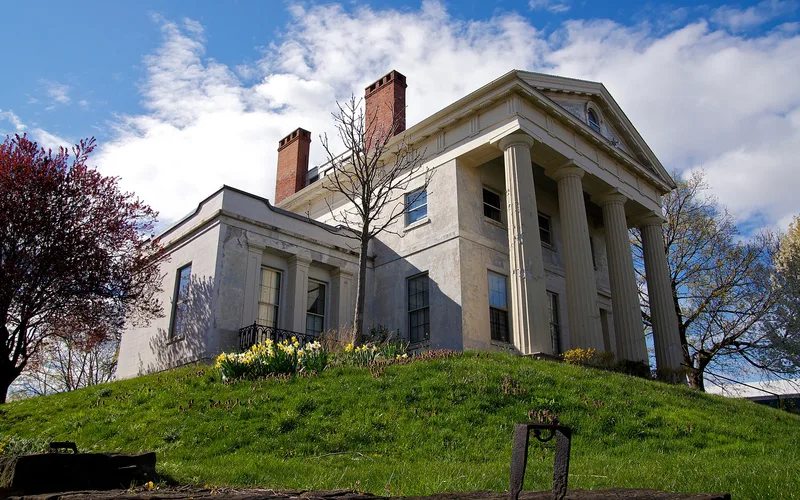
Perched on a hill in Rochester's affluent Third Ward, this two-and-a-half-story house of stuccoed brick was built in 1837 for Hervey Ely, owner of the Red Mill grist mill. Hugh Hastings built it in the Greek Revival manner, with a front portico of free-standing Doric columns, a full Doric entablature with metopes and triglyphs, and flanking one-story wings with recessed windows and cast-iron balconies. Inside, much of the original interior survives, including pilasters around doors and windows, deeply recessed ceilings, elaborate plaster decoration and marble fireplaces. Ely lost his wealth and had to sell the house, and later owners included Bishop Whitehouse, William Kidd, Azariah Boody and other prominent Rochester citizens. Since 1920 it has belonged to the Irondequoit Chapter of the Daughters of the American Revolution, which uses it for meetings and rents it to other groups. It is regarded as one of western New York's finest Greek Revival buildings.
Significance in brief: The nomination calls it one of the finest examples of Greek Revival architecture in western New York State. It has free-standing Doric columns, entablature, pilasters and antae derived from classical Greek architecture, and elaborate plaster interiors with marble fireplaces. It also reflects the history of the wealthy Third Ward and its prominent Rochester owners.
Machine-generated summary. This summary was generated by a language model from the official nomination document and has not been reviewed line by line by an editor. It may contain errors. Check the source document before relying on any detail. Source: nomination document (PDF) · National Archives catalog entry. NRHP reference 71000544, listed August 12, 1971. Summary generated October 2026 (model claude-sonnet-5-5, prompt v1.0-2026-10-29, confidence high).
Key facts
| Address | 138 Troup St., Rochester |
|---|---|
| County | Monroe County |
| Listed | August 12, 1971 |
| Reference number | 71000544 |
| Resource type | Building |
| Period of significance | 19th Century (specific date 1837) |
| Architect / builder | Hugh Hastings (builder) |
| Architectural style | Greek Revival |
| Areas of significance | Architecture |
| Level of significance | State |
| Status (as stated in the nomination) | Condition listed as good; occupied and used as a Daughters of the American Revolution chapter house and meeting place, also rented to other groups. |
| Acreage | 0.9 |
| Within district | Third Ward Historic District |
| Coordinates | 43.15155, -77.61803 (NPS GIS) |
What listing means for this property
National Register listing is honorary for a privately owned home: it does not by itself restrict what an owner may do with their own money, and it does not require public access. Restrictions come from local landmark or historic-district ordinances, which are separate (how they differ).
Owner-occupied houses are not eligible for the 20% federal rehabilitation tax credit, which applies to income-producing buildings, but many states offer credits for homeowners. Listing also opens the door to preservation easements and to buying a plaque. Start with what listing means for homeowners, renovating a listed house and selling one.
General information, not legal or tax advice. Rules change; confirm with your State Historic Preservation Office or a qualified adviser.
Sources and further reading
- National Park Service, National Register of Historic Places database (snapshot May 2026), reference 71000544.
- Nomination form (PDF, National Archives) — catalog entry
- Wikipedia article (used for cross-checking only; text not reproduced here)
- Wikidata Q5744979
- This listing as JSON
Last updated October 2026. Found an error? See the editorial policy for how to report it.