Westchester House
Also known as: Pioneer Hotel

Why it's listed
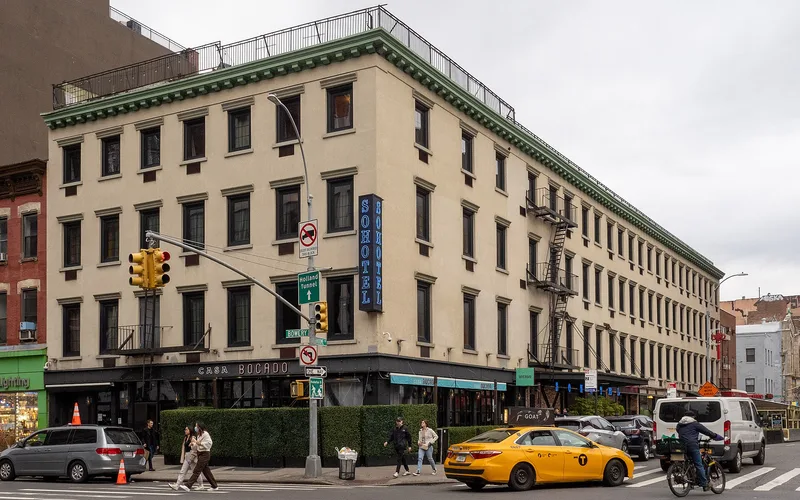
Standing on the southwest corner of the Bowery and Broome Street, this four-story brick building began as a hotel in the 1830s and still operates as one. The first three floors date from about 1835-40, and a fourth floor matching the original brickwork and windows was added around 1867. Inside, the upper floors keep their original corridor layout, wooden door frames, paneled doors, plaster moldings, and Greek Revival mantels, which the nomination describes as the only surviving Greek Revival hotel rooms in New York. Later additions include an Italianate cornice, Eastlake overmantels, a turn-of-the-century lobby desk and a large hall mirror. Renamed the Occidental Hotel after the Civil War, it became the headquarters of Tammany Hall leader Timothy "Big Tim" Sullivan, who lived there from 1905 until 1911. Its dining room drew leading city and state politicians. It is listed for both its architectural survival and its political history.
Significance in brief: The nomination argues it is a rare surviving Greek Revival hotel in Manhattan, believed to be the only one that keeps its original exterior and interior features, and the oldest hotel in continuous operation in New York City. It is also significant for politics and government, as the headquarters of Tammany Hall boss "Big Tim" Sullivan around the turn of the twentieth century, when it was a gathering place for prominent politicians.
Machine-generated summary. This summary was generated by a language model from the official nomination document and has not been reviewed line by line by an editor. It may contain errors. Check the source document before relying on any detail. Source: nomination document (PDF) · National Archives catalog entry. NRHP reference 86000450, listed March 20, 1986. Summary generated October 2026 (model claude-sonnet-5-5, prompt v1.0-2026-10-29, confidence high).
Key facts
| Address | 541--551 Broome St., New York |
|---|---|
| County | Manhattan |
| Listed | March 20, 1986 |
| Reference number | 86000450 |
| Resource type | Building |
| Period of significance | c. 1835-1911 |
| Architect / builder | Builder/architect listed as unknown; the text says it was probably built by Joseph C. Yates, a former governor of New York |
| Architectural style | Greek Revival |
| Areas of significance | Politics/Government, Architecture |
| Level of significance | Local |
| Status (as stated in the nomination) | Occupied and still operating as a hotel; part of the Broome Street facade collapsed in 1984-85 during ground-floor construction work and the walls have been shored up. |
| Acreage | 0.9 |
| Coordinates | 40.71961, -73.99994 (NPS GIS) |
What listing means for this property
National Register listing is honorary for a privately owned home: it does not by itself restrict what an owner may do with their own money, and it does not require public access. Restrictions come from local landmark or historic-district ordinances, which are separate (how they differ).
Owner-occupied houses are not eligible for the 20% federal rehabilitation tax credit, which applies to income-producing buildings, but many states offer credits for homeowners. Listing also opens the door to preservation easements and to buying a plaque. Start with what listing means for homeowners, renovating a listed house and selling one.
General information, not legal or tax advice. Rules change; confirm with your State Historic Preservation Office or a qualified adviser.
Sources and further reading
- National Park Service, National Register of Historic Places database (snapshot May 2026), reference 86000450.
- Nomination form (PDF, National Archives) — catalog entry
- Wikipedia article (used for cross-checking only; text not reproduced here)
- Wikidata Q7987251
- This listing as JSON
Last updated October 2026. Found an error? See the editorial policy for how to report it.