Town Hall

Why it's listed
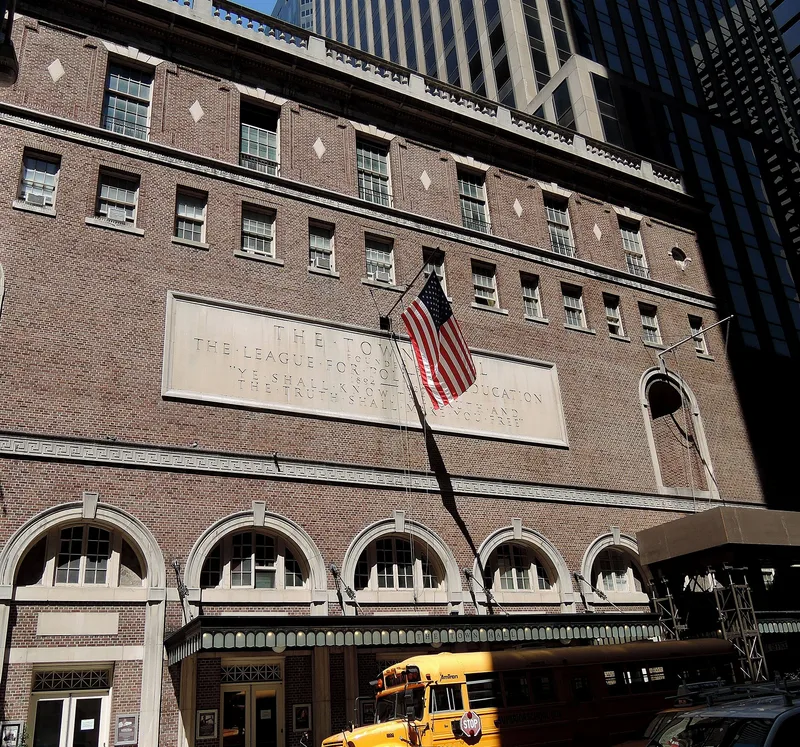
Town Hall is a four-story auditorium building on West 43rd Street in Manhattan, built in 1919-21 for the League for Political Education. McKim, Mead & White designed it in a neo-Federal manner, with Flemish bond brick, limestone trim, a seven-bay blind arcade and an Adamesque frieze. Inside, a columnar screen separates the lobby from a semicircular auditorium with a cantilevered balcony, gilded pilasters and carved organ grilles. The League grew from the defeat of the 1894 women's suffrage amendment in New York, and it wanted a permanent home for lectures and public debate. The hall hosted speakers of international fame and, from 1935, broadcast "America's Town Meeting of the Air" for 21 years. Its acoustics and intimate scale also made it a preferred stage for soloists, jazz musicians and chamber groups, and a "Town Hall debut" became a familiar phrase in American musical life.
Significance in brief: The building was erected for the League for Political Education as a forum for educating the public on political issues, an outgrowth of early 20th-century efforts to win women's suffrage. It gained national importance through the radio program "America's Town Meeting of the Air" and became a favored New York concert hall and debut venue because of its acoustics and intimacy.
Machine-generated summary. This summary was generated by a language model from the official nomination document and has not been reviewed line by line by an editor. It may contain errors. Check the source document before relying on any detail. Source: nomination document (PDF) · National Archives catalog entry. NRHP reference 80002724, listed April 23, 1980. Summary generated October 2026 (model claude-sonnet-5-5, prompt v1.0-2026-10-29, confidence high).
Key facts
| Address | 113--123 W. 43rd St., New York |
|---|---|
| County | Manhattan |
| Listed | April 23, 1980 |
| Reference number | 80002724 |
| Resource type | Building |
| Period of significance | 1919-21 |
| Architect / builder | McKim, Mead & White |
| Architectural style | Neo-Federal |
| Areas of significance | Education, Politics/Government, Architecture, Social History, Performing Arts |
| Level of significance | National, Local |
| National Historic Landmark | Yes, designated March 2, 2012 |
| Status (as stated in the nomination) | Listed condition is good; the form marks it as occupied and in educational and entertainment use. |
| Acreage | 0.9 |
| Coordinates | 40.75610, -73.98438 (NPS GIS) |
What listing means for this property
For a publicly owned building or structure, listing mainly matters when federal funds, permits or licences are involved: projects then go through Section 106 review so effects on the property are considered. Listing also strengthens applications for preservation grants and, for leased income-producing uses, can enable the federal rehabilitation tax credit.
General information, not legal or tax advice. Rules change; confirm with your State Historic Preservation Office or a qualified adviser.
Sources and further reading
- National Park Service, National Register of Historic Places database (snapshot May 2026), reference 80002724.
- Nomination form (PDF, National Archives) — catalog entry
- Wikipedia article (used for cross-checking only; text not reproduced here)
- Wikidata Q1634948
- This listing as JSON
Last updated October 2026. Found an error? See the editorial policy for how to report it.