The Players
Also known as: The Players Club

Why it's listed
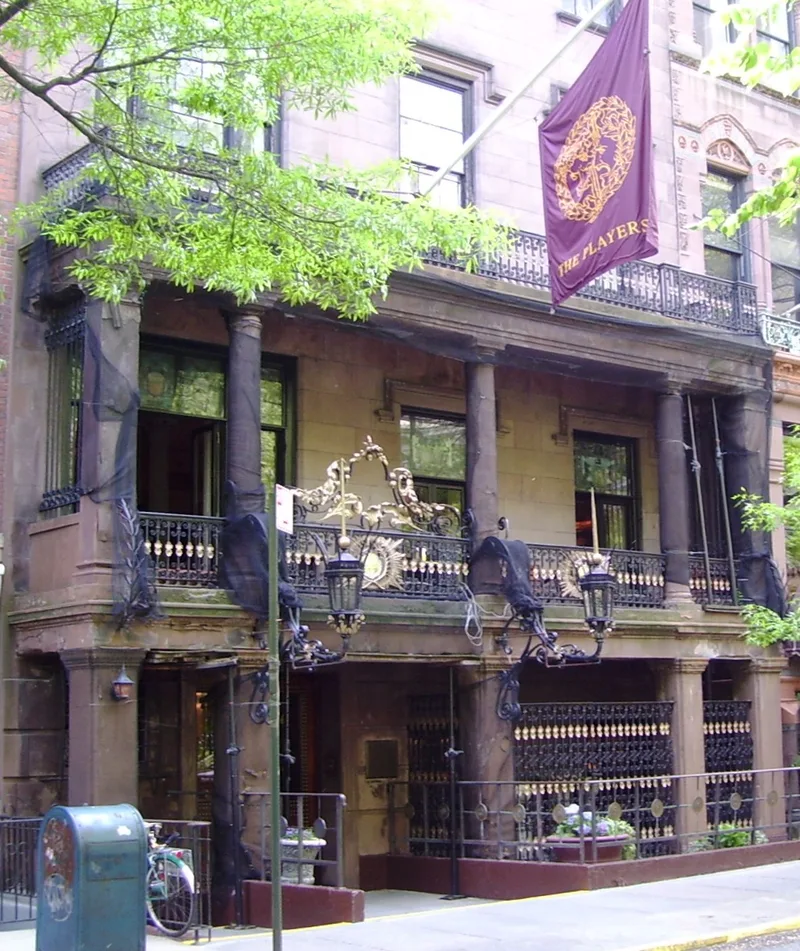
Number 16 Gramercy Park began around 1845 as a private townhouse. In 1888 it became the clubhouse of the Players, a club founded by the actor Edwin Booth so that performers could meet writers, artists and other professionals on equal footing. Booth gave the house to the club and hired Stanford White, of McKim, Mead and White, to remodel it. White recast the Gothic exterior in an Italian Renaissance manner, adding a two-story loggia with wrought iron lamps and balcony grillwork. Inside, the Great Hall, dining room and library hold paintings, costumes, playbills and rare books on the American stage. Booth lived in his third-floor apartment until his death there in 1893, and the rooms remain furnished as he left them. The club's incorporators included Mark Twain, Joseph Jefferson, John Drew and General William Tecumseh Sherman. The property is recognized for its link to Booth and its role as a theatrical institution and archive.
Significance in brief: Edwin Booth, the celebrated tragedian, founded the Players in 1888 and donated his house as its clubhouse, intending to raise the social standing of actors. The building keeps Booth's preserved third-floor apartment and one of the finest collections of theatrical literature and memorabilia. Its character is described as largely unchanged since White's redesign.
Machine-generated summary. This summary was generated by a language model from the official nomination document and has not been reviewed line by line by an editor. It may contain errors. Check the source document before relying on any detail. Source: nomination document (PDF) · National Archives catalog entry. NRHP reference 66000549, listed October 15, 1966. Summary generated October 2026 (model claude-sonnet-5-5, prompt v1.0-2026-10-29, confidence high).
Key facts
| Address | 16 Gramercy Park, New York |
|---|---|
| County | Manhattan |
| Listed | October 15, 1966 |
| Reference number | 66000549 |
| Resource type | Building |
| Period of significance | 1800-1899 |
| Architect / builder | Stanford White |
| Architectural style | Italian Renaissance remodeling of an earlier Gothic exterior |
| Areas of significance | Performing Arts |
| Level of significance | National |
| National Historic Landmark | Yes, designated December 29, 1962 |
| Status (as stated in the nomination) | Occupied, private club in excellent condition with minor alterations; it serves as a meeting place, library, and dining and overnight facility for members. |
| Acreage | 0.9 |
| Coordinates | 40.73758, -73.98668 (NPS GIS) |
What listing means for this property
National Register listing is honorary: it recognises significance and does not restrict what a private owner may do without federal money or permits. It unlocks the 20% federal rehabilitation tax credit for income-producing buildings, state credits in many states, and Section 106 review when federal agencies are involved. See what listing means in practice.
General information, not legal or tax advice. Rules change; confirm with your State Historic Preservation Office or a qualified adviser.
Sources and further reading
- National Park Service, National Register of Historic Places database (snapshot May 2026), reference 66000549.
- Nomination form (PDF, National Archives) — catalog entry
- Wikidata Q96280364
- This listing as JSON
Last updated October 2026. Found an error? See the editorial policy for how to report it.