St. Mark's Historic District
Also known as: See Also:Saint Mark's Historic District (Boundary Increase)

Why it's listed
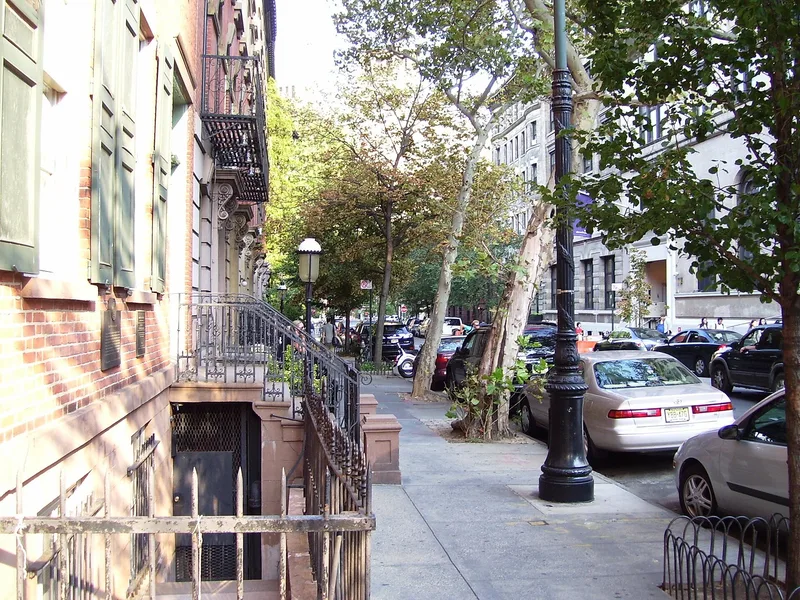
This residential district in Manhattan lies between Second and Third Avenues and East 9th and East 11th Streets, on part of Peter Stuyvesant's old Bouwerie farm. Its street pattern grew from the wills of successive Stuyvesant generations. Three buildings date from the lifetime of Petrus Stuyvesant: St. Mark's-in-the-Bowery (1795-1799), No. 44 Stuyvesant Street (1795) and No. 21 Stuyvesant Street (1803-1804), which was the birthplace of Hamilton Fish. The church combines a late Georgian body, a Greek Revival steeple added in 1828 and an Italianate cast iron porch of 1858. Most of the remaining area was developed after the late 1850s. It includes three matching Italianate houses at 106-110 East 10th Street and the Triangle, a group of brick buildings designed to read as one grand Italianate structure. Later waves of immigrants turned many houses into rooming houses, but the district keeps much of its original character.
Significance in brief: The district is notable for its associations with the Stuyvesant family and for the quality and variety of its architecture. It occupies part of Peter Stuyvesant's Bouwerie farm and keeps its own street pattern shaped by Stuyvesant wills. Its Federal houses, St. Mark's-in-the-Bowery and Italianate rowhouses are among the best of their types in the city.
Machine-generated summary. This summary was generated by a language model from the official nomination document and has not been reviewed line by line by an editor. It may contain errors. Check the source document before relying on any detail. Source: nomination document (PDF) · National Archives catalog entry. NRHP reference 74001276, listed November 13, 1974. Summary generated October 2026 (model claude-sonnet-5-5, prompt v1.0-2026-10-29, confidence medium).
Key facts
| Address | Roughly bounded by 2nd and 3rd Aves. and E. 9th and 11th Sts., New York |
|---|---|
| County | Manhattan |
| Listed | November 13, 1974 |
| Reference number | 74001276 |
| Resource type | District |
| Period of significance | 1795-185- |
| Architect / builder | Martin Thompson (steeple of St. Mark's, 1828); The Triangle often attributed to James Renwick, Jr. |
| Architectural style | Federal, Georgian, Greek Revival and Italianate |
| Areas of significance | Politics/Government, Architecture |
| Level of significance | Local |
| Status (as stated in the nomination) | Condition marked good and altered; the district is occupied, restricted in access, and in private residential use. |
| Acreage | 1.5 |
| Within district | Saint Mark's Historic District (Boundary Increase) |
| Coordinates | 40.73050, -73.98783 (NPS GIS) |
What listing means for this property
This is a historic district. Buildings within its boundary are either contributing (they add to the district's significance) or non-contributing. Owners of contributing income-producing buildings can claim the 20% federal rehabilitation tax credit; homeowners should look at state credits. National Register districts impose no design review by themselves; a local historic district ordinance, if one exists, does (the difference explained).
General information, not legal or tax advice. Rules change; confirm with your State Historic Preservation Office or a qualified adviser.
Sources and further reading
- National Park Service, National Register of Historic Places database (snapshot May 2026), reference 74001276.
- Nomination form (PDF, National Archives) — catalog entry
- Wikipedia article (used for cross-checking only; text not reproduced here)
- Wikidata Q7589961
- This listing as JSON
Last updated October 2026. Found an error? See the editorial policy for how to report it.