Saint Mark's Historic District (Boundary Increase)
Also known as: See Also:St. Mark's Historic District

Why it's listed
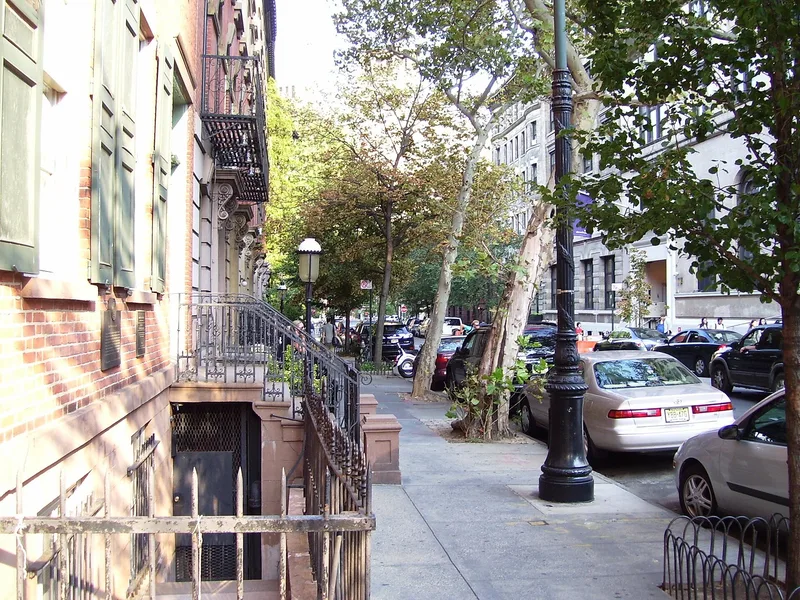
Two brick row houses at 102 and 104 East 10th Street in Manhattan were added to the Saint Mark's Historic District because they had been omitted from the original boundary by professional error. Number 102 dates from about 1839 and was raised to three stories by 1879; number 104 was built in 1879. Both are three-story, three-bay buildings with metal cornices, brownstone lintels and sills, and original brownstone stoops with iron railings. The houses belong to the Stuyvesant family's development of the neighborhood. Thomas MacFarlan, manager of Peter Gerard Stuyvesant's real estate, lived at 102, while 104 was a speculative venture by Rutherford Stuyvesant, who kept its design in harmony with its neighbors. Together they close the south side of East 10th Street's continuous row of Italianate residences and set the district apart from the larger buildings along Third Avenue. With the addition, the district contains 38 contributing buildings.
Significance in brief: The two houses were left out of the original district by professional error and match its Italianate row houses. They were developed by Stuyvesant family heirs and mark the last stage of the family's mid-nineteenth century subdivision of the area (c. 1854-1879). They also form the western end of a continuous residential streetscape that differs from the larger commercial buildings on Third Avenue.
Machine-generated summary. This summary was generated by a language model from the official nomination document and has not been reviewed line by line by an editor. It may contain errors. Check the source document before relying on any detail. Source: nomination document (PDF) · National Archives catalog entry. NRHP reference 85001956, listed September 5, 1985. Summary generated October 2026 (model claude-sonnet-5-5, prompt v1.0-2026-10-29, confidence medium).
Key facts
| Address | E. 9th, 10th & N Sts. & S. side of Stuyvesant St., New York |
|---|---|
| County | Manhattan |
| Listed | September 5, 1985 |
| Reference number | 85001956 |
| Resource type | District |
| Period of significance | 1795-1879 |
| Architect / builder | Various |
| Architectural style | Italianate row houses, with Greek Revival and neo-Grec detailing |
| Areas of significance | Architecture |
| Level of significance | Local |
| Status (as stated in the nomination) | The district is occupied and mostly private residences; a large vacant lot adjoins 102 East 10th Street. |
| Acreage | 0.5 |
| Within district | St. Mark's Historic District |
| Coordinates | 40.73005, -73.98791 (NPS GIS) |
What listing means for this property
This is a historic district. Buildings within its boundary are either contributing (they add to the district's significance) or non-contributing. Owners of contributing income-producing buildings can claim the 20% federal rehabilitation tax credit; homeowners should look at state credits. National Register districts impose no design review by themselves; a local historic district ordinance, if one exists, does (the difference explained).
General information, not legal or tax advice. Rules change; confirm with your State Historic Preservation Office or a qualified adviser.
Sources and further reading
- National Park Service, National Register of Historic Places database (snapshot May 2026), reference 85001956.
- Nomination form (PDF, National Archives) — catalog entry
- Wikipedia article (used for cross-checking only; text not reproduced here)
- Wikidata Q7589961
- This listing as JSON
Last updated October 2026. Found an error? See the editorial policy for how to report it.