Fish, Hamilton, House
Also known as: Stuyvesant-Fish House

Why it's listed
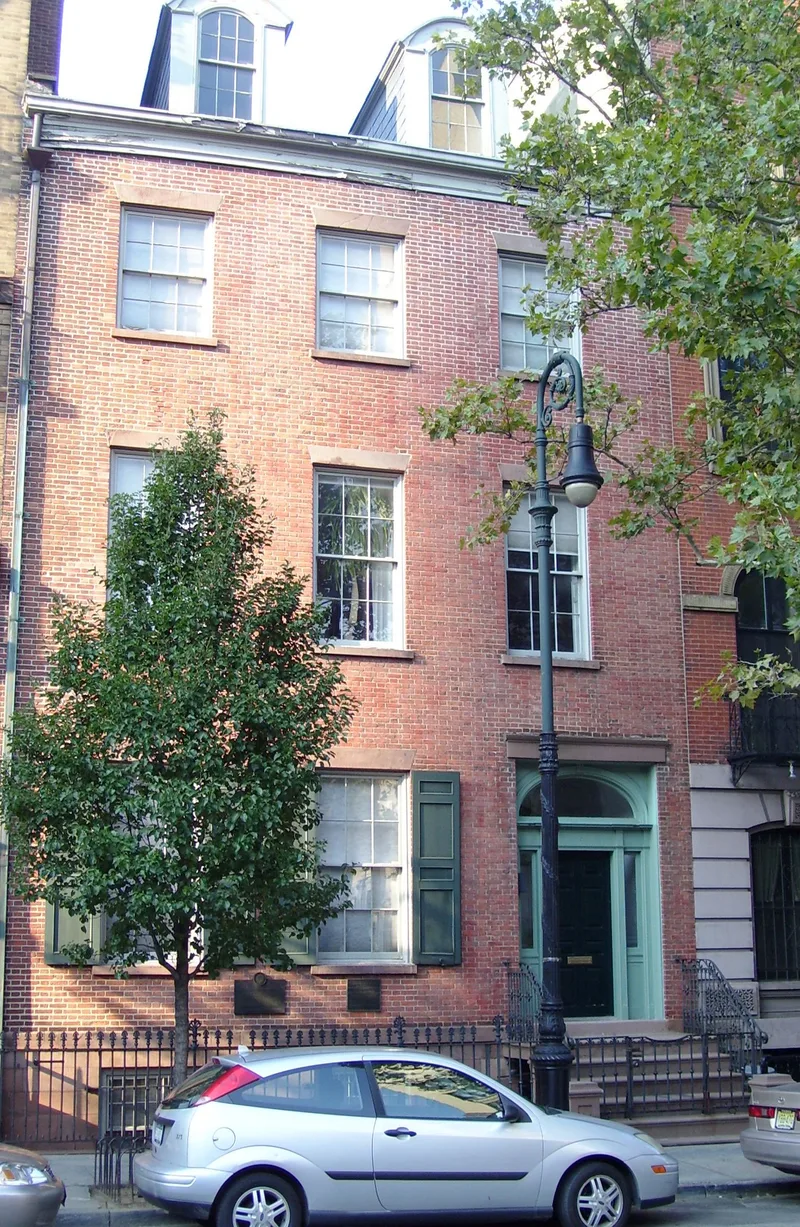
Built in 1804 at 21 Stuyvesant Street in Manhattan, this three-and-a-half-story brick town house shows what a well-built Federal-era home in New York City looked like. Peter Stuyvesant, a great-grandson of the last Dutch Director-General of New Netherland, built it for his daughter Elizabeth and her husband Nicholas Fish, on land granted to his ancestor in 1651. The three-bay house has Flemish bond brickwork, splayed stone lintels, a pitched roof with two arched dormers, and original ironwork at the stoop and areaway. Inside, the stairway, hall archway and ceiling decorations survive. Nicholas Fish was a Revolutionary War officer and friend of Alexander Hamilton, and the house hosted General Lafayette in 1824. Their son Hamilton Fish was born here in 1808 and later served as Governor of New York, U.S. Senator and Secretary of State. The house is valued both for its architecture and for these associations.
Significance in brief: It represents the type of town house built in New York City during the Federal era at the start of the 19th century, and few such houses survive in original condition. It is also associated with Nicholas Fish, a Revolutionary War officer and Federalist, and is the birthplace of his son Hamilton Fish, who became Governor of New York, U.S. Senator and Secretary of State.
Machine-generated summary. This summary was generated by a language model from the official nomination document and has not been reviewed line by line by an editor. It may contain errors. Check the source document before relying on any detail. Source: nomination document (PDF) · National Archives catalog entry. NRHP reference 72001456, listed July 31, 1972. Summary generated October 2026 (model claude-sonnet-5-5, prompt v1.0-2026-10-29, confidence high).
Key facts
| Address | 21 Stuyvesant St., New York |
|---|---|
| County | Manhattan |
| Listed | July 31, 1972 |
| Reference number | 72001456 |
| Resource type | Building |
| Period of significance | 19th Century; specific date 1804 |
| Architect / builder | Built by Peter Stuyvesant; architect unknown |
| Architectural style | Federal |
| Areas of significance | Politics/Government |
| Level of significance | National |
| National Historic Landmark | Yes, designated May 15, 1975 |
| Status (as stated in the nomination) | Listed in excellent condition, unaltered and on its original site; restored in 1967; the form checks both occupied and private residence use. |
| Acreage | 0.9 |
| Within district | St. Mark's Historic District |
| Coordinates | 40.73011, -73.98855 (NPS GIS) |
What listing means for this property
National Register listing is honorary for a privately owned home: it does not by itself restrict what an owner may do with their own money, and it does not require public access. Restrictions come from local landmark or historic-district ordinances, which are separate (how they differ).
Owner-occupied houses are not eligible for the 20% federal rehabilitation tax credit, which applies to income-producing buildings, but many states offer credits for homeowners. Listing also opens the door to preservation easements and to buying a plaque. Start with what listing means for homeowners, renovating a listed house and selling one.
General information, not legal or tax advice. Rules change; confirm with your State Historic Preservation Office or a qualified adviser.
Sources and further reading
- National Park Service, National Register of Historic Places database (snapshot May 2026), reference 72001456.
- Nomination form (PDF, National Archives) — catalog entry
- Wikipedia article (used for cross-checking only; text not reproduced here)
- Wikidata Q5644943
- This listing as JSON
Last updated October 2026. Found an error? See the editorial policy for how to report it.