Smith, Alfred E., House

Why it's listed
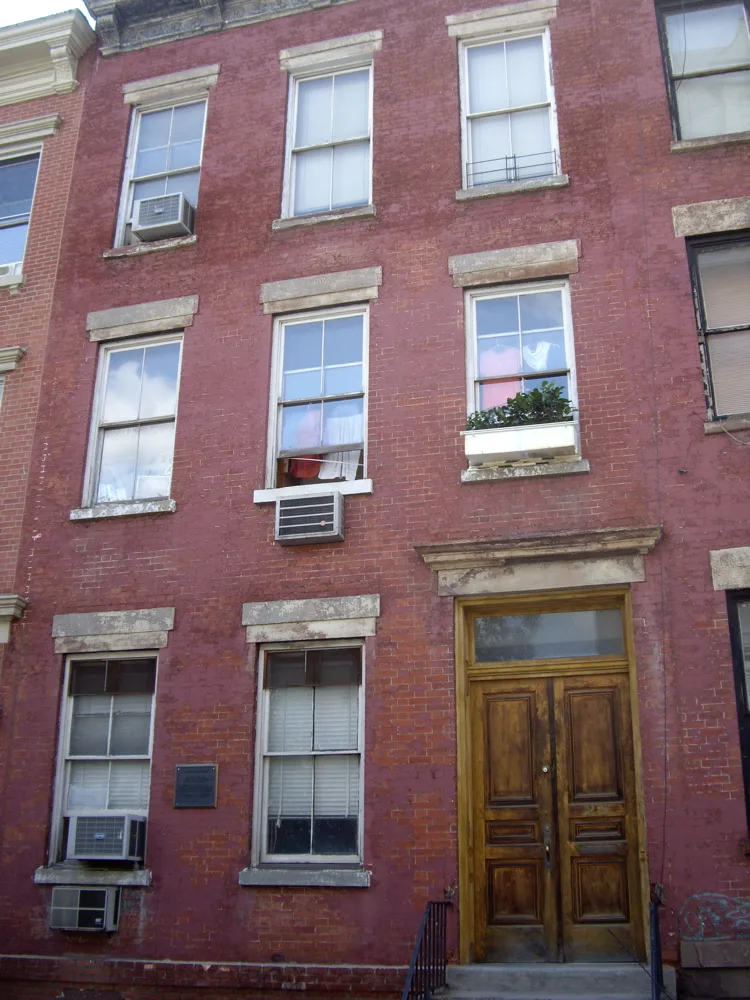
Number 25 Oliver Street is a three-bay, three-story Victorian rowhouse of pressed brick on a rusticated ashlar basement, with a bracketed tin cornice and a narrow stoop. Built sometime between 1870 and 1890, it was leased in 1907 by Alfred E. Smith from adjoining St. James' Catholic Church. Smith lived here until 1923, during the formative years of a career that carried him from the New York State legislature to the governorship and the 1928 Democratic presidential nomination. Historians cast him as an early urban challenger to rural domination of national politics, and his defeat by Herbert Hoover exposed deep religious and cultural divisions. The house stands a few blocks from his birthplace and near the church where he served as an altar boy. Inside, the marble mantelpieces, woodwork, original stairway and tiled floors survive, although the upper floors were converted to living quarters and the ground floor now holds medical offices.
Significance in brief: It was the home of Alfred E. Smith from 1907 to 1923, the formative years of his political career. Smith, Governor of New York and 1928 Democratic presidential nominee, is presented as a symbol of the rise of urban America against rural dominance in national politics. The house sits in the neighborhood that shaped him from boyhood.
Machine-generated summary. This summary was generated by a language model from the official nomination document and has not been reviewed line by line by an editor. It may contain errors. Check the source document before relying on any detail. Source: nomination document (PDF) · National Archives catalog entry. NRHP reference 72000882, listed November 28, 1972. Summary generated October 2026 (model claude-sonnet-5-5, prompt v1.0-2026-10-29, confidence high).
Key facts
| Address | 25 Oliver St., New York |
|---|---|
| County | Manhattan |
| Listed | November 28, 1972 |
| Reference number | 72000882 |
| Resource type | Building |
| Period of significance | 1907-1924 |
| Architectural style | Victorian rowhouse |
| Areas of significance | Politics/Government |
| Level of significance | National |
| National Historic Landmark | Yes, designated November 28, 1972 |
| Status (as stated in the nomination) | Condition listed as fair and altered; the main floor serves as medical offices, the upper floors as living quarters and the basement as a separate apartment. |
| Acreage | 0.1 |
| Within district | Two Bridges Historic District |
| Coordinates | 40.71232, -73.99812 (NPS GIS) |
What listing means for this property
National Register listing is honorary for a privately owned home: it does not by itself restrict what an owner may do with their own money, and it does not require public access. Restrictions come from local landmark or historic-district ordinances, which are separate (how they differ).
Owner-occupied houses are not eligible for the 20% federal rehabilitation tax credit, which applies to income-producing buildings, but many states offer credits for homeowners. Listing also opens the door to preservation easements and to buying a plaque. Start with what listing means for homeowners, renovating a listed house and selling one.
General information, not legal or tax advice. Rules change; confirm with your State Historic Preservation Office or a qualified adviser.
Sources and further reading
- National Park Service, National Register of Historic Places database (snapshot May 2026), reference 72000882.
- Nomination form (PDF, National Archives) — catalog entry
- Wikipedia article (used for cross-checking only; text not reproduced here)
- Wikidata Q4722597
- This listing as JSON
Last updated October 2026. Found an error? See the editorial policy for how to report it.