Church of the Transfiguration
Also known as: The English Lutheran Zion Church

Why it's listed
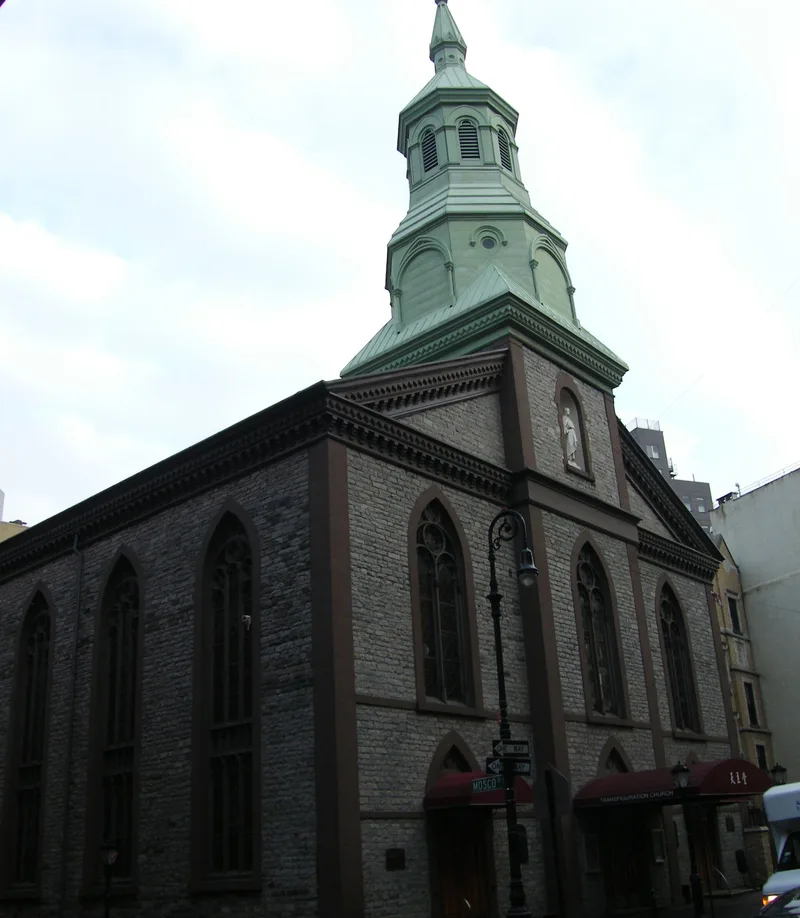
Standing on a narrow, winding street in Chinatown, this stone church at 25 Mott Street dates to 1801, when it was built for the English Lutheran Zion Church. A severe fire in 1815 destroyed the interior and left only the stone walls, and the building was rebuilt with pointed-arch windows. In the 1860s a copper-topped octagonal tower and cupola were added, burial vaults in the basement were removed for a chapel, and an Italian marble altar and frescoes were installed. The congregation joined the Episcopal group in 1810, and in 1853 the building was sold to a Roman Catholic congregation that became the Church of the Transfiguration. The parish shifted from Irish to Italian to, today, mostly Chinese members. Its shape, massing and Gothic tracery combine Georgian and Gothic features. It is among the oldest surviving churches in New York City and remains an active house of worship.
Significance in brief: The nomination argues it is one of the oldest surviving churches in New York City, surpassed in age by only four others. Its vernacular Georgian-Gothic design reflects the many periods and styles of its long history. It has served a changing community, now primarily Chinese, for nearly 200 years.
Machine-generated summary. This summary was generated by a language model from the official nomination document and has not been reviewed line by line by an editor. It may contain errors. Check the source document before relying on any detail. Source: nomination document (PDF) · National Archives catalog entry. NRHP reference 80002682, listed April 16, 1980. Summary generated October 2026 (model claude-sonnet-5-5, prompt v1.0-2026-10-29, confidence high).
Key facts
| Address | 25 Mott St., New York |
|---|---|
| County | Manhattan |
| Listed | April 16, 1980 |
| Reference number | 80002682 |
| Resource type | Building |
| Period of significance | 1800-1899 |
| Architect / builder | Various; interior design attributed to Henry Engelbert |
| Architectural style | Vernacular Georgian-Gothic |
| Areas of significance | Architecture |
| Level of significance | Local |
| Status (as stated in the nomination) | Occupied and in use as a religious building; condition listed as good and altered. |
| Acreage | 0.9 |
| Coordinates | 40.71474, -73.99871 (NPS GIS) |
What listing means for this property
Religious properties are listed for their architectural or historical significance, not their religious use. Listing is honorary and does not restrict the congregation's use of the building. The federal rehabilitation credit is generally unavailable unless part of the building is income-producing; some state programmes and preservation grants do cover religious buildings. Federal funding or permits trigger Section 106 review.
General information, not legal or tax advice. Rules change; confirm with your State Historic Preservation Office or a qualified adviser.
Sources and further reading
- National Park Service, National Register of Historic Places database (snapshot May 2026), reference 80002682.
- Nomination form (PDF, National Archives) — catalog entry
- Wikipedia article (used for cross-checking only; text not reproduced here)
- Wikidata Q5118060
- This listing as JSON
Last updated October 2026. Found an error? See the editorial policy for how to report it.