Macy, R. H., and Company Store

Why it's listed
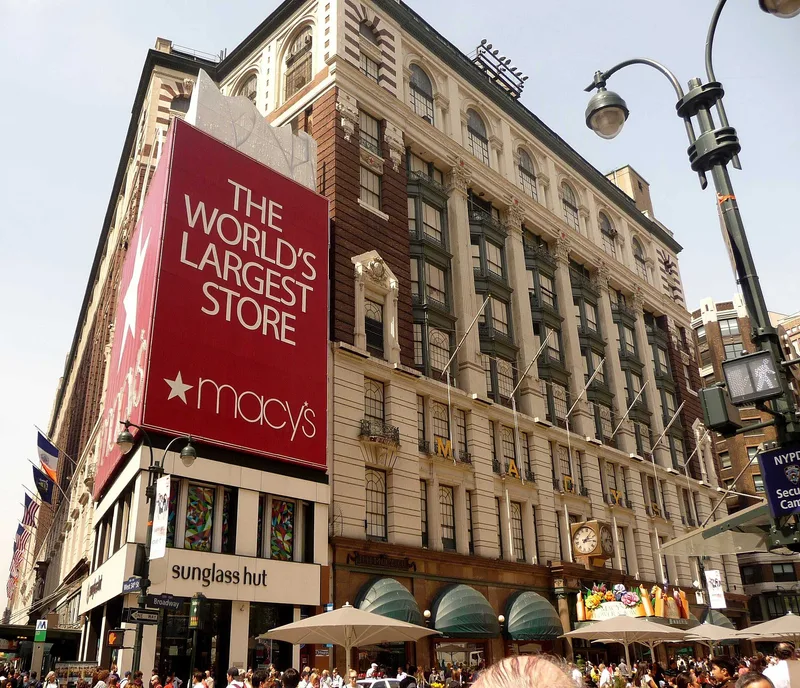
Covering almost an entire block at Herald Square, this Manhattan department store was built in stages: a 9-story steel-frame masonry section on the Broadway side in 1901-02, a one-story addition in 1910, and a 20-story section on the Seventh Avenue side in 1922-24. DeLemos & Cordes designed the first section and the George A. Fuller Company built it for about $4.8 million. Two small corner lots were never acquired by the firm. The exterior mixes stone, marble and brick, with hexagonal bays and arched windows on the Broadway side. Inside, crystal chandeliers, marble columns and stairs, and original Otis steel-and-mahogany escalators survive on the main selling floor. The property matters because R. H. Macy helped pioneer the one-price system, cash sales, heavy newspaper advertising and departmental organization, and the store has been the world's largest under one roof since 1924. Historians describe its story as a main chapter in American retailing.
Significance in brief: The nomination argues that Macy's store is the world's largest department store under one roof and has held that distinction since 1924. R. H. Macy helped pioneer the one-price system, innovative advertising and new merchandise lines. Retailing historians cite the firm as central to the story of the American department store.
Machine-generated summary. This summary was generated by a language model from the official nomination document and has not been reviewed line by line by an editor. It may contain errors. Check the source document before relying on any detail. Source: nomination document (PDF) · National Archives catalog entry. NRHP reference 78001873, listed June 2, 1978. Summary generated October 2026 (model claude-sonnet-5-5, prompt v1.0-2026-10-29, confidence medium).
Key facts
| Address | 151 W. 34th St., New York |
|---|---|
| County | Manhattan |
| Listed | June 2, 1978 |
| Reference number | 78001873 |
| Resource type | Building |
| Period of significance | 1800-1899, 1900- (subject 1858-present; site 1901-present) |
| Architect / builder | DeLemos & Cordes (architects); George A. Fuller Co. (builder) |
| Areas of significance | Commerce |
| Level of significance | National |
| National Historic Landmark | Yes, designated June 2, 1978 |
| Status (as stated in the nomination) | Occupied and in use as a department store; the interior is described as little altered, and the company plans to remodel the interior while keeping basic decorative features. |
| Acreage | 3 |
| Coordinates | 40.75087, -73.98921 (NPS GIS) |
What listing means for this property
For an income-producing building, listing (individually or as a contributing building in a district) is the gateway to the 20% federal rehabilitation tax credit on qualified rehabilitation costs, often stackable with state credits. Work claiming the credit must follow the Secretary of the Interior's Standards and be approved in advance.
Listing does not restrict a private owner acting without federal money or permits; where federal funding or licensing is involved, Section 106 review applies.
General information, not legal or tax advice. Rules change; confirm with your State Historic Preservation Office or a qualified adviser.
Sources and further reading
- National Park Service, National Register of Historic Places database (snapshot May 2026), reference 78001873.
- Nomination form (PDF, National Archives) — catalog entry
- Wikipedia article (used for cross-checking only; text not reproduced here)
- Wikidata Q6725862
- This listing as JSON
Last updated October 2026. Found an error? See the editorial policy for how to report it.