House at 203 Prince Street

Why it's listed
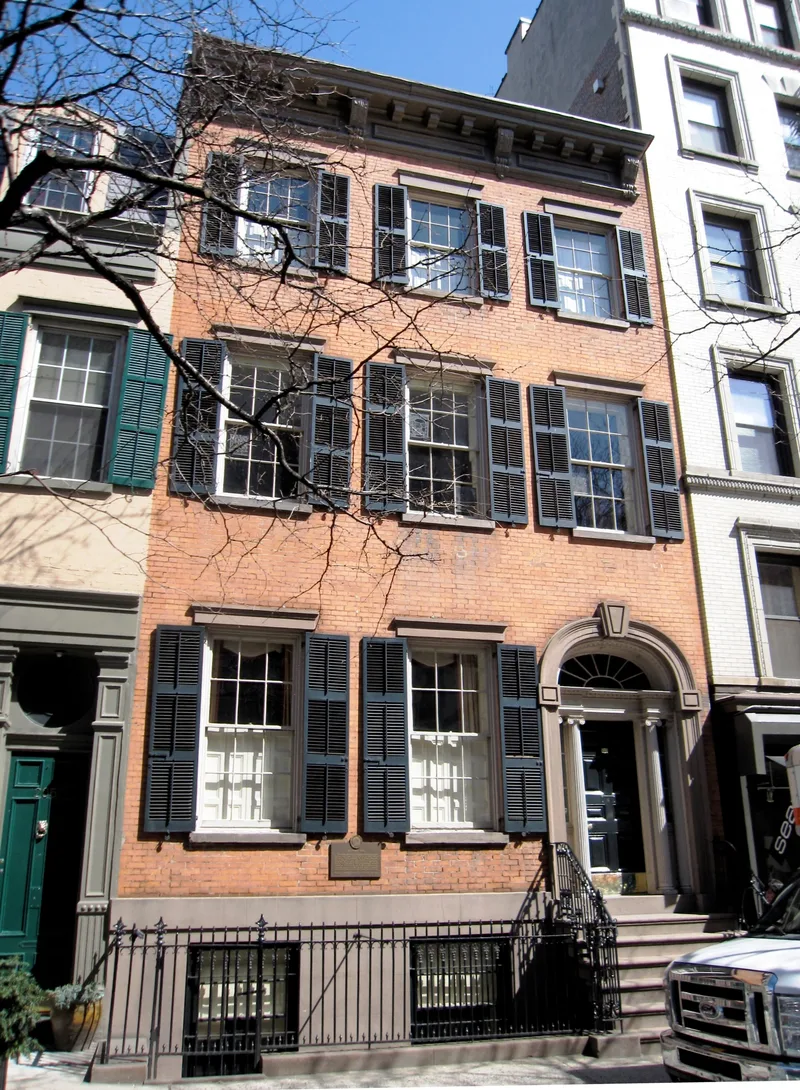
Built in 1833-34 for John P. Haff, a leather inspector, this three-story townhouse at 203 Prince Street in Manhattan has a Flemish bond brick front and a brownstone basement. Its style bridges Federal and Greek Revival design. The Federal-style entrance sits above a high stoop, with an arched doorway, Ionic columns, sidelights and a semi-elliptical fanlight, while the brownstone window lintels reflect Greek Revival taste. The third floor was raised in 1888, replacing the original peaked attic. Inside, Greek Revival woodwork and black marble mantels fill the parlors, and the second floor keeps earlier Federal detailing and original pine floors. A careful restoration in 1972 removed a later fire escape and brought back six-over-six windows and louvered blinds. The house is valued as one of very few surviving examples of this transitional type in the city, and as a typical middle-class home of the 1830s on land once part of Aaron Burr's Richmond Hill estate.
Significance in brief: It is one of very few surviving New York City houses in a transitional style combining Federal and Greek Revival elements. Hundreds of similar houses once existed, but only a handful remain and many are heavily altered. It is also a characteristic upper middle-class residence of the 1830s, built on land once part of Aaron Burr's Richmond Hill estate.
Machine-generated summary. This summary was generated by a language model from the official nomination document and has not been reviewed line by line by an editor. It may contain errors. Check the source document before relying on any detail. Source: nomination document (PDF) · National Archives catalog entry. NRHP reference 83001731, listed May 26, 1983. Summary generated October 2026 (model claude-sonnet-5-5, prompt v1.0-2026-10-29, confidence medium).
Key facts
| Address | 203 Prince St., New York |
|---|---|
| County | Manhattan |
| Listed | May 26, 1983 |
| Reference number | 83001731 |
| Resource type | Building |
| Period of significance | 1800-1899 |
| Architectural style | Transitional Federal to Greek Revival |
| Areas of significance | Architecture |
| Level of significance | Local |
| Status (as stated in the nomination) | Listed in excellent condition; restored by the owner in 1972 and used as a private residence. |
| Acreage | 0.9 |
| Within district | Charlton-King-Vandam Historic District |
| Coordinates | 40.72693, -74.00279 (NPS GIS) |
What listing means for this property
National Register listing is honorary for a privately owned home: it does not by itself restrict what an owner may do with their own money, and it does not require public access. Restrictions come from local landmark or historic-district ordinances, which are separate (how they differ).
Owner-occupied houses are not eligible for the 20% federal rehabilitation tax credit, which applies to income-producing buildings, but many states offer credits for homeowners. Listing also opens the door to preservation easements and to buying a plaque. Start with what listing means for homeowners, renovating a listed house and selling one.
General information, not legal or tax advice. Rules change; confirm with your State Historic Preservation Office or a qualified adviser.
Sources and further reading
- National Park Service, National Register of Historic Places database (snapshot May 2026), reference 83001731.
- Nomination form (PDF, National Archives) — catalog entry
- Wikipedia article (used for cross-checking only; text not reproduced here)
- Wikidata Q4630423
- This listing as JSON
Last updated October 2026. Found an error? See the editorial policy for how to report it.