Henry Street Settlement and Neighborhood Playhouse

Why it's listed
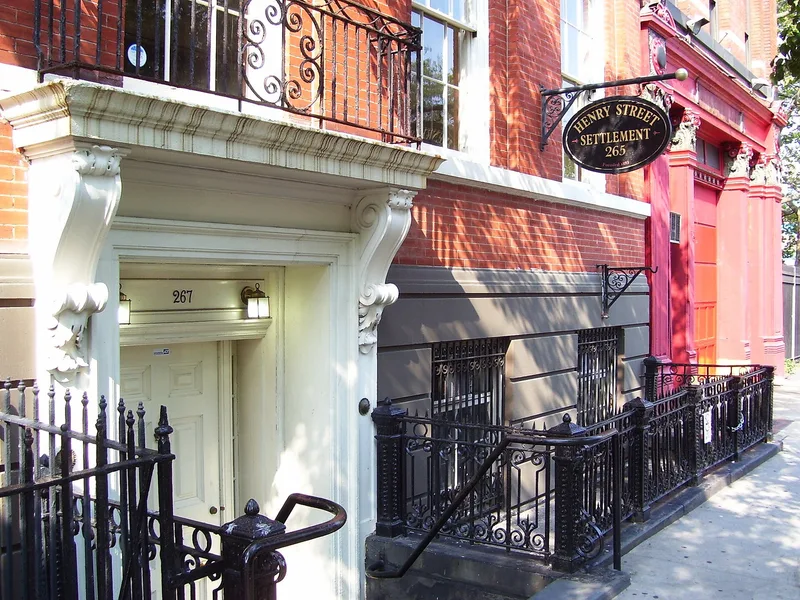
Three early nineteenth-century townhouses on Henry Street, together with a 1915 playhouse two blocks north on Grand Street, make up the Henry Street Settlement. No. 265, a three-story Federal house from 1827, became the headquarters of nurse Lillian Wald in 1895. Nos. 263 and 267 were added in 1905. From these houses Wald developed public health nursing, bringing care to poor immigrant families on the Lower East Side, and her work led to the first public school nursing system in the world. She also pioneered public playgrounds and supported housing reform, labor regulation, woman suffrage and pacifism. She lived and worked here for nearly forty years, until 1933. The Neighborhood Playhouse, a Georgian Revival building funded by Alice and Irene Lewisohn, extended the settlement's work into drama, dance and music. Both the houses and the playhouse remain in use, and the settlement continues to offer social, educational and recreational programs.
Significance in brief: The houses were the home and base of Lillian Wald, who founded the Henry Street Settlement and originated public health nursing. Her work there led to the first public school nursing system in the world and advanced playgrounds, housing reform, labor regulation and other causes. The Neighborhood Playhouse added theater, music and dance for the neighborhood from 1915.
Machine-generated summary. This summary was generated by a language model from the official nomination document and has not been reviewed line by line by an editor. It may contain errors. Check the source document before relying on any detail. Source: nomination document (PDF) · National Archives catalog entry. NRHP reference 74001272, listed September 13, 1974. Summary generated October 2026 (model claude-sonnet-5-5, prompt v1.0-2026-10-29, confidence high).
Key facts
| Address | 263-267 Henry St. and 466 Grand St., New York |
|---|---|
| County | Manhattan |
| Listed | September 13, 1974 |
| Reference number | 74001272 |
| Resource type | Building |
| Period of significance | 1895-; playhouse 1915- |
| Architect / builder | Neighborhood Playhouse built by Alice and Irene Lewisohn (1915) |
| Architectural style | Federal (No. 265 and No. 263, the latter modified); Georgian Eclectic (No. 267); Georgian Revival (Neighborhood Playhouse) |
| Areas of significance | Social History |
| Level of significance | National |
| National Historic Landmark | Yes, designated May 30, 1974 |
| Status (as stated in the nomination) | Condition listed as excellent and altered. The settlement is still active, and preservation work is in progress at the Neighborhood Playhouse. |
| Acreage | 1 |
| Within district | Lower East Side Historic District |
| Coordinates | 40.71534, -73.98362 (NPS GIS) |
What listing means for this property
National Register listing is honorary: it recognises significance and does not restrict what a private owner may do without federal money or permits. It unlocks the 20% federal rehabilitation tax credit for income-producing buildings, state credits in many states, and Section 106 review when federal agencies are involved. See what listing means in practice.
General information, not legal or tax advice. Rules change; confirm with your State Historic Preservation Office or a qualified adviser.
Sources and further reading
- National Park Service, National Register of Historic Places database (snapshot May 2026), reference 74001272.
- Nomination form (PDF, National Archives) — catalog entry
- Wikipedia article (used for cross-checking only; text not reproduced here)
- Wikidata Q5728819
- This listing as JSON
Last updated October 2026. Found an error? See the editorial policy for how to report it.