Bialystoker Synagogue
Also known as: Willett Street Methodist Episcopal Church

Why it's listed
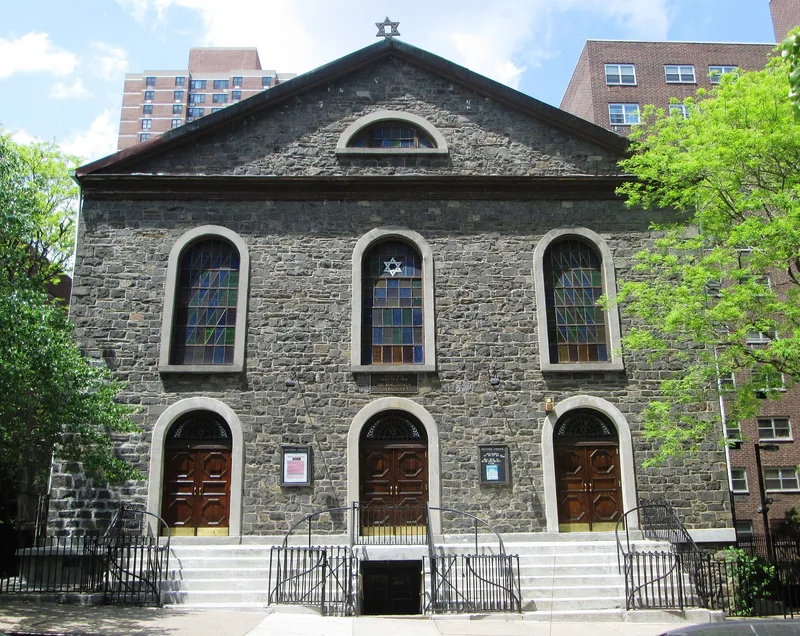
Built in 1826 at 7-13 Willett Street on Manhattan's Lower East Side, this two-story stone building with an attic began as the Willett Street Methodist Episcopal Church. It has a rectangular plan, masonry bearing walls of random ashlar, a three-bay east facade, and round-arched doors and windows with masonry frames. A low-pitched roof carries a wood-cornice pediment around a lunette window, and a brownstone base course runs along the front. Its plain classical detail is described as reminiscent of a time when lower Manhattan had a more rural atmosphere. In 1905 the building became the Bialystoker Synagogue, requiring very little modification. That change of use reflects the neighborhood's shift from a semi-rural Protestant community to a more commercial area, where an incoming Jewish population replaced residents who moved uptown. It is valued as a fine example of vernacular masonry construction and as one of the few surviving Federal period religious buildings in New York City.
Significance in brief: The nomination presents it as a small, sturdy late Federal period building and one of the few surviving ecclesiastical buildings of that era in New York City. It is a fine example of vernacular masonry construction with simple classical detail. Its change from church to synagogue in 1905 also records the shift in the neighborhood's population.
Machine-generated summary. This summary was generated by a language model from the official nomination document and has not been reviewed line by line by an editor. It may contain errors. Check the source document before relying on any detail. Source: nomination document (PDF) · National Archives catalog entry. NRHP reference 72000861, listed April 26, 1972. Summary generated October 2026 (model claude-sonnet-5-5, prompt v1.0-2026-10-29, confidence high).
Key facts
| Address | 7-13 Willett St., New York |
|---|---|
| County | Manhattan |
| Listed | April 26, 1972 |
| Reference number | 72000861 |
| Resource type | Building |
| Period of significance | 19th Century (specific date 1826) |
| Architectural style | Late Federal period, vernacular masonry tradition with simple classical detail |
| Areas of significance | Architecture, Religion |
| Level of significance | State |
| Status (as stated in the nomination) | Listed as occupied, in religious use, in good condition and unaltered, on its original site. |
| Acreage | 0.9 |
| Within district | Lower East Side Historic District |
| Coordinates | 40.71559, -73.98307 (NPS GIS) |
What listing means for this property
Religious properties are listed for their architectural or historical significance, not their religious use. Listing is honorary and does not restrict the congregation's use of the building. The federal rehabilitation credit is generally unavailable unless part of the building is income-producing; some state programmes and preservation grants do cover religious buildings. Federal funding or permits trigger Section 106 review.
General information, not legal or tax advice. Rules change; confirm with your State Historic Preservation Office or a qualified adviser.
Sources and further reading
- National Park Service, National Register of Historic Places database (snapshot May 2026), reference 72000861.
- Nomination form (PDF, National Archives) — catalog entry
- Wikipedia article (used for cross-checking only; text not reproduced here)
- Wikidata Q4902461
- This listing as JSON
Last updated October 2026. Found an error? See the editorial policy for how to report it.