Founder's Hall, The Rockefeller University
Also known as: Rockefeller Institute for Medical Research

Why it's listed
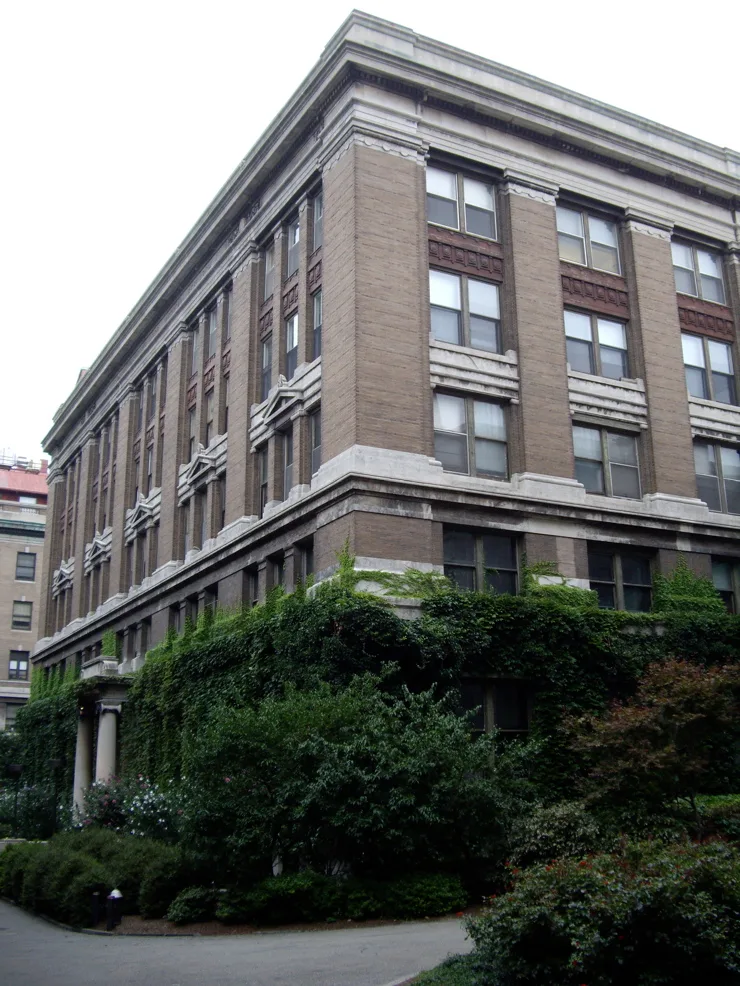
Founder's Hall, at 66th Street and York Avenue in Manhattan, was the first laboratory building of the Rockefeller Institute for Medical Research. John D. Rockefeller bought the site, a rocky plateau above the East River, and the building opened on May 11, 1906. Designed by the Boston firm of Shepley, Rutan and Coolidge, it is a fireproof, steel-frame structure of yellowish-grey brick and limestone, five stories tall, with a simple facade and a modest portico of two Ionic columns. Welch Hall was added behind it in 1927, and an enclosed walkway links it to other Institute buildings. It is listed because the Institute, founded in 1901, was the first of the great philanthropic foundations devoted to research. Work here and at the Institute produced a meningitis serum, the drug tryparsamide, advances in arterial surgery and the antibiotic gramicidin. The building still serves its original laboratory purpose.
Significance in brief: The Rockefeller Institute, founded in 1901, was the first of the great philanthropic foundations, aimed at attacking disease through research. Its first laboratory opened in 1906, and Institute scientists went on to make landmark medical discoveries, including a meningitis serum, tryparsamide, advances in arterial surgery and the antibiotic gramicidin.
Machine-generated summary. This summary was generated by a language model from the official nomination document and has not been reviewed line by line by an editor. It may contain errors. Check the source document before relying on any detail. Source: nomination document (PDF) · National Archives catalog entry. NRHP reference 74001269, listed September 13, 1974. Summary generated October 2026 (model claude-sonnet-5-5, prompt v1.0-2026-10-29, confidence medium).
Key facts
| Address | 66th St. and York Ave., New York |
|---|---|
| County | Manhattan |
| Listed | September 13, 1974 |
| Reference number | 74001269 |
| Resource type | Building |
| Period of significance | 1906- |
| Architect / builder | Shepley, Rutan and Coolidge (Boston) |
| Areas of significance | Science, Social History |
| Level of significance | National |
| National Historic Landmark | Yes, designated May 30, 1974 |
| Status (as stated in the nomination) | Condition listed as excellent and altered; the building continues to serve its original function as a laboratory. |
| Acreage | 0.9 |
| Coordinates | 40.76249, -73.95520 (NPS GIS) |
What listing means for this property
For a publicly owned building or structure, listing mainly matters when federal funds, permits or licences are involved: projects then go through Section 106 review so effects on the property are considered. Listing also strengthens applications for preservation grants and, for leased income-producing uses, can enable the federal rehabilitation tax credit.
General information, not legal or tax advice. Rules change; confirm with your State Historic Preservation Office or a qualified adviser.
Sources and further reading
- National Park Service, National Register of Historic Places database (snapshot May 2026), reference 74001269.
- Nomination form (PDF, National Archives) — catalog entry
- Wikipedia article (used for cross-checking only; text not reproduced here)
- Wikidata Q5474593
- This listing as JSON
Last updated October 2026. Found an error? See the editorial policy for how to report it.