East 73rd Street Historic District

Why it's listed
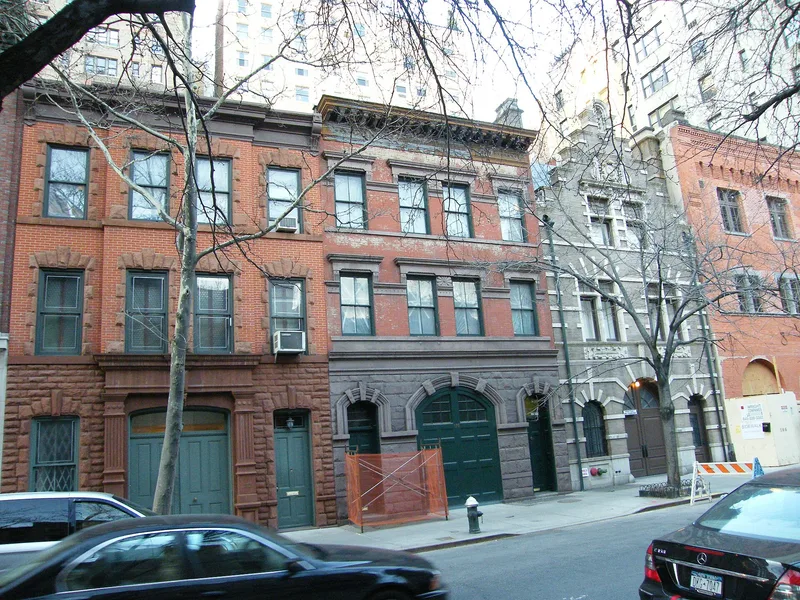
Fifteen small-scale buildings on East 73rd Street between Lexington and Third Avenues form a rare pocket of carriage-era Manhattan, hemmed in by high-rise apartment towers. Eleven were built as private carriage houses for wealthy New Yorkers, among them Edward Harkness, Joseph Pulitzer and Henry T. Sloane. Two Italianate rowhouses from 1860 survive from the street's first development, alongside a commercial stable and an early commercial garage dating to 1906. The designs range from simple vernacular work to high-style Romanesque Revival, Beaux-Arts and neo-Flemish buildings, with architects including Richard Morris Hunt and Charles Romeyn. Ground floors held carriages and horse stalls, with rooms above for coachmen and grooms. As automobiles replaced carriages, the buildings became garages and chauffeurs' quarters, and later most became stylish private homes. Alterations have been modest, mostly to carriage doors. The block is recognized as the only cohesive group of carriage houses in Manhattan.
Significance in brief: The nomination argues the block is one of the most unusual architectural enclaves in New York City and the only cohesive grouping of carriage houses in Manhattan. The buildings were designed by obscure, prominent and nationally known architects, and were built for some of the city's wealthiest residents. Their later conversion to garages and then to residences reflects changing transportation and lifestyles.
Machine-generated summary. This summary was generated by a language model from the official nomination document and has not been reviewed line by line by an editor. It may contain errors. Check the source document before relying on any detail. Source: nomination document (PDF) · National Archives catalog entry. NRHP reference 82003374, listed July 22, 1982. Summary generated October 2026 (model claude-sonnet-5-5, prompt v1.0-2026-10-29, confidence high).
Key facts
| Address | 161--179 and 166--182 E. 73rd St., New York |
|---|---|
| County | Manhattan |
| Listed | July 22, 1982 |
| Reference number | 82003374 |
| Resource type | District |
| Period of significance | 1860-1920 |
| Architect / builder | Various (including Thomas Rae, John H. Friend, Charles Romeyn, Richard Morris Hunt, Hobart Walker and William Schickel) |
| Architectural style | Carriage houses in Romanesque Revival, Beaux-Arts, neo-Flemish, neo-Grec and Queen Anne styles; Italianate rowhouses |
| Areas of significance | Architecture |
| Level of significance | Local |
| Status (as stated in the nomination) | Condition rated excellent to good with no intrusions. Most carriage houses and rowhouses are private homes, two carriage houses house businesses, and Nos. 177-79 and 182 remain commercial garages. |
| Acreage | 1.4 |
| Within district | Upper East Side Historic District (Boundary Increase) |
| Coordinates | 40.77080, -73.96090 (NPS GIS) |
What listing means for this property
This is a historic district. Buildings within its boundary are either contributing (they add to the district's significance) or non-contributing. Owners of contributing income-producing buildings can claim the 20% federal rehabilitation tax credit; homeowners should look at state credits. National Register districts impose no design review by themselves; a local historic district ordinance, if one exists, does (the difference explained).
General information, not legal or tax advice. Rules change; confirm with your State Historic Preservation Office or a qualified adviser.
Sources and further reading
- National Park Service, National Register of Historic Places database (snapshot May 2026), reference 82003374.
- Nomination form (PDF, National Archives) — catalog entry
- Wikipedia article (used for cross-checking only; text not reproduced here)
- Wikidata Q1277703
- This listing as JSON
Last updated October 2026. Found an error? See the editorial policy for how to report it.