69th Street Transfer Bridge

Why it's listed
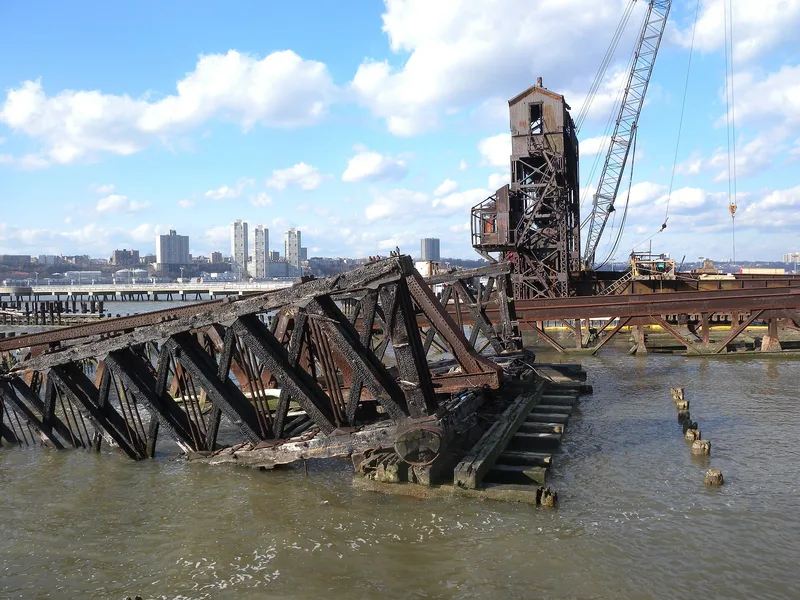
This railroad transfer bridge, also called a float bridge, stands on the Hudson River waterfront in Manhattan between West 66th and West 70th Streets. Completed in 1911 for the New York Central Railroad, it moved freight cars between land tracks and carfloats, the barges that carried rail cars around New York Harbor. Two steel plate girder spans, each carrying one track, hang from a shared overhead structure with counterweights and motor-driven threaded screws that raise and lower them. Its importance lies in engineering. Designed by James B. French and patented in 1911, it was the first bridge to use a contained apron, a flexible platform within the main span that absorbed the twisting of a listing carfloat. The design proved faster, easier to operate and cheaper than earlier suspended types, and later bridges in the port followed it. The bridge was taken out of service after the 1968 railroad merger but remains largely intact, minus its rails.
Significance in brief: The nomination argues it meets Criterion C in engineering as the first bridge of the "contained apron" design, patented by engineer James B. French. The design was faster, easier to operate and cheaper than earlier suspended transfer bridges, and later suspended bridges at the Port of New York followed it. It is described as one of the most significant marine structures remaining in New York City.
Machine-generated summary. This summary was generated by a language model from the official nomination document and has not been reviewed line by line by an editor. It may contain errors. Check the source document before relying on any detail. Source: nomination document (PDF) · National Archives catalog entry. NRHP reference 03000577, listed June 26, 2003. Summary generated October 2026 (model claude-sonnet-5-5, prompt v1.0-2026-10-29, confidence high).
Key facts
| Address | Hudson River W of the West Side Highway bet. W 66th and 70th Sts., New York |
|---|---|
| County | Manhattan |
| Listed | June 26, 2003 |
| Reference number | 03000577 |
| Resource type | Structure |
| Period of significance | 1911 |
| Architect / builder | French, James B. (engineer) |
| Architectural style | No style |
| Criteria |
|
| Areas of significance | Engineering |
| Level of significance | Local |
| Status (as stated in the nomination) | Taken out of service but left intact after the 1968 merger of the New York Central and Pennsylvania Railroads; essentially as built except for removed rails, some deterioration and vandalism. |
| Acreage | 0.9 |
| Coordinates | 40.77906, -73.99020 (NPS GIS) |
What listing means for this property
For a publicly owned building or structure, listing mainly matters when federal funds, permits or licences are involved: projects then go through Section 106 review so effects on the property are considered. Listing also strengthens applications for preservation grants and, for leased income-producing uses, can enable the federal rehabilitation tax credit.
Noted as vacant in the nomination. Nomination documents can be decades old; current status may differ. If you are considering buying an empty listed property, read the due-diligence checklist.
General information, not legal or tax advice. Rules change; confirm with your State Historic Preservation Office or a qualified adviser.
Sources and further reading
- National Park Service, National Register of Historic Places database (snapshot May 2026), reference 03000577.
- Nomination form (PDF, National Archives) — catalog entry
- Wikipedia article (used for cross-checking only; text not reproduced here)
- Wikidata Q15032023
- This listing as JSON
Last updated October 2026. Found an error? See the editorial policy for how to report it.