Tompkins Street/Main Street Historic District (Boundary Increase)
Also known as: See Also:Tompkins Street/Main Street Historic District

Why it's listed
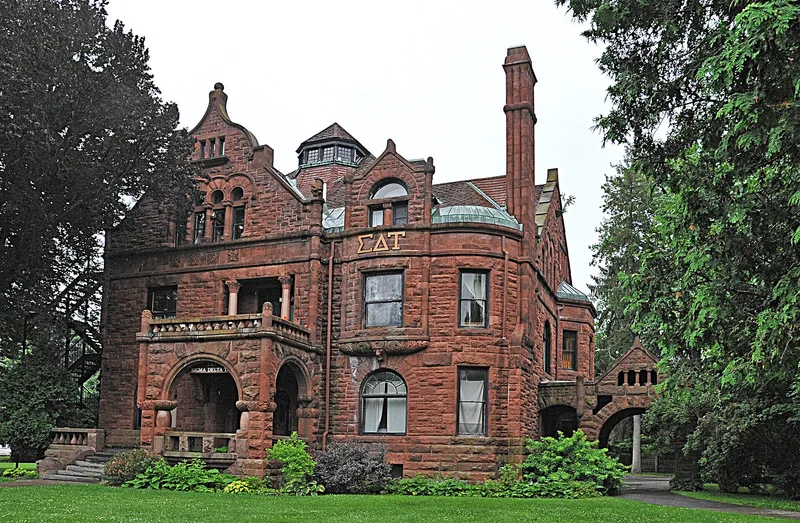
Downtown Cortland and its adjoining residential street form this district of 109 properties on roughly 97.6 acres. The northern part holds about sixty commercial buildings along three blocks of Main Street and one block of Central Avenue, mostly deep brick blocks of three or four stories built between 1860 and 1910. Public buildings, including the Post Office, YWCA, YMCA, Masonic Temple and VFW building, cluster near Clayton Avenue. To the southwest, two long blocks of Tompkins Street hold about forty houses on large landscaped lots, ranging from modest 1830s vernacular homes to mansions of 1890-1916. The Cortland Rural Cemetery closes the district at its southwestern end. The district enlarges an earlier residential district listed in 1975. Later research showed that the commercial area was shaped by the same forces and architectural fashions as Tompkins Street, so the boundaries were redrawn to include it. Cortland grew after becoming county seat in 1810, and expanded rapidly after the Civil War with wagonmaking and wire industries.
Significance in brief: The expansion adds the commercial district to the earlier Tompkins Street Area Historic District, because research showed the same historical forces and architectural fashions shaped both areas. It contains a broad range of nineteenth and twentieth century styles, including outstanding examples of Italianate, Victorian Gothic and Chateauesque architecture. It also reflects Cortland's growth as a county seat and industrial village.
Machine-generated summary. This summary was generated by a language model from the official nomination document and has not been reviewed line by line by an editor. It may contain errors. Check the source document before relying on any detail. Source: nomination document (PDF) · National Archives catalog entry. NRHP reference 82001116, listed November 17, 1982. Summary generated October 2026 (model claude-sonnet-5-5, prompt v1.0-2026-10-29, confidence medium).
Key facts
| Address | Main St. from Tompkins St. to Clinton Ave., Cortland |
|---|---|
| County | Cortland County |
| Listed | November 17, 1982 |
| Reference number | 82001116 |
| Resource type | District |
| Architectural style | Wide range of 19th and 20th century styles, including Italianate, Victorian Gothic, Richardsonian Romanesque, Queen Anne, Second Renaissance Revival, Neoclassical and Art Moderne |
| Areas of significance | Commerce, Exploration/Settlement, Architecture |
| Level of significance | Local |
| Status (as stated in the nomination) | Marked occupied and in good condition; uses include commercial, government, museum, entertainment and private residence. Nineteen modern commercial buildings are listed as non-contributing. |
| Acreage | 97.6 |
| Within district | Tompkins Street Historic District |
| Coordinates | 42.59729, -76.18405 (NPS GIS) |
What listing means for this property
This is a historic district. Buildings within its boundary are either contributing (they add to the district's significance) or non-contributing. Owners of contributing income-producing buildings can claim the 20% federal rehabilitation tax credit; homeowners should look at state credits. National Register districts impose no design review by themselves; a local historic district ordinance, if one exists, does (the difference explained).
General information, not legal or tax advice. Rules change; confirm with your State Historic Preservation Office or a qualified adviser.
Sources and further reading
- National Park Service, National Register of Historic Places database (snapshot May 2026), reference 82001116.
- Nomination form (PDF, National Archives) — catalog entry
- Wikipedia article (used for cross-checking only; text not reproduced here)
- Wikidata Q7820370
- This listing as JSON
Last updated October 2026. Found an error? See the editorial policy for how to report it.