Point, The, Historic District

Why it's listed
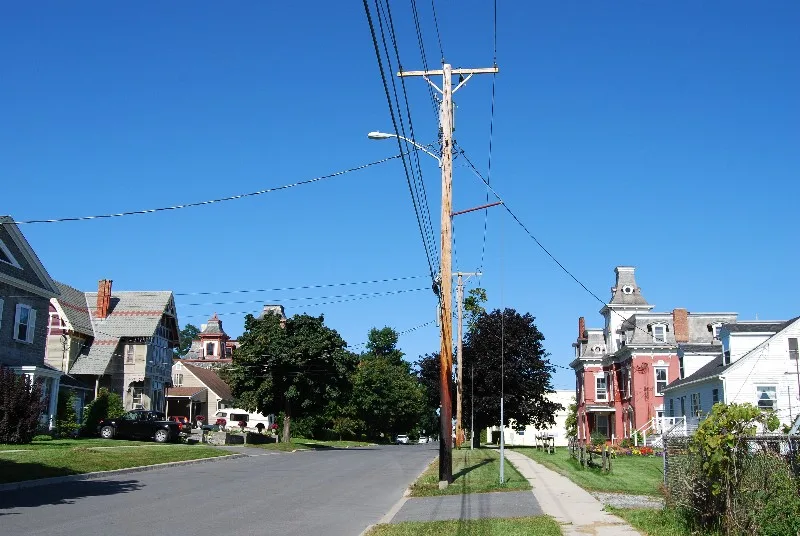
Known as "The Point," this residential district on Plattsburgh's east side covers 38 structures between the Saranac River and Lake Champlain. Most were built between 1815 and 1880. Peru and Bridge Streets hold the earliest houses, including Federal-style brick homes. Larger, fashionable brick houses line McComb Street, and Hamilton Street has double houses and more modest dwellings from the late nineteenth century. The area was first settled in the early 1800s and had become a fashionable neighborhood by 1850, when wealthy lumber and shipping magnates built ornate homes here. It also played a part in the War of 1812 battle of Plattsburgh. The house at 3 Peru Street served as General Alexander McComb's headquarters, and a British cannonball remains lodged in its south wall. Together with the neighboring houses at 7 Peru and 17 McComb Streets, it forms the earliest concentrated group of surviving buildings in the city. The district shows Federal, Greek Revival, Italianate and Eclectic styles reflecting upper middle class tastes from 1800 to 1880.
Significance in brief: The district contains both the earliest and the most fashionable houses built in Plattsburgh during the nineteenth century. It was settled in the first decade of the 1800s and became a fashionable area by 1850, when wealthy lumber and shipping magnates built ornate homes there. It also figured in the War of 1812 battle of Plattsburgh.
Machine-generated summary. This summary was generated by a language model from the official nomination document and has not been reviewed line by line by an editor. It may contain errors. Check the source document before relying on any detail. Source: nomination document (PDF) · National Archives catalog entry. NRHP reference 82001110, listed November 12, 1982. Summary generated October 2026 (model claude-sonnet-5-5, prompt v1.0-2026-10-29, confidence medium).
Key facts
| Address | Roughly bounded by Jay, Hamilton, Peru, and Bridge Sts., Plattsburgh |
|---|---|
| County | Clinton County |
| Listed | November 12, 1982 |
| Reference number | 82001110 |
| Resource type | Building |
| Period of significance | 1800 to 1880 (as described in the significance statement; no formal period field is legible) |
| Architectural style | Federal, Greek Revival, Italianate, Second Empire, Queen Anne and Eclectic residential architecture |
| Areas of significance | Military, Architecture, Social History |
| Level of significance | Local |
| Status (as stated in the nomination) | Includes a few non-contributing modern buildings; several houses are noted as altered, though many retain original features. Some boundary and owner-objection material is attached. |
| Acreage | 16 |
| Within district | Plattsburgh Bay |
| Coordinates | 44.70003, -73.44550 (NPS GIS) |
What listing means for this property
National Register listing is honorary: it recognises significance and does not restrict what a private owner may do without federal money or permits. It unlocks the 20% federal rehabilitation tax credit for income-producing buildings, state credits in many states, and Section 106 review when federal agencies are involved. See what listing means in practice.
General information, not legal or tax advice. Rules change; confirm with your State Historic Preservation Office or a qualified adviser.
Sources and further reading
- National Park Service, National Register of Historic Places database (snapshot May 2026), reference 82001110.
- Nomination form (PDF, National Archives) — catalog entry
- Wikipedia article (used for cross-checking only; text not reproduced here)
- Wikidata Q7757599
- This listing as JSON
Last updated October 2026. Found an error? See the editorial policy for how to report it.