Chemung Railway Depot-Horseheads
Also known as: Horseheads Railroad Station

Why it's listed
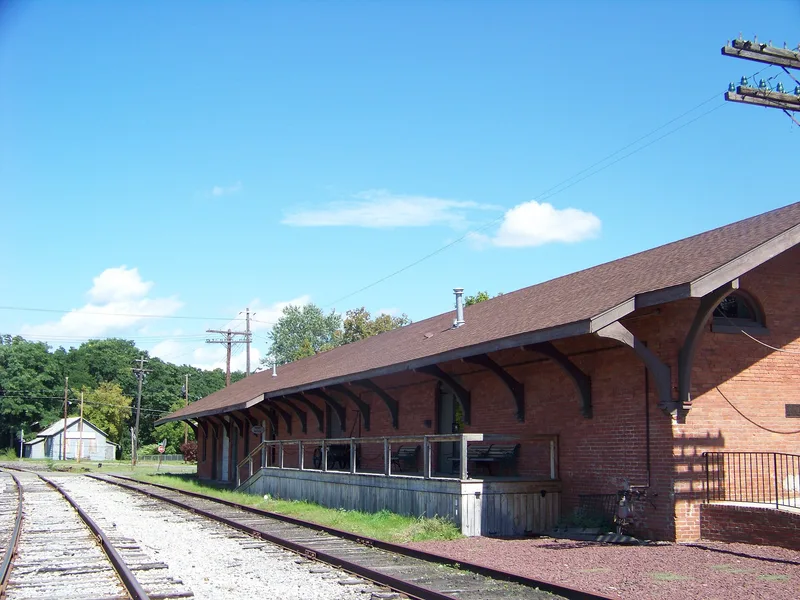
Built in 1866 beside the tracks on West Broad Street in Horseheads, this one-story brick depot replaced an earlier station. It has an Italianate design with a gable roof, wide overhangs and large wooden brackets resting on carved stone corbels. About two-thirds of the floor area served freight storage and transfer, while the rest held an agent's and telegrapher's office, an express office and a waiting room. The Chemung Railway, later the Northern Central Railway and then the Pennsylvania Railroad, used the station until 1956. It was later a feed store until 1994. Inside, the exposed heavy-timber roof trusses, plank freight floor and an original freight scale survive. The depot was listed for its architecture as a typical standardized rural depot and for its link to the railroad that drove the village's growth after the canal era. It is among the last railroad-related structures left in Horseheads.
Significance in brief: The nomination argues the depot is a representative example of nineteenth-century railroad station architecture in the eastern Southern Tier, with its trackside location, gable roof, wide overhang and large brackets. It is also tied to the railroad's role in the economic and physical development of Horseheads. It is described as one of the last structures in the village directly associated with the railroad.
Machine-generated summary. This summary was generated by a language model from the official nomination document and has not been reviewed line by line by an editor. It may contain errors. Check the source document before relying on any detail. Source: nomination document (PDF) · National Archives catalog entry. NRHP reference 96001442, listed December 12, 1996. Summary generated October 2026 (model claude-sonnet-5-5, prompt v1.0-2026-10-29, confidence high).
Key facts
| Address | 312 W. Broad St., Horseheads |
|---|---|
| County | Chemung County |
| Listed | December 12, 1996 |
| Reference number | 96001442 |
| Resource type | Building |
| Period of significance | 1866-1956 |
| Architect / builder | Unknown |
| Architectural style | Late Victorian/Italianate |
| Criteria |
|
| Areas of significance | Community Planning and Development, Transportation, Architecture |
| Level of significance | Local |
| Status (as stated in the nomination) | Listed in Section 6 as vacant and not in use; the building was purchased in 1994 for retail use and partly altered inside. |
| Acreage | 0.4 |
| Coordinates | 42.16652, -76.82385 (NPS GIS) |
What listing means for this property
For an income-producing building, listing (individually or as a contributing building in a district) is the gateway to the 20% federal rehabilitation tax credit on qualified rehabilitation costs, often stackable with state credits. Work claiming the credit must follow the Secretary of the Interior's Standards and be approved in advance.
Listing does not restrict a private owner acting without federal money or permits; where federal funding or licensing is involved, Section 106 review applies.
Noted as vacant in the nomination. Nomination documents can be decades old; current status may differ. If you are considering buying an empty listed property, read the due-diligence checklist.
General information, not legal or tax advice. Rules change; confirm with your State Historic Preservation Office or a qualified adviser.
Sources and further reading
- National Park Service, National Register of Historic Places database (snapshot May 2026), reference 96001442.
- Nomination form (PDF, National Archives) — catalog entry
- Wikipedia article (used for cross-checking only; text not reproduced here)
- Wikidata Q5090682
- This listing as JSON
Last updated October 2026. Found an error? See the editorial policy for how to report it.