Plymouth Church of the Pilgrims
Also known as: Plymouth Church

Why it's listed
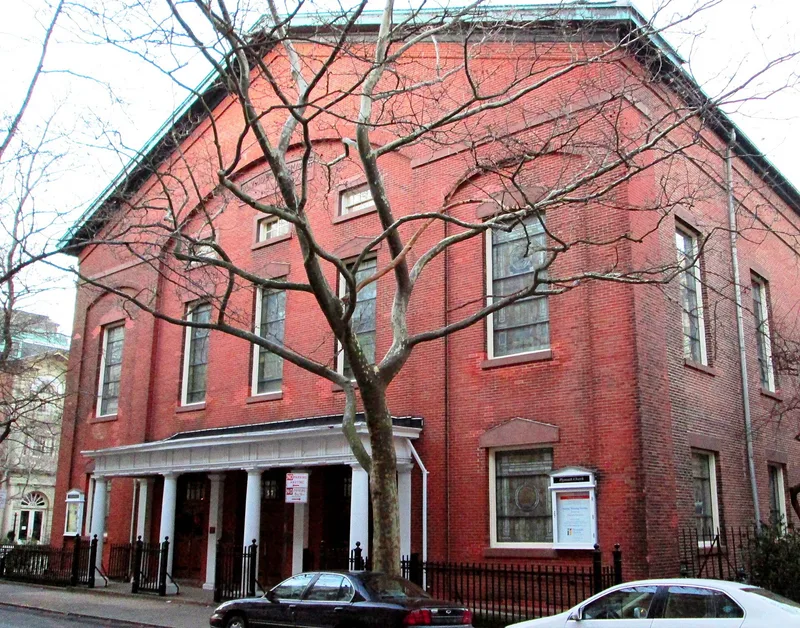
Plymouth Church of the Pilgrims is a Congregational church at 57 Orange Street in Brooklyn Heights. Built in 1849 after an earlier meeting house burned, it opened for services in January 1850. Sherman Day, chairman of the building committee, drew a rough design that English architect J. C. Wells finished. The plain red brick building has a gable facing the street, a Doric portico, and a nearly square auditorium with galleries on three sides carried on slender cast-iron columns. Stained glass installed in 1907-09 depicts scenes of political and religious liberty. A silver plaque marks the pew Abraham Lincoln used the day before his Cooper Union Address. The church matters for its role in the abolition movement. Henry Ward Beecher served as minister for forty years, drew congregations of about 2,500, hosted prominent anti-slavery speakers, and in 1860 auctioned a girl named Pinky from the pulpit to win her freedom. The congregation backed settlers in Kansas with rifles.
Significance in brief: The church was a leading center of anti-slavery sentiment from 1847 until the Civil War under pastor Henry Ward Beecher. Speakers such as William Lloyd Garrison, Wendell Phillips, Charles Sumner and John Greenleaf Whittier appeared from its pulpit. The nomination states that no surviving structure or site commemorates the abolition movement so well.
Machine-generated summary. This summary was generated by a language model from the official nomination document and has not been reviewed line by line by an editor. It may contain errors. Check the source document before relying on any detail. Source: nomination document (PDF) · National Archives catalog entry. NRHP reference 66000525, listed October 15, 1966. Summary generated October 2026 (model claude-sonnet-5-5, prompt v1.0-2026-10-29, confidence medium).
Key facts
| Address | 75 Hicks St., New York |
|---|---|
| County | Brooklyn |
| Listed | October 15, 1966 |
| Reference number | 66000525 |
| Resource type | Building |
| Period of significance | 1849 |
| Architect / builder | J. C. Wells (English architect); rough design by Sherman Day, chairman of the building committee |
| Areas of significance | Religion, Social History |
| Level of significance | National |
| National Historic Landmark | Yes, designated July 4, 1961 |
| Status (as stated in the nomination) | Occupied and in use as a religious building; condition listed as good, on its original site. |
| Acreage | 0.8 |
| Within district | Brooklyn Heights Historic District |
| Coordinates | 40.69941, -73.99334 (NPS GIS) |
What listing means for this property
Religious properties are listed for their architectural or historical significance, not their religious use. Listing is honorary and does not restrict the congregation's use of the building. The federal rehabilitation credit is generally unavailable unless part of the building is income-producing; some state programmes and preservation grants do cover religious buildings. Federal funding or permits trigger Section 106 review.
General information, not legal or tax advice. Rules change; confirm with your State Historic Preservation Office or a qualified adviser.
Sources and further reading
- National Park Service, National Register of Historic Places database (snapshot May 2026), reference 66000525.
- Nomination form (PDF, National Archives) — catalog entry
- Wikipedia article (used for cross-checking only; text not reproduced here)
- Wikidata Q7205773
- This listing as JSON
Last updated October 2026. Found an error? See the editorial policy for how to report it.