Park Slope Historic District

Why it's listed
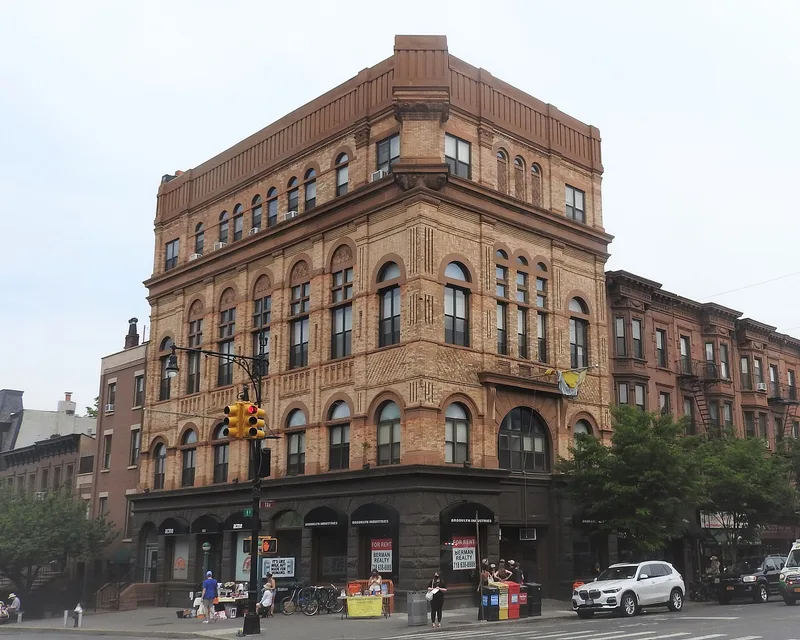
Park Slope Historic District covers about thirty-three blocks of Brooklyn beside Prospect Park, made up almost entirely of rowhouses, mansions, churches and low apartment houses. Development took place in roughly five decades between the Civil War and World War I. The oldest houses, at 8 through 16 Seventh Avenue, date from 1860 and are Italianate. Other notable buildings include the Montauk Club on Eighth Avenue, Grace Methodist Episcopal Church of 1882, and the Brooklyn Ethical Culture Society building on Prospect Park West. The district contains late Italianate, Second Empire, neo-Grec, Victorian Gothic, Queen Anne and Romanesque Revival work, followed by neo-Renaissance, neo-Classical, neo-Federal and neo-Georgian styles. It was listed because of the quality and consistency of its blockfronts, with deep front yards, uniform rooflines and church spires. The nomination notes that its streets present vistas largely unchanged since the turn of the century, and its boundaries match those of the city-designated district of 1973.
Significance in brief: The district is significant mainly for the outstanding quality and coherence of its late nineteenth and early twentieth century architecture. Its development was closely tied to Prospect Park and occurred within about five decades. It includes Romanesque Revival houses described as the finest in the city, and its rowhouse blockfronts, churches and low scale remain largely unchanged.
Machine-generated summary. This summary was generated by a language model from the official nomination document and has not been reviewed line by line by an editor. It may contain errors. Check the source document before relying on any detail. Source: nomination document (PDF) · National Archives catalog entry. NRHP reference 80002636, listed November 21, 1980. Summary generated October 2026 (model claude-sonnet-5-5, prompt v1.0-2026-10-29, confidence medium).
Key facts
| Address | Roughly bounded by Prospect Park West, Berkeley Pl., 15th St., 6th, 7th and Flatbush Aves., New York |
|---|---|
| County | Brooklyn |
| Listed | November 21, 1980 |
| Reference number | 80002636 |
| Resource type | District |
| Period of significance | 1800-1899 |
| Architectural style | Late Italianate, French Second Empire, neo-Grec, Victorian Gothic, Queen Anne, Romanesque Revival, neo-Renaissance, neo-Classical, neo-Federal and neo-Georgian |
| Areas of significance | Architecture |
| Level of significance | Local |
| Status (as stated in the nomination) | Described as largely undisturbed, with many houses preserved with little change; some rebuilding has introduced small sections of modern architecture. A few vacant lots are noted. |
| Acreage | 150 |
| Coordinates | 40.66646, -73.97879 (NPS GIS) |
What listing means for this property
This is a historic district. Buildings within its boundary are either contributing (they add to the district's significance) or non-contributing. Owners of contributing income-producing buildings can claim the 20% federal rehabilitation tax credit; homeowners should look at state credits. National Register districts impose no design review by themselves; a local historic district ordinance, if one exists, does (the difference explained).
General information, not legal or tax advice. Rules change; confirm with your State Historic Preservation Office or a qualified adviser.
Sources and further reading
- National Park Service, National Register of Historic Places database (snapshot May 2026), reference 80002636.
- Nomination form (PDF, National Archives) — catalog entry
- Wikipedia article (used for cross-checking only; text not reproduced here)
- Wikidata Q7138025
- This listing as JSON
Last updated October 2026. Found an error? See the editorial policy for how to report it.