Olmstead Street Historic District

Why it's listed
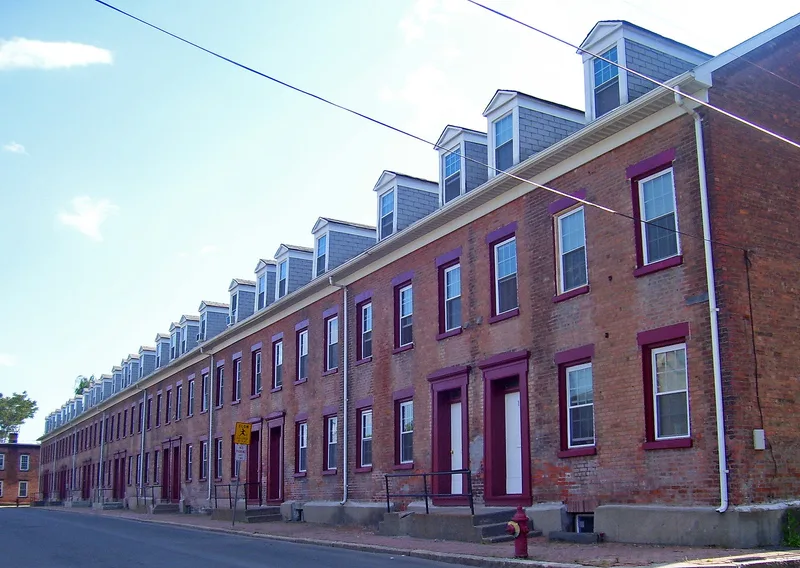
Olmstead Street in Cohoes, New York, curves along the path of a former power canal that once separated the living and working worlds of a textile community. On one side stands the Ogden Mill, a large brick cotton mill built in sections in 1844, 1846 and 1859. On the other are three blocks of brick row houses, two to three stories tall and notable for their uniform materials, scale and design. The Cohoes Company built the first mill beside an abandoned stretch of the Erie Canal that had been added to its power canal system. The row houses were built on a street named for Charles A. Olmstead, the company agent. In 1847 the Ogden Mills led the city in woven cotton production. The mills later passed to the Harmony Company, which joined them with the central section. The filled canal is being turned into a park, and the district still reads as a self-contained industrial community.
Significance in brief: The nomination presents the district as a microcosm of mid-nineteenth century industrial history, combining mill, canal and mill housing in one cohesive group. It records the mill's role in Cohoes's textile industry and the Cohoes Company's use of canals to power development. The curving street follows the route of the old canal, and the well-preserved row houses and mill still read as an integrated industrial complex.
Machine-generated summary. This summary was generated by a language model from the official nomination document and has not been reviewed line by line by an editor. It may contain errors. Check the source document before relying on any detail. Source: nomination document (PDF) · National Archives catalog entry. NRHP reference 73001159, listed June 19, 1973. Summary generated October 2026 (model claude-sonnet-5-5, prompt v1.0-2026-10-29, confidence medium).
Key facts
| Address | Olmstead St. between Ontario and Cayuga Sts., Cohoes |
|---|---|
| County | Albany County |
| Listed | June 19, 1973 |
| Reference number | 73001159 |
| Resource type | District |
| Period of significance | 19th Century (specific dates 1826, 1844, 1846, 1859) |
| Areas of significance | Industry, Commerce, Architecture |
| Level of significance | Local |
| Status (as stated in the nomination) | Condition is checked as good, with the property marked altered and occupied. The mill is owned by a shirt company and the row houses by various owners. The canal has been filled in and is being made into a park with a fountain. |
| Acreage | 1 |
| Within district | Enlarged Erie Canal Historic District (Discontiguous) |
| Coordinates | 42.77508, -73.70287 (NPS GIS) |
What listing means for this property
This is a historic district. Buildings within its boundary are either contributing (they add to the district's significance) or non-contributing. Owners of contributing income-producing buildings can claim the 20% federal rehabilitation tax credit; homeowners should look at state credits. National Register districts impose no design review by themselves; a local historic district ordinance, if one exists, does (the difference explained).
General information, not legal or tax advice. Rules change; confirm with your State Historic Preservation Office or a qualified adviser.
Sources and further reading
- National Park Service, National Register of Historic Places database (snapshot May 2026), reference 73001159.
- Nomination form (PDF, National Archives) — catalog entry
- Wikipedia article (used for cross-checking only; text not reproduced here)
- Wikidata Q7088427
- This listing as JSON
Last updated October 2026. Found an error? See the editorial policy for how to report it.