Heywood-Wakefield Company Complex

Why it's listed
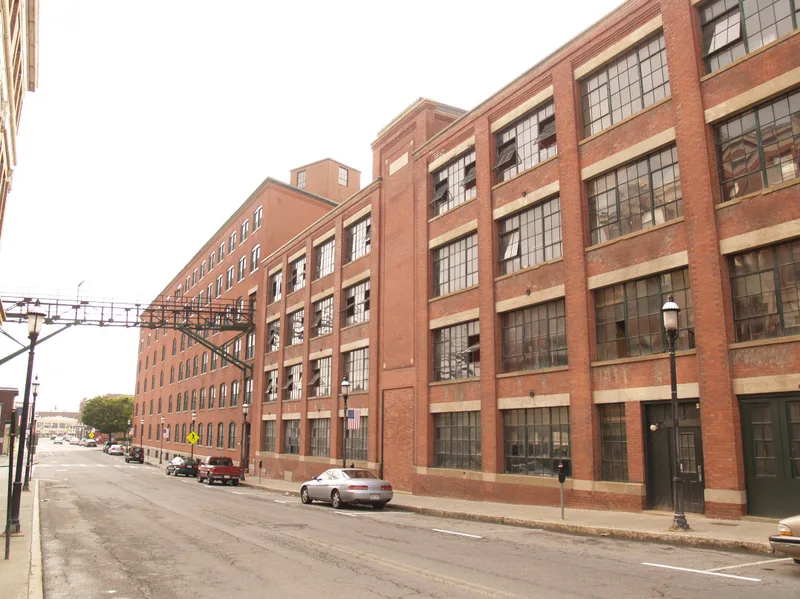
Along Central Street in Gardner, Massachusetts, a cluster of about 25 red brick factory buildings records more than 80 years of furniture manufacturing. The oldest, Building No. 5, dates from 1863 and is a gable-roofed mill; most others were built between 1880 and 1910 as multi-story brick mills, with concrete-trimmed additions in the 20th century. A formal 1907 office building, with granite trim and Doric columns at the entrance, is the most elaborate structure. The complex belonged to the Heywood family firm, which began making chairs in Gardner in the 1820s and grew into one of the largest furniture makers in the world. The company introduced factory methods, specialized machinery and new product lines, and employed thousands of workers in the 1920s. The Heywoods also took part in local railroads, banks, a library and a hospital. Consistent brick, color and detailing keep the complex visually unified, and little has been altered.
Significance in brief: The complex is argued to be significant as one of the oldest and largest furniture factories in the world and as an innovator in the American furniture industry. It also drove Gardner's economic growth, is tied to the civically prominent Heywood family, and is a largely intact late 19th to early 20th century factory complex.
Machine-generated summary. This summary was generated by a language model from the official nomination document and has not been reviewed line by line by an editor. It may contain errors. Check the source document before relying on any detail. Source: nomination document (PDF) · National Archives catalog entry. NRHP reference 83000610, listed September 15, 1983. Summary generated October 2026 (model claude-sonnet-5-5, prompt v1.0-2026-10-29, confidence high).
Key facts
| Address | 206 Central St., Gardner |
|---|---|
| County | Worcester County |
| Listed | September 15, 1983 |
| Reference number | 83000610 |
| Resource type | Building |
| Period of significance | 1900- (specific dates given as 1863, etc.) |
| Criteria |
|
| Areas of significance | Industry, Architecture, Social History |
| Level of significance | Local |
| Status (as stated in the nomination) | Described as in excellent condition and largely unaltered. The Gardner factory closed in 1978, and the complex was then occupied by various light manufacturing firms, with the company's main administrative offices remaining in Gardner. |
| Acreage | 12.5 |
| Coordinates | 42.57736, -71.99084 (NPS GIS) |
What listing means for this property
For an income-producing building, listing (individually or as a contributing building in a district) is the gateway to the 20% federal rehabilitation tax credit on qualified rehabilitation costs, often stackable with state credits. Work claiming the credit must follow the Secretary of the Interior's Standards and be approved in advance.
Listing does not restrict a private owner acting without federal money or permits; where federal funding or licensing is involved, Section 106 review applies.
General information, not legal or tax advice. Rules change; confirm with your State Historic Preservation Office or a qualified adviser.
Sources and further reading
- National Park Service, National Register of Historic Places database (snapshot May 2026), reference 83000610.
- Nomination form (PDF, National Archives) — catalog entry
- Wikipedia article (used for cross-checking only; text not reproduced here)
- Wikidata Q5749842
- This listing as JSON
Last updated October 2026. Found an error? See the editorial policy for how to report it.