Town Hill District

Why it's listed
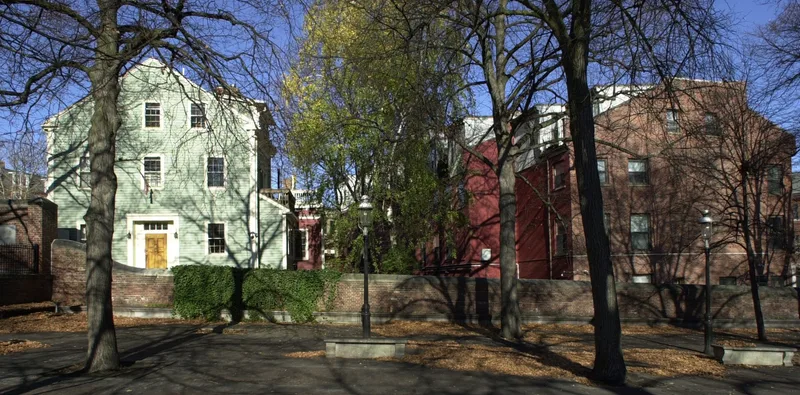
Town Hill in Charlestown, Boston, is a dense neighborhood of small-scale buildings from the late eighteenth and nineteenth centuries, laid out along streets that follow the sloping ground. The street plan goes back to a 1641 layout by engineer Thomas Graves. After the British burned Charlestown in 1775, rebuilding kept the original street pattern. Eleven surviving residences date from the late Georgian and Federal periods, which the nomination describes as the best-preserved cluster of its kind in Boston. Notable buildings include the brick Edward Everett House, the splitstone house at 92 Main Street, the Warren Tavern, the Benjamin Thompson House, and the wooden Larkin and Hurd mansions. St. John's Church, built in 1841 by Richard Bond, shows early Gothic Revival design. Brick row houses, Greek Revival rows and Italianate townhouses on Harvard Street add later nineteenth-century variety. The district covers roughly 11 acres and includes homes, shops, a church and a park.
Significance in brief: The nomination argues the district holds the best-preserved cluster of Pre-Federalist and Federalist buildings in Boston, including 11 late Georgian and Federal residences. Its street pattern traces to a 1641 plan and was respected when the town was rebuilt after the 1775 burning. It also has ties to figures such as Edward Everett and the Thompson family.
Machine-generated summary. This summary was generated by a language model from the official nomination document and has not been reviewed line by line by an editor. It may contain errors. Check the source document before relying on any detail. Source: nomination document (PDF) · National Archives catalog entry. NRHP reference 73000850, listed May 11, 1973. Summary generated October 2026 (model claude-sonnet-5-5, prompt v1.0-2026-10-29, confidence medium).
Key facts
| Address | Bounded roughly by Rutherford Ave. and Main and Warren Sts., Boston |
|---|---|
| County | Suffolk County |
| Listed | May 11, 1973 |
| Reference number | 73000850 |
| Resource type | District |
| Architect / builder | Richard Bond (St. John's Church, 1841); Matthew Bridge (Edward Everett House); Timothy Thompson, Sr. (119 Main Street); Nathaniel Austin (reputedly, 92 Main Street) |
| Architectural style | Late Georgian, Federal, Greek Revival, Gothic Revival and Italianate |
| Areas of significance | Community Planning and Development, Architecture |
| Level of significance | State |
| Status (as stated in the nomination) | Mixed condition ranging from excellent to deteriorated; some buildings are altered, with ground floors converted to commercial use. Uses include residential, commercial, educational, religious and park. |
| Acreage | 11 |
| Coordinates | 42.37331, -71.06319 (NPS GIS) |
What listing means for this property
This is a historic district. Buildings within its boundary are either contributing (they add to the district's significance) or non-contributing. Owners of contributing income-producing buildings can claim the 20% federal rehabilitation tax credit; homeowners should look at state credits. National Register districts impose no design review by themselves; a local historic district ordinance, if one exists, does (the difference explained).
General information, not legal or tax advice. Rules change; confirm with your State Historic Preservation Office or a qualified adviser.
Sources and further reading
- National Park Service, National Register of Historic Places database (snapshot May 2026), reference 73000850.
- Nomination form (PDF, National Archives) — catalog entry
- Wikipedia article (used for cross-checking only; text not reproduced here)
- Wikidata Q7829978
- This listing as JSON
Last updated October 2026. Found an error? See the editorial policy for how to report it.