Roughan Hall

Why it's listed
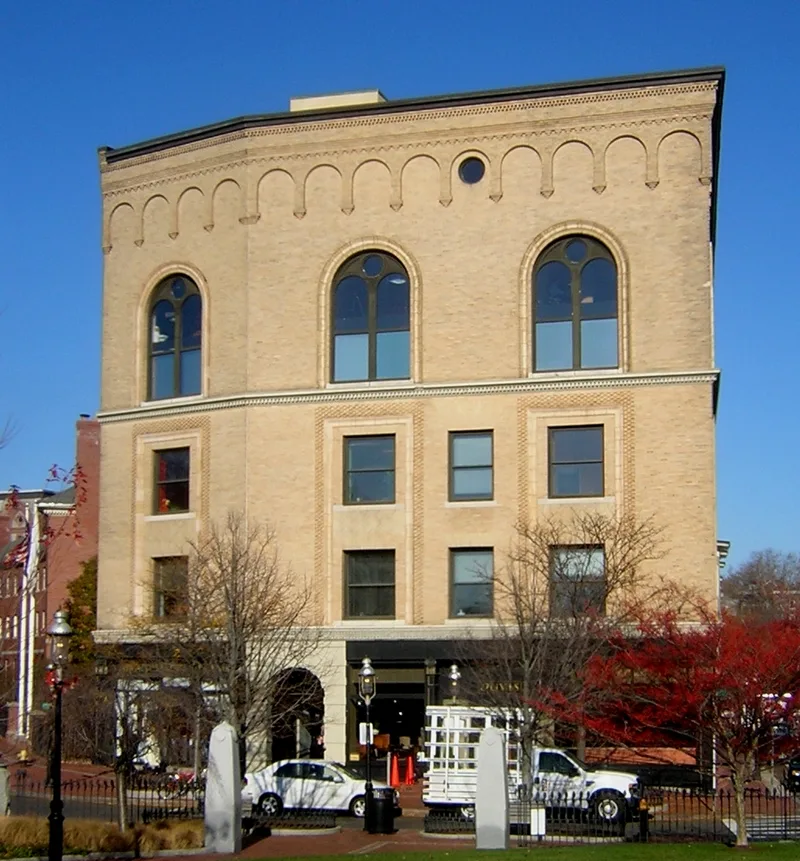
Roughan Hall is a four-story, flat-roofed masonry building in City Square, the gateway to Charlestown. Built in 1892 with an addition in 1896, it was designed by Boston municipal architect Arthur H. Vinal and constructed by Donovan and Brock for Charlestown businessman and philanthropist Michael Roughan. Its buff brick walls show Renaissance Revival and Romanesque Revival influences, with limestone string courses, terra cotta window surrounds and cast iron columns at the storefronts. The building originally held shops on the ground floor, a bowling and billiard basement, offices and clubrooms, a society hall for the Knights of Columbus, and a large fourth-floor hall spanning nearly 50 feet thanks to a Howe truss roof. The hall opened with a charity ball and later hosted social groups, light manufacturing, taverns, a cinema and roller skating. It is the only surviving 19th century building in City Square and one of few remaining 19th century halls in Boston, which supported its listing for architectural merit.
Significance in brief: The nomination argues it is an outstanding example of mixed-use building design (retail, commercial and private halls) in the Boston area and a fine example of late Italian Renaissance Revival vernacular commercial architecture. It is one of the few remaining 19th century halls in Boston and the only remaining 19th century building fronting City Square. It is nominated under criterion C.
Machine-generated summary. This summary was generated by a language model from the official nomination document and has not been reviewed line by line by an editor. It may contain errors. Check the source document before relying on any detail. Source: nomination document (PDF) · National Archives catalog entry. NRHP reference 82004448, listed April 15, 1982. Summary generated October 2026 (model claude-sonnet-5-5, prompt v1.0-2026-10-29, confidence high).
Key facts
| Address | 15-18 City Sq., Boston |
|---|---|
| County | Suffolk County |
| Listed | April 15, 1982 |
| Reference number | 82004448 |
| Resource type | Building |
| Period of significance | 1800-1899 |
| Architect / builder | Arthur H. Vinal, Architect; Donovan & Brock, Builders |
| Architectural style | Late Italian Renaissance Revival vernacular commercial architecture, with Renaissance Revival and Romanesque Revival influences |
| Criteria |
|
| Areas of significance | Commerce, Engineering, Architecture, Social History |
| Level of significance | Local |
| Status (as stated in the nomination) | Listed as unoccupied and vacant; condition is described as good, and the fourth-floor hall is in disrepair though some moldings, mirror frames and plasterwork survive. |
| Acreage | 1.4 |
| Coordinates | 42.37231, -71.06175 (NPS GIS) |
What listing means for this property
National Register listing is honorary for a privately owned home: it does not by itself restrict what an owner may do with their own money, and it does not require public access. Restrictions come from local landmark or historic-district ordinances, which are separate (how they differ).
Owner-occupied houses are not eligible for the 20% federal rehabilitation tax credit, which applies to income-producing buildings, but many states offer credits for homeowners. Listing also opens the door to preservation easements and to buying a plaque. Start with what listing means for homeowners, renovating a listed house and selling one.
Noted as vacant in the nomination. Nomination documents can be decades old; current status may differ. If you are considering buying an empty listed property, read the due-diligence checklist.
General information, not legal or tax advice. Rules change; confirm with your State Historic Preservation Office or a qualified adviser.
Sources and further reading
- National Park Service, National Register of Historic Places database (snapshot May 2026), reference 82004448.
- Nomination form (PDF, National Archives) — catalog entry
- Wikipedia article (used for cross-checking only; text not reproduced here)
- Wikidata Q7370894
- This listing as JSON
Last updated October 2026. Found an error? See the editorial policy for how to report it.