Saint Augustine Chapel and Cemetery

Why it's listed
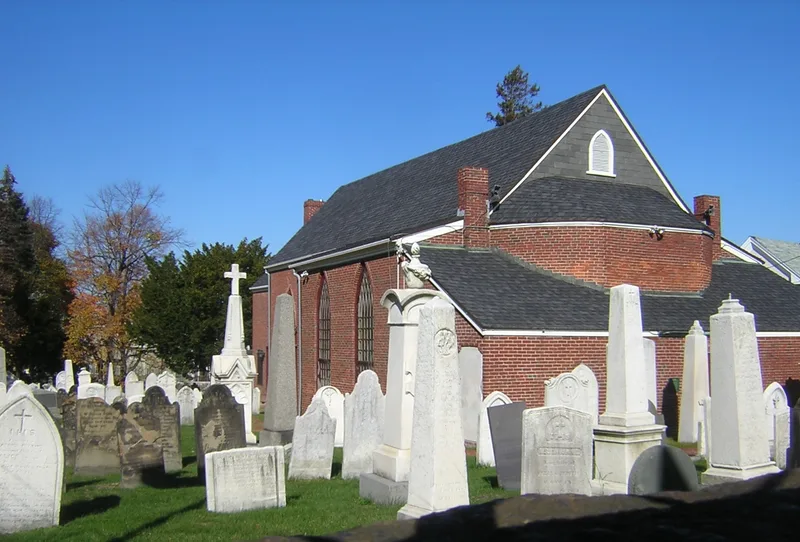
St. Augustine Chapel and Cemetery occupy a city block in South Boston. The cemetery was founded in 1818 by Bishop John Cheverus to bury Father Francis Matignon, his close colleague in organizing the Catholic Church in New England. The brick chapel, dedicated on July 4, 1819, was built as a mortuary chapel for Matignon and was enlarged in 1831 with a narthex, transept, apse and sacristies. Its tall lancet windows and plain brick walls mark it as an early, simple example of Gothic Revival, and it is described as the oldest surviving Catholic church in Massachusetts. The cemetery holds about 639 gravestones, mostly white marble, along with priests buried beneath the chapel floor. It was Boston's first Catholic burying ground, and many Irish immigrants who died in cholera epidemics and fever outbreaks of the 1830s to 1850s are buried there. The last burial took place in the mid-1880s. A puddingstone wall surrounds the site.
Significance in brief: The chapel is described as the oldest surviving Catholic church in Massachusetts, and the cemetery as the first Catholic burying ground in Boston. Both are tied to Bishop Cheverus and Father Matignon and to the founding of the Catholic Church in New England. The chapel is also an early, vernacular brick example of Gothic Revival, and the cemetery records the history of Boston's Irish Catholic community.
Machine-generated summary. This summary was generated by a language model from the official nomination document and has not been reviewed line by line by an editor. It may contain errors. Check the source document before relying on any detail. Source: nomination document (PDF) · National Archives catalog entry. NRHP reference 87001495, listed September 18, 1987. Summary generated October 2026 (model claude-sonnet-5-5, prompt v1.0-2026-10-29, confidence high).
Key facts
| Address | Dorchester St. between W. Sixth and Tudor Sts., Boston |
|---|---|
| County | Suffolk County |
| Listed | September 18, 1987 |
| Reference number | 87001495 |
| Resource type | District |
| Period of significance | 1818-ca. 1885 |
| Architect / builder | Unknown |
| Architectural style | Gothic Revival |
| Criteria |
|
| Areas of significance | Architecture, Religion, Social History |
| Level of significance | State, Local |
| Status (as stated in the nomination) | Chapel condition is described as fair to good, with rising dampness in interior brick walls and temporary reinforcement of the nave walls; it continues in religious use and the cemetery remains a cemetery. |
| Acreage | 0.9 |
| Coordinates | 42.33390, -71.04945 (NPS GIS) |
What listing means for this property
This is a historic district. Buildings within its boundary are either contributing (they add to the district's significance) or non-contributing. Owners of contributing income-producing buildings can claim the 20% federal rehabilitation tax credit; homeowners should look at state credits. National Register districts impose no design review by themselves; a local historic district ordinance, if one exists, does (the difference explained).
General information, not legal or tax advice. Rules change; confirm with your State Historic Preservation Office or a qualified adviser.
Sources and further reading
- National Park Service, National Register of Historic Places database (snapshot May 2026), reference 87001495.
- Nomination form (PDF, National Archives) — catalog entry
- Wikipedia article (used for cross-checking only; text not reproduced here)
- Wikidata Q7400996
- This listing as JSON
Last updated October 2026. Found an error? See the editorial policy for how to report it.