Loring, Harrison, House

Why it's listed
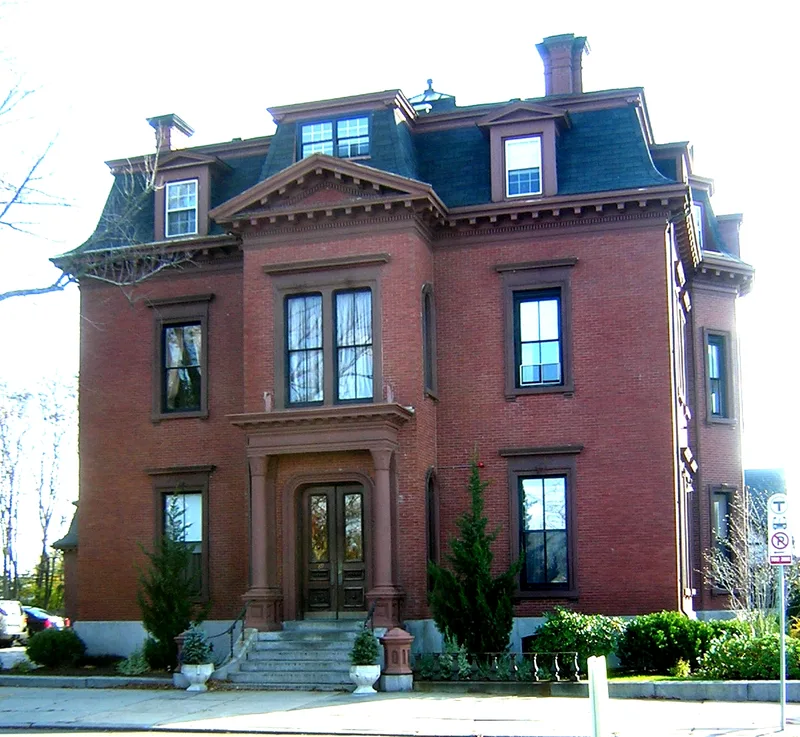
Built in 1865 on East Broadway in South Boston, this three-story brick mansion faces Independence Square and was the home of Harrison Loring, who ran one of the first South Boston shipyards building iron steamships and their engines. The house shows the French Second Empire style through its bell-cast mansard roof, central projecting pavilion, brownstone-framed windows, classical moldings and symmetrical arrangement of bays. A matching two-story carriage house with a cupola was built the same year. The architect is unknown, but the interior may reflect naval construction methods, including dovetail joinery, wall air circulation and cabinets with counterswinging doors, suggesting shipyard carpenters built it. Detached brick Victorian mansions are uncommon in Boston, and South Boston holds the city's most notable group of them. The house was designated a Boston Landmark in 1981. It later served as a convent and chapel under the Catholic Church, then returned to private residential use. It is the only surviving property tied to Loring.
Significance in brief: The nomination argues the house is a fine example of a 19th century French Second Empire mansion, with a mansard roof, central projecting pavilion, classical moldings and symmetrical bays. It is also tied to Harrison Loring, an early South Boston builder of iron steamships, and it contributes to the character of the Independence Square neighborhood. The detached brick Victorian mansion is rare in Boston's dense neighborhoods, and South Boston has the city's most notable concentration of them.
Machine-generated summary. This summary was generated by a language model from the official nomination document and has not been reviewed line by line by an editor. It may contain errors. Check the source document before relying on any detail. Source: nomination document (PDF) · National Archives catalog entry. NRHP reference 83000604, listed September 1, 1983. Summary generated October 2026 (model claude-sonnet-5-5, prompt v1.0-2026-10-29, confidence high).
Key facts
| Address | 789 E. Broadway St., Boston |
|---|---|
| County | Suffolk County |
| Listed | September 1, 1983 |
| Reference number | 83000604 |
| Resource type | Building |
| Period of significance | 1800-1899 |
| Architect / builder | Unknown; believed to have been built by skilled shipyard carpenters |
| Architectural style | French Second Empire |
| Criteria |
|
| Areas of significance | Industry, Architecture |
| Level of significance | Local |
| Status (as stated in the nomination) | Occupied as a private residence; condition listed as excellent and altered. Formerly used as a convent with the carriage house as a chapel. |
| Acreage | 0.3 |
| Coordinates | 42.33545, -71.03299 (NPS GIS) |
What listing means for this property
National Register listing is honorary for a privately owned home: it does not by itself restrict what an owner may do with their own money, and it does not require public access. Restrictions come from local landmark or historic-district ordinances, which are separate (how they differ).
Owner-occupied houses are not eligible for the 20% federal rehabilitation tax credit, which applies to income-producing buildings, but many states offer credits for homeowners. Listing also opens the door to preservation easements and to buying a plaque. Start with what listing means for homeowners, renovating a listed house and selling one.
General information, not legal or tax advice. Rules change; confirm with your State Historic Preservation Office or a qualified adviser.
Sources and further reading
- National Park Service, National Register of Historic Places database (snapshot May 2026), reference 83000604.
- Nomination form (PDF, National Archives) — catalog entry
- Wikipedia article (used for cross-checking only; text not reproduced here)
- Wikidata Q5665736
- This listing as JSON
Last updated October 2026. Found an error? See the editorial policy for how to report it.