Faneuil Hall

Why it's listed
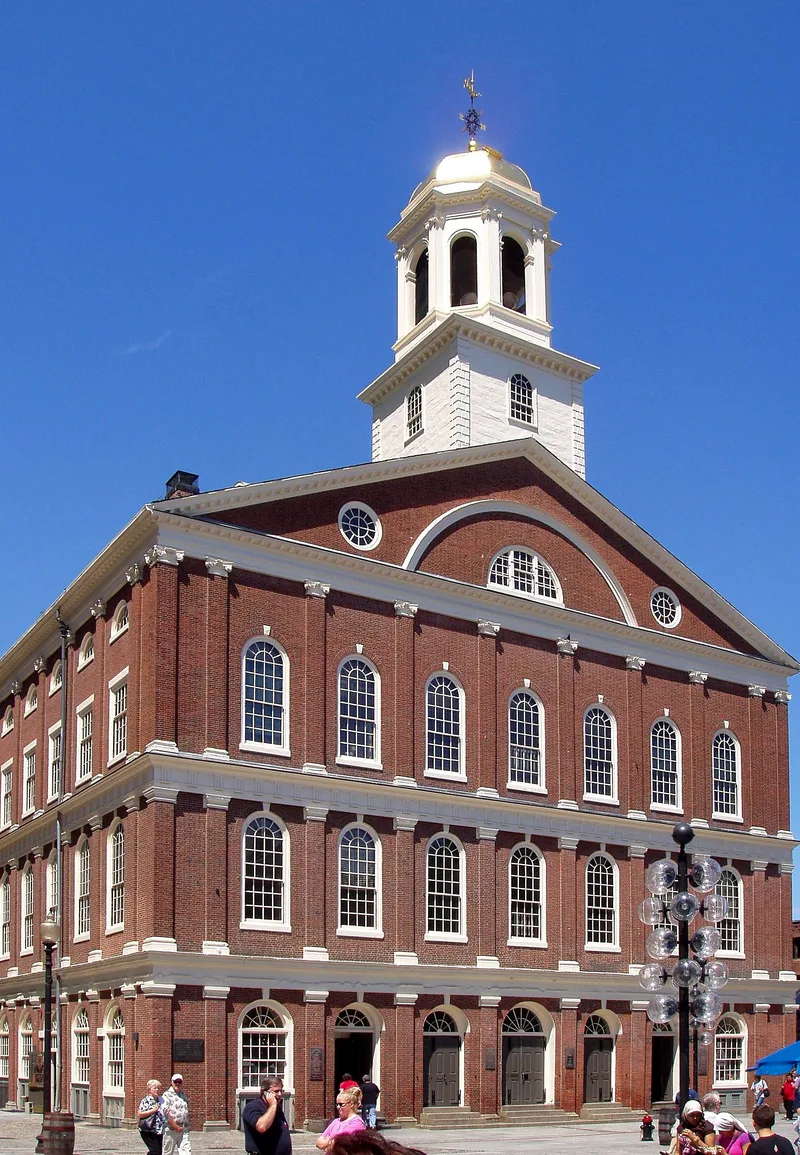
Faneuil Hall, at Dock Square in Boston, was offered to the town by merchant Peter Faneuil in 1740 as a market house with a public hall above. Completed in August 1742 to designs by John Smibert, it was a two-story Georgian brick building with Doric pilasters and a grasshopper weathervane on its cupola. A fire in January 1761 left only the walls standing, and it reopened in 1763. In 1805-06 Charles Bulfinch tripled its size by widening it and adding a third story. The city reconstructed it in 1898-99 using iron, steel and stone in place of combustible materials. The hall is known as the Cradle of Liberty. Colonial leaders met there to oppose the Stamp Act and later British measures, and 19th-century abolitionists spoke there. Today shops occupy the ground floor, the great hall serves mainly as a museum, and the attic houses the Ancient and Honorable Artillery Company armory.
Significance in brief: The hall was a focal point for colonial protest against British Parliament before the Revolutionary War, hosting leaders such as Samuel Adams, James Otis and John Hancock. In the 19th century it was a major forum for abolitionists including William Lloyd Garrison and Wendell Phillips. It is also significant for its Georgian architecture and Bulfinch's enlargement.
Machine-generated summary. This summary was generated by a language model from the official nomination document and has not been reviewed line by line by an editor. It may contain errors. Check the source document before relying on any detail. Source: nomination document (PDF) · National Archives catalog entry. NRHP reference 66000368, listed October 15, 1966. Summary generated October 2026 (model claude-sonnet-5-5, prompt v1.0-2026-10-29, confidence medium).
Key facts
| Address | Dock Sq., Boston |
|---|---|
| County | Suffolk County |
| Listed | October 15, 1966 |
| Reference number | 66000368 |
| Resource type | Building |
| Architect / builder | John Smibert, Charles Bulfinch |
| Architectural style | Georgian (Early Georgian) |
| Areas of significance | Politics/Government, Architecture, Social History |
| Level of significance | National |
| National Historic Landmark | Yes, designated October 9, 1960 |
| Status (as stated in the nomination) | Owned by the City of Boston and in use: shops on the ground floor and basement, a museum in the great hall, and the Ancient and Honorable Artillery Company armory in the attic. |
| Acreage | 0.9 |
| Within district | Boston National Historical Park |
| Coordinates | 42.36005, -71.05624 (NPS GIS) |
What listing means for this property
National Register listing is honorary for a privately owned home: it does not by itself restrict what an owner may do with their own money, and it does not require public access. Restrictions come from local landmark or historic-district ordinances, which are separate (how they differ).
Owner-occupied houses are not eligible for the 20% federal rehabilitation tax credit, which applies to income-producing buildings, but many states offer credits for homeowners. Listing also opens the door to preservation easements and to buying a plaque. Start with what listing means for homeowners, renovating a listed house and selling one.
General information, not legal or tax advice. Rules change; confirm with your State Historic Preservation Office or a qualified adviser.
Sources and further reading
- National Park Service, National Register of Historic Places database (snapshot May 2026), reference 66000368.
- Nomination form (PDF, National Archives) — catalog entry
- Wikipedia article (used for cross-checking only; text not reproduced here)
- Wikidata Q49137
- This listing as JSON
Last updated October 2026. Found an error? See the editorial policy for how to report it.