Ether Dome, Massachusetts General Hospital

Why it's listed
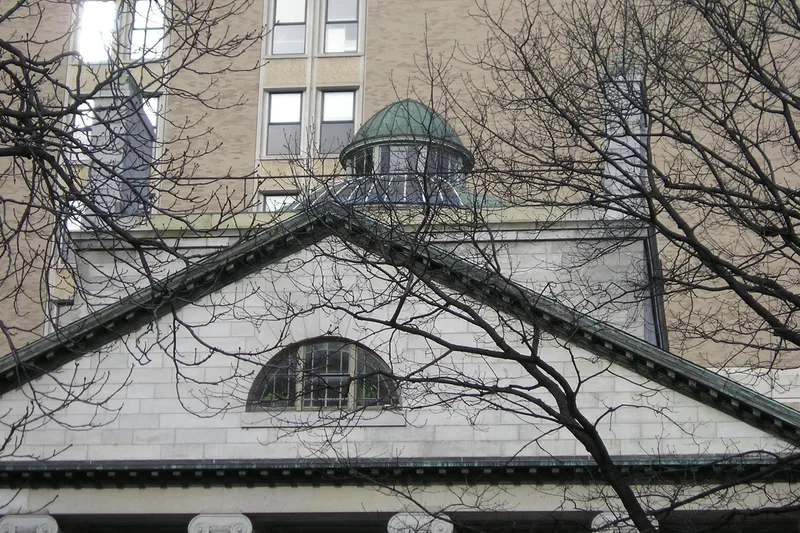
Atop the central section of Massachusetts General Hospital's original Boston building sits a square attic story capped by a skylighted saucer dome. Inside is the Ether Dome, a tiered clinical amphitheatre. Charles Bulfinch designed the granite Greek Revival hospital, built in 1818-23 under Alexander Parris, and George Perkins directed interior revisions in 1844-46 that gave the room its present look. On October 16, 1846, Dr. John Collins Warren removed a tumor from patient Gilbert Abbott's neck while Dr. William T. G. Morton administered ether. It was the first successful public use of ether as a surgical anesthetic, and Warren declared, "Gentlemen, this is no humbug." The room served as the hospital's operating theatre until 1867 and has since hosted lectures, meetings and classes. It was restored in 1930 and 1965, with only modest changes to the dome, lighting and seat railings. The room is open to visitors when hospital staff are not using it.
Significance in brief: The room is where ether was first used successfully in public to anesthetize a surgical patient, on October 16, 1846. Dr. John Collins Warren operated and Dr. William T. G. Morton administered the ether. The demonstration is credited with proving the value of ether in surgery. The room has kept its essential character since the 1844-46 interior revisions.
Machine-generated summary. This summary was generated by a language model from the official nomination document and has not been reviewed line by line by an editor. It may contain errors. Check the source document before relying on any detail. Source: nomination document (PDF) · National Archives catalog entry. NRHP reference 66000366, listed October 15, 1966. Summary generated October 2026 (model claude-sonnet-5-5, prompt v1.0-2026-10-29, confidence medium).
Key facts
| Address | Fruit St., Boston |
|---|---|
| County | Suffolk County |
| Listed | October 15, 1966 |
| Reference number | 66000366 |
| Resource type | Building |
| Period of significance | 1800-1899 |
| Architect / builder | Charles Bulfinch; George Perkins |
| Architectural style | Greek Revival |
| Areas of significance | Science |
| Level of significance | National |
| National Historic Landmark | Yes, designated January 12, 1965 |
| Status (as stated in the nomination) | In good condition and occupied; restored in 1930 and 1965, used for lectures, meetings and classes, and open to the public when not in use by hospital staff. |
| Acreage | 0.9 |
| Coordinates | 42.36349, -71.06791 (NPS GIS) |
What listing means for this property
For a publicly owned building or structure, listing mainly matters when federal funds, permits or licences are involved: projects then go through Section 106 review so effects on the property are considered. Listing also strengthens applications for preservation grants and, for leased income-producing uses, can enable the federal rehabilitation tax credit.
General information, not legal or tax advice. Rules change; confirm with your State Historic Preservation Office or a qualified adviser.
Sources and further reading
- National Park Service, National Register of Historic Places database (snapshot May 2026), reference 66000366.
- Nomination form (PDF, National Archives) — catalog entry
- Wikipedia article (used for cross-checking only; text not reproduced here)
- Wikidata Q257073
- This listing as JSON
Last updated October 2026. Found an error? See the editorial policy for how to report it.