Codman Square District
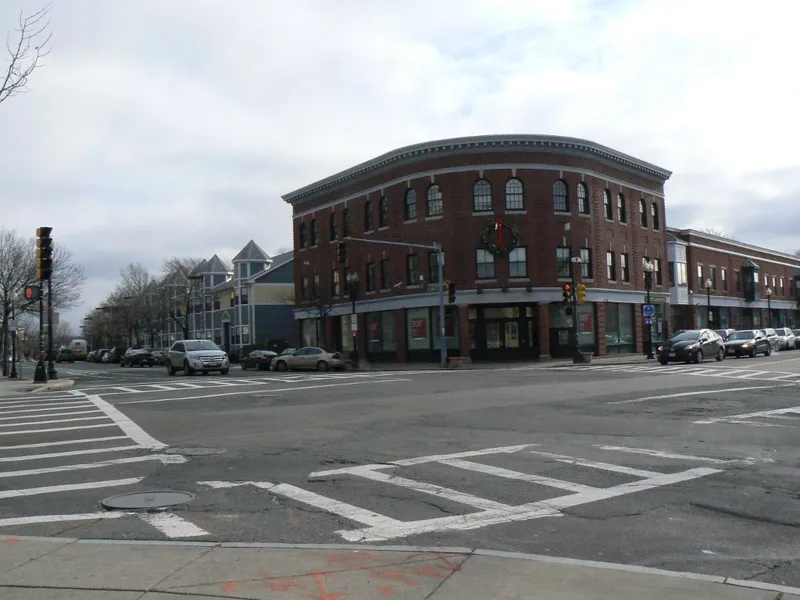

Why it's listed
Codman Square is a major crossroads in Dorchester, Boston, where Washington Street meets Norfolk, Talbot and Centre Streets. The listed district covers about four acres and four buildings that mark the area's change from a rural Puritan community to a middle-class streetcar suburb. The oldest is the Second Church of Dorchester, a Federal-style meeting house built in 1806 by Oliver Warren, with a bell cast by Paul Revere & Sons in 1816. The others are the Renaissance Revival Dorchester High School of 1900, designed by Hartwell, Richardson & Driver, the Georgian Revival Lithgow Building of 1899 by Joseph T. Greene, and the Georgian Revival branch library of 1904. The district was listed for its role in the area's community development and for the architectural quality of these buildings. One single-story commercial building from 1913 is the only intrusion. The Lithgow Building shows signs of neglect, though the group remains largely intact.
Significance in brief: The district shows how Codman Square grew from a rural religious center into a commercial and civic hub and streetcar suburb. The four buildings are cited as strong examples of architectural styles from Federal to Classical Revival. Together they reflect the long prosperous period the square enjoyed.
Machine-generated summary. This summary was generated by a language model from the official nomination document and has not been reviewed line by line by an editor. It may contain errors. Check the source document before relying on any detail. Source: nomination document (PDF) · National Archives catalog entry. NRHP reference 83000602, listed June 23, 1983. Summary generated October 2026 (model claude-sonnet-5-5, prompt v1.0-2026-10-29, confidence medium).
Key facts
| Address | Norfolk, Talbot, Epping, Lithgow, Centre, and Moultrie Sts., Boston |
|---|---|
| County | Suffolk County |
| Listed | June 23, 1983 |
| Reference number | 83000602 |
| Resource type | District |
| Architect / builder | Church: Oliver Warren; Lithgow Building: Joseph T. Greene; Library: Charles Bateman (as given, 'Chales Bateman'); School: Hartwell, Richardson & Driver |
| Architectural style | Federal to Classical Revival, including Federal (church), Renaissance Revival (school), Georgian Revival (Lithgow Building and library) |
| Criteria |
|
| Areas of significance | Commerce, Education, Architecture, Religion, Social History |
| Level of significance | Local |
| Status (as stated in the nomination) | The Lithgow Building shows neglect and under-utilization, with boarded windows and doors. The form says the four buildings survive in remarkably intact order amid neighborhood decline. The church remains in use for worship. |
| Acreage | 4 |
| Coordinates | 42.29048, -71.07021 (NPS GIS) |
What listing means for this property
This is a historic district. Buildings within its boundary are either contributing (they add to the district's significance) or non-contributing. Owners of contributing income-producing buildings can claim the 20% federal rehabilitation tax credit; homeowners should look at state credits. National Register districts impose no design review by themselves; a local historic district ordinance, if one exists, does (the difference explained).
General information, not legal or tax advice. Rules change; confirm with your State Historic Preservation Office or a qualified adviser.
Sources and further reading
- National Park Service, National Register of Historic Places database (snapshot May 2026), reference 83000602.
- Nomination form (PDF, National Archives) — catalog entry
- Wikipedia article (used for cross-checking only; text not reproduced here)
- Wikidata Q5140312
- This listing as JSON
Last updated October 2026. Found an error? See the editorial policy for how to report it.