Boston Athenaeum

Why it's listed
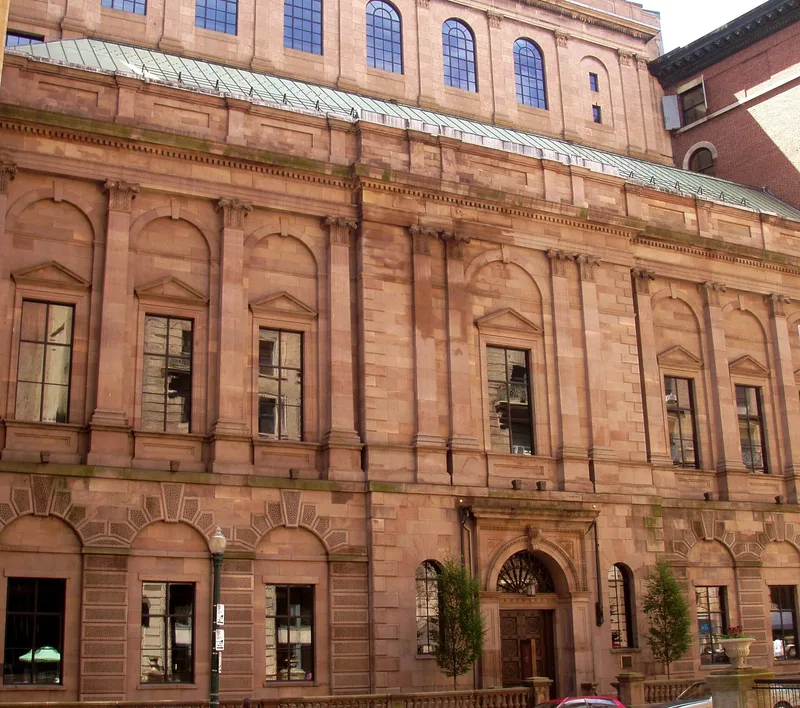
Located on the south side of Beacon Street in Boston, this brown freestone library houses the Boston Athenaeum, a private institution founded in 1807. Edward Clark Cabot won a design competition for the building, which was constructed from 1847 to 1849. Its facade, modeled on a Palladian palace, looks two stories tall though the interior has three floors. A grand staircase named for Senator Charles Sumner was removed in 1888 to make room for the growing collections. In 1913-14 a Renaissance Revival addition by Henry Bigelow and Philip Wadsworth was set back from the original roofline. The Athenaeum is regarded as the largest and most influential early proprietary library still existing in the United States. It began as a reading room and library, served as the city's first art gallery, and holds more than 600,000 items, including parts of the libraries of George Washington and John Quincy Adams. It also holds many Confederate imprints.
Significance in brief: The nomination calls the Athenaeum the largest and most influential of the early proprietary libraries still existing in the United States. Founded in 1807 by private individuals, before the rise of free public libraries, it remains a leading cultural institution and research center. Its collections include large parts of the libraries of George Washington and John Quincy Adams and many Confederate imprints.
Machine-generated summary. This summary was generated by a language model from the official nomination document and has not been reviewed line by line by an editor. It may contain errors. Check the source document before relying on any detail. Source: nomination document (PDF) · National Archives catalog entry. NRHP reference 66000132, listed October 15, 1966. Summary generated October 2026 (model claude-sonnet-5-5, prompt v1.0-2026-10-29, confidence medium).
Key facts
| Address | 10 1/2 Beacon St., Boston |
|---|---|
| County | Suffolk County |
| Listed | October 15, 1966 |
| Reference number | 66000132 |
| Resource type | Building |
| Architect / builder | Edward Clark Cabot (1847); Henry Bigelow and Philip Wadsworth (1913-14) |
| Architectural style | Palladian palace-style facade (original); Renaissance Revival (1913-14 addition) |
| Areas of significance | Education |
| Level of significance | National |
| National Historic Landmark | Yes, designated December 21, 1965 |
| Status (as stated in the nomination) | Described as in good structural condition, regularly maintained, occupied and in use as a library; no major alterations since 1913-14. |
| Acreage | 0.9 |
| Coordinates | 42.35793, -71.06204 (NPS GIS) |
What listing means for this property
National Register listing is honorary: it recognises significance and does not restrict what a private owner may do without federal money or permits. It unlocks the 20% federal rehabilitation tax credit for income-producing buildings, state credits in many states, and Section 106 review when federal agencies are involved. See what listing means in practice.
General information, not legal or tax advice. Rules change; confirm with your State Historic Preservation Office or a qualified adviser.
Sources and further reading
- National Park Service, National Register of Historic Places database (snapshot May 2026), reference 66000132.
- Nomination form (PDF, National Archives) — catalog entry
- Wikipedia article (used for cross-checking only; text not reproduced here)
- Wikidata Q478013
- This listing as JSON
Last updated October 2026. Found an error? See the editorial policy for how to report it.