Murphy, William, House

Why it's listed
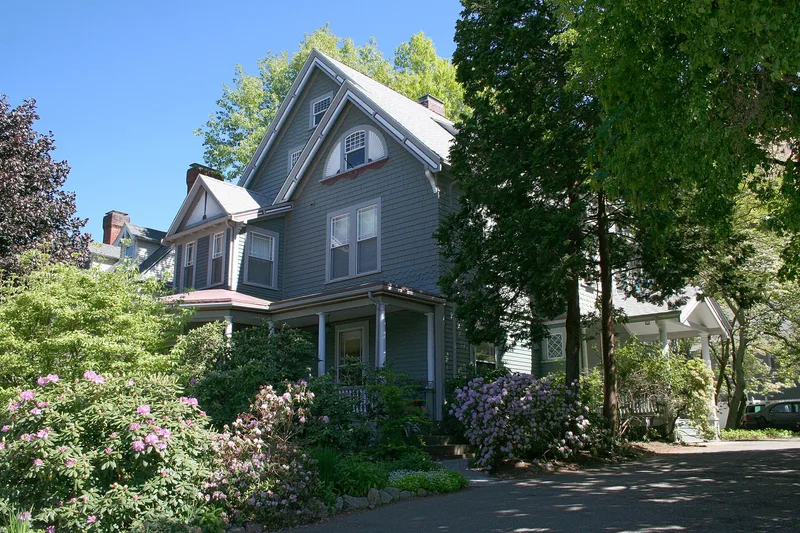
This Queen Anne house at 97 Sewall Avenue in Brookline was built in 1886, according to the tax list, for Waldo Stearns, treasurer of the A.T. Stearns Lumber Company. It has a shingled exterior with varied shingle patterns, elaborate window treatment in the gables, and a spacious front piazza with a rounded bay. Its three front gables are finely scaled and balanced, and its porch columns and gable decorations are more delicate than those of the comparable house at 109 Sewall Avenue. The generous lot, shared with only a few neighboring houses, gives it a rural appearance. In 1930 the house was bought by Dr. William Parry Murphy, who with Dr. George Minot received the 1934 Nobel Prize in Medicine for discovering a cure for pernicious anemia. The property is recognized both for its association with Murphy and as a well-preserved example of Queen Anne architecture. A shingled barn survives on the grounds, and no alteration permits are on file.
Significance in brief: The house is significant under criterion B as the home of Dr. William Parry Murphy, who shared the 1934 Nobel Prize in Medicine for a cure for pernicious anemia. It is also significant under criterion C as a well-preserved Queen Anne house with a finely balanced grouping of three front gables and delicate porch and gable details.
Machine-generated summary. This summary was generated by a language model from the official nomination document and has not been reviewed line by line by an editor. It may contain errors. Check the source document before relying on any detail. Source: nomination document (PDF) · National Archives catalog entry. NRHP reference 85003303, listed October 17, 1985. Summary generated October 2026 (model claude-sonnet-5-5, prompt v1.0-2026-10-29, confidence high).
Key facts
| Address | 97 Sewall Ave., Brookline |
|---|---|
| County | Norfolk County |
| Listed | October 17, 1985 |
| Reference number | 85003303 |
| Resource type | Building |
| Architectural style | Queen Anne |
| Criteria |
|
| Areas of significance | Science, Architecture |
| Level of significance | National, State, Local |
| Status (as stated in the nomination) | Present use is residential; no alteration permits are on file. |
| Acreage | 0.9 |
| Coordinates | 42.34177, -71.11671 (NPS GIS) |
What listing means for this property
National Register listing is honorary for a privately owned home: it does not by itself restrict what an owner may do with their own money, and it does not require public access. Restrictions come from local landmark or historic-district ordinances, which are separate (how they differ).
Owner-occupied houses are not eligible for the 20% federal rehabilitation tax credit, which applies to income-producing buildings, but many states offer credits for homeowners. Listing also opens the door to preservation easements and to buying a plaque. Start with what listing means for homeowners, renovating a listed house and selling one.
General information, not legal or tax advice. Rules change; confirm with your State Historic Preservation Office or a qualified adviser.
Sources and further reading
- National Park Service, National Register of Historic Places database (snapshot May 2026), reference 85003303.
- Nomination form (PDF, National Archives) — catalog entry
- Wikipedia article (used for cross-checking only; text not reproduced here)
- Wikidata Q14716042
- This listing as JSON
Last updated October 2026. Found an error? See the editorial policy for how to report it.