Longwood Historic District

Why it's listed
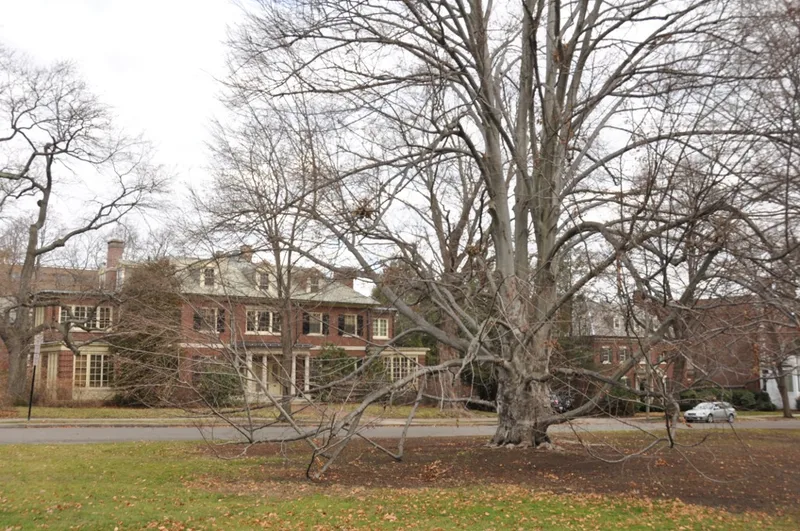
Longwood is a 52-acre residential district in eastern Brookline, a short distance from downtown Boston. Its regular street grid, mature trees and Longwood Square, with its European beech grove, reflect planned suburban development that began around 1850. Financier David Sears and businessman Amos A. Lawrence developed much of the land after the Brookline Branch Railroad arrived. The streets hold a varied collection of mid-to-late 19th century houses in Mansard, Queen Anne, Shingle and Georgian Revival styles, along with Gothic Revival brick townhouses on Monmouth Court designed by George Putnam in 1876. Christ's Church, built in 1860 of Roxbury pudding stone, and the Church of Our Saviour, built in 1867 with Tiffany chancel windows, anchor the district's religious history. Longwood Towers, a Gothic Revival apartment complex from 1923, adds a larger-scale element. The district was listed for its architectural variety and its ties to Sears, Lawrence and other prominent Bostonians who lived there.
Significance in brief: The district is argued to be significant both architecturally and historically. It grew into one of the most fashionable neighborhoods in metropolitan Boston after 1850 under the development of David Sears and Amos A. Lawrence. It holds a wide range of mid-to-late 19th century domestic architecture, townhouses, churches and Longwood Towers, and was home to several notable Boston figures.
Machine-generated summary. This summary was generated by a language model from the official nomination document and has not been reviewed line by line by an editor. It may contain errors. Check the source document before relying on any detail. Source: nomination document (PDF) · National Archives catalog entry. NRHP reference 78000460, listed September 13, 1978. Summary generated October 2026 (model claude-sonnet-5-5, prompt v1.0-2026-10-29, confidence medium).
Key facts
| Address | Roughly bounded by Chapel, St. Marys, Monmouth, and Kent Sts., Brookline |
|---|---|
| County | Norfolk County |
| Listed | September 13, 1978 |
| Reference number | 78000460 |
| Resource type | District |
| Period of significance | 1800-1899 |
| Architect / builder | George Putnam (Gothic Revival townhouses, 1876); Alexander Estey (Church of Our Saviour); Hartwell, Richardson and Driver (1905 Georgian Revival house); Kenneth M. DeVos (Longwood Towers); Peabody and Stearns (Boit House); Samuel Glaser; others listed in the inventory |
| Architectural style | Mansard, Queen Anne, Shingle Style, Georgian Revival, Gothic Revival and Romanesque Revival |
| Areas of significance | Community Planning and Development, Landscape Architecture, Architecture, Religion, Social History |
| Level of significance | Local |
| Status (as stated in the nomination) | Largely residential and well maintained, with a few educational facilities, two churches, apartment buildings and one restaurant; a small number of modern intrusions. |
| Acreage | 52 |
| Coordinates | 42.34202, -71.11181 (NPS GIS) |
What listing means for this property
This is a historic district. Buildings within its boundary are either contributing (they add to the district's significance) or non-contributing. Owners of contributing income-producing buildings can claim the 20% federal rehabilitation tax credit; homeowners should look at state credits. National Register districts impose no design review by themselves; a local historic district ordinance, if one exists, does (the difference explained).
General information, not legal or tax advice. Rules change; confirm with your State Historic Preservation Office or a qualified adviser.
Sources and further reading
- National Park Service, National Register of Historic Places database (snapshot May 2026), reference 78000460.
- Nomination form (PDF, National Archives) — catalog entry
- Wikipedia article (used for cross-checking only; text not reproduced here)
- Wikidata Q6674525
- This listing as JSON
Last updated October 2026. Found an error? See the editorial policy for how to report it.