Beacon Street Historic District

Why it's listed
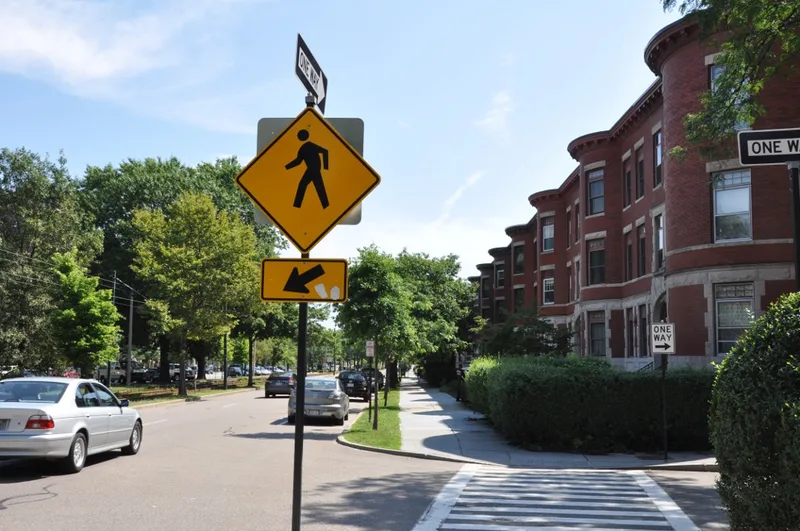
Brookline's section of Beacon Street is a boulevard of a little over two miles that crosses the northern part of the town. It began as a county way built in 1850-51. In the 1880s Henry Whitney assembled land and financing, and Frederick Law and John Charles Olmsted planned its widening to 160 feet with a streetcar line down the center. The street became a symbol of Brookline's shift from farmland to streetcar suburb and set off development in nearby neighborhoods. Commercial centers at Lower Beacon, Washington Square and Coolidge Corner alternate with residential blocks. Typical buildings are red brick attached houses and apartment blocks from the 1890s to about 1910, with Chateauesque townhouse rows and courtyard apartments such as Richmond Court and the Stoneholm. Churches and a synagogue add institutional variety. Deed restrictions requiring brick and stone gave many buildings a Back Bay character. Later high-rise infill and altered facades have affected parts of the street.
Significance in brief: The district reflects North Brookline's change from an agricultural community into a streetcar suburb. It follows the route of the first electric streetcar in the country and embodies the boulevard concept designed by Frederick Law and John Charles Olmsted and promoted by Henry Whitney. It also contains fine townhouses, commercial blocks and apartment buildings by established architects.
Machine-generated summary. This summary was generated by a language model from the official nomination document and has not been reviewed line by line by an editor. It may contain errors. Check the source document before relying on any detail. Source: nomination document (PDF) · National Archives catalog entry. NRHP reference 85003322, listed October 17, 1985. Summary generated October 2026 (model claude-sonnet-5-5, prompt v1.0-2026-10-29, confidence medium).
Key facts
| Address | Roughly on Beacon St. from Saint Mary's to Ayr Rd., Brookline |
|---|---|
| County | Norfolk County |
| Listed | October 17, 1985 |
| Reference number | 85003322 |
| Resource type | District |
| Period of significance | 1890-1980 |
| Architect / builder | Frederick Law and John Charles Olmsted (boulevard plan); architects include Winslow and Wetherell, Ralph Adams Cram, Clarence Blackall, Samuel D. Kelley, Arthur Bowditch, Shepley, Rutan and Coolidge, and Fehmer and Page |
| Architectural style | Mixed: Chateauesque, Beaux-Arts Baroque, Tudor, Neo-Classical, Art Deco, Georgian Revival, Second Renaissance Revival and Byzantine |
| Criteria |
|
| Areas of significance | Community Planning and Development, Architecture |
| Level of significance | National, State, Local |
| Status (as stated in the nomination) | Still a mixed commercial and residential boulevard with a streetcar line down its center. Some mansions have been replaced by apartments and condominiums, and some buildings have been altered or built in incompatible styles. |
| Acreage | 130 |
| Within district | Cypress-Emerson Historic District |
| Coordinates | 42.34135, -71.12436 (NPS GIS) |
What listing means for this property
This is a historic district. Buildings within its boundary are either contributing (they add to the district's significance) or non-contributing. Owners of contributing income-producing buildings can claim the 20% federal rehabilitation tax credit; homeowners should look at state credits. National Register districts impose no design review by themselves; a local historic district ordinance, if one exists, does (the difference explained).
General information, not legal or tax advice. Rules change; confirm with your State Historic Preservation Office or a qualified adviser.
Sources and further reading
- National Park Service, National Register of Historic Places database (snapshot May 2026), reference 85003322.
- Nomination form (PDF, National Archives) — catalog entry
- Wikipedia article (used for cross-checking only; text not reproduced here)
- Wikidata Q4875986
- This listing as JSON
Last updated October 2026. Found an error? See the editorial policy for how to report it.