Cypress-Emerson Historic District

Why it's listed
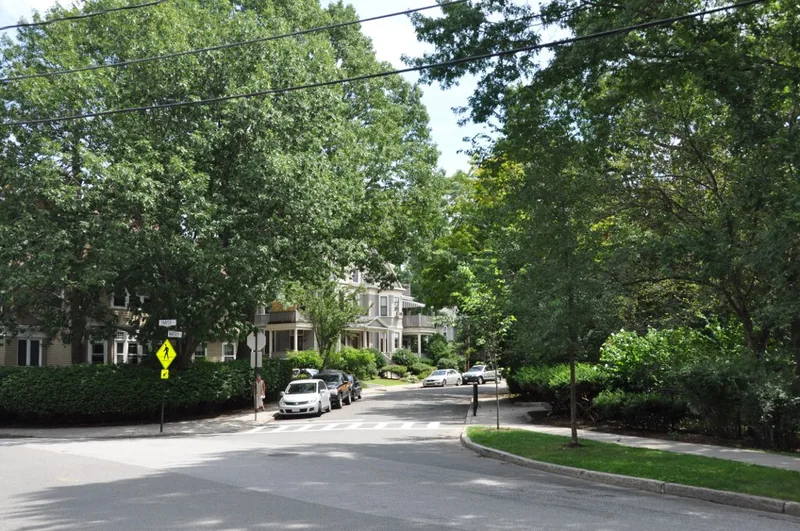
This Brookline neighborhood of Cypress, Emerson and Waverly Streets grew up largely between 1872 and 1895 on land once held by farming families and by the merchant Elijah Emerson, whose estate is now remembered in Emerson Garden. Cypress Street itself was laid out in 1719 as a town road. The oldest house is a Greek Revival dwelling at 58-60 Waverly Street, built in 1827. Most other buildings are one- to multi-family Victorian houses in Second Empire and Queen Anne styles, with decorative shingles, bay windows, porches and pedimented dormers. Builder Daniel Russell put up seven houses on Cypress Street between 1880 and 1886, giving that street a notable uniformity. Architects such as F. Manton Wakefield, Charles Rutan and Arthur Bowditch designed other homes. The area was listed because its growth mirrors Brookline's expansion after the Civil War alongside the village commercial center, and because its houses illustrate mid to late Victorian domestic architecture. Most buildings survive intact.
Significance in brief: The nomination argues the district reflects the growth of Brookline, especially after the Civil War, as a residential neighborhood tied to the village commercial area, civic center and public transportation. Its houses are fine examples of mid to late Victorian domestic architecture, particularly late Mansard (Second Empire) and Queen Anne styles.
Machine-generated summary. This summary was generated by a language model from the official nomination document and has not been reviewed line by line by an editor. It may contain errors. Check the source document before relying on any detail. Source: nomination document (PDF) · National Archives catalog entry. NRHP reference 85003257, listed October 17, 1985. Summary generated October 2026 (model claude-sonnet-5-5, prompt v1.0-2026-10-29, confidence high).
Key facts
| Address | Roughly bounded by Waverly, Emerson, and Cypress Sts., Brookline |
|---|---|
| County | Norfolk County |
| Listed | October 17, 1985 |
| Reference number | 85003257 |
| Resource type | District |
| Period of significance | 1872-1895 |
| Architect / builder | Architects named include Arthur Bowditch, F. Manton Wakefield, Charles Rutan, Olin Cutter, Rand and Taylor and Alexis French; Daniel W. Russell built seven houses on Cypress Street; Elijah Emerson built several houses on his land; many architects are unknown. |
| Architectural style | Mid to late Victorian, including Greek Revival, Mansardic (Second French Empire), Stick Style influence, Queen Anne and Colonial Revival |
| Criteria |
|
| Areas of significance | Community Planning and Development, Architecture |
| Level of significance | National, State, Local |
| Status (as stated in the nomination) | Most houses have remained intact, and considerable renovation and rehabilitation work is in evidence; the inventory lists most properties as contributing and a few as non-contributing. |
| Coordinates | 42.34264, -71.12421 (NPS GIS) |
What listing means for this property
This is a historic district. Buildings within its boundary are either contributing (they add to the district's significance) or non-contributing. Owners of contributing income-producing buildings can claim the 20% federal rehabilitation tax credit; homeowners should look at state credits. National Register districts impose no design review by themselves; a local historic district ordinance, if one exists, does (the difference explained).
General information, not legal or tax advice. Rules change; confirm with your State Historic Preservation Office or a qualified adviser.
Sources and further reading
- National Park Service, National Register of Historic Places database (snapshot May 2026), reference 85003257.
- Nomination form (PDF, National Archives) — catalog entry
- Wikipedia article (used for cross-checking only; text not reproduced here)
- Wikidata Q5200301
- This listing as JSON
Last updated October 2026. Found an error? See the editorial policy for how to report it.