Baldwin, Maria, House

Why it's listed
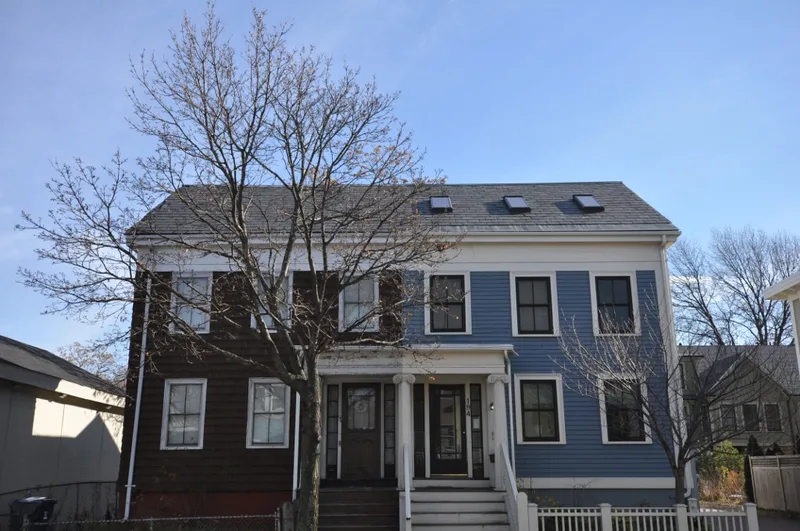
This double house at 196 Prospect Street in Cambridge, Massachusetts, dates from the 1840s and follows a T-shaped plan. A two-story front section faces the street, with a kitchen ell extending behind it. Its most prominent feature is an Ionic portico over a double entrance, along with wide, low Greek Revival window mouldings and an entablature cornice. A concrete block garage was later added at the rear. The house matters because of Maria Louise Baldwin, who lived here from 1892 until her death in 1922. Born in Cambridge in 1856, she taught at the Agassiz School and in 1916 became its Master, the only Black person in New England and one of two women in the Cambridge system to hold that post. She supervised a largely white staff and student body, lectured to audiences across the country, and led women's and literary organizations. She hosted Boston Banneker Club meetings and reading classes for Black Harvard students at this address, including W. E. B. Du Bois.
Significance in brief: It was the home of Maria Louise Baldwin (1856-1922), one of the most distinguished Black educators of her era. She became Master of the Agassiz School in Cambridge, the only Black person in New England to hold such a post. She also led community groups and lectured nationally, and she lived in the house from 1892 to 1922.
Machine-generated summary. This summary was generated by a language model from the official nomination document and has not been reviewed line by line by an editor. It may contain errors. Check the source document before relying on any detail. Source: nomination document (PDF) · National Archives catalog entry. NRHP reference 76000272, listed May 11, 1976. Summary generated October 2026 (model claude-sonnet-5-5, prompt v1.0-2026-10-29, confidence medium).
Key facts
| Address | 196 Prospect St., Cambridge |
|---|---|
| County | Middlesex County |
| Listed | May 11, 1976 |
| Reference number | 76000272 |
| Resource type | Building |
| Period of significance | 1900- |
| Architect / builder | Not Known |
| Architectural style | Greek Revival |
| Areas of significance | Black, Education, Social History |
| Level of significance | National |
| National Historic Landmark | Yes, designated May 11, 1976 |
| Status (as stated in the nomination) | Listed as occupied and used as a private residence; the form describes the building as having later alterations, including shingles over the original clapboards. |
| Acreage | 0.9 |
| Coordinates | 42.37014, -71.10013 (NPS GIS) |
What listing means for this property
National Register listing is honorary for a privately owned home: it does not by itself restrict what an owner may do with their own money, and it does not require public access. Restrictions come from local landmark or historic-district ordinances, which are separate (how they differ).
Owner-occupied houses are not eligible for the 20% federal rehabilitation tax credit, which applies to income-producing buildings, but many states offer credits for homeowners. Listing also opens the door to preservation easements and to buying a plaque. Start with what listing means for homeowners, renovating a listed house and selling one.
General information, not legal or tax advice. Rules change; confirm with your State Historic Preservation Office or a qualified adviser.
Sources and further reading
- National Park Service, National Register of Historic Places database (snapshot May 2026), reference 76000272.
- Nomination form (PDF, National Archives) — catalog entry
- Wikipedia article (used for cross-checking only; text not reproduced here)
- Wikidata Q6761040
- This listing as JSON
Last updated October 2026. Found an error? See the editorial policy for how to report it.