Maple Avenue Historic District

Why it's listed
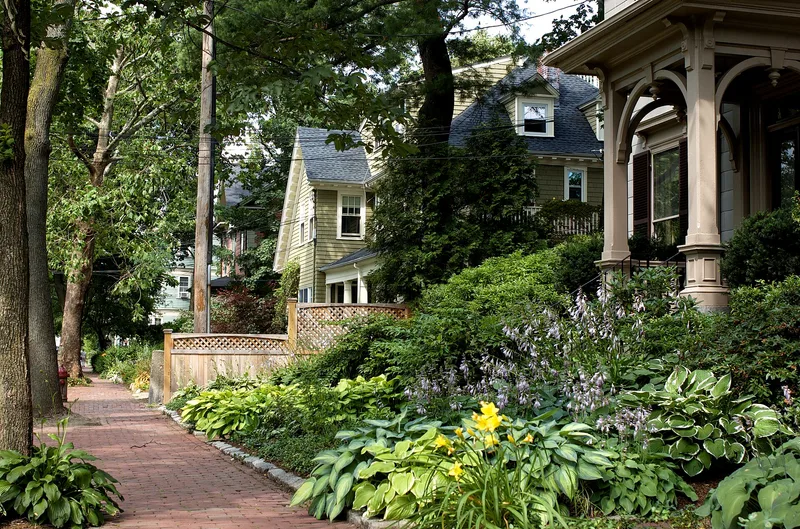
Maple Avenue in the Dana Hill area of Cambridge is a residential street first laid out in 1841, with larger lots than other streets between Broadway and Cambridge Street. The nominated district takes in both sides of the avenue from Marie Avenue to Broadway and is known above all for its Mansard-roofed houses built between about 1860 and 1890. Italianate, Queen Anne and Colonial Revival houses are mixed among them. The houses are widely spaced and vary in height and size, and Mansard roofs and bay windows create a rhythmic pattern along the street. Examples include the Francis B. Webster House of 1861, the Lewis Hall House of 1867, the Charles B. Stevens House of 1873 and the Philip Munroe House of 1887. Most buildings contribute to the district, though a vacant lot, a heavily altered house and some later two-family buildings are noted as intrusions. Reviewers valued the street as a collection of mid-19th century homes distinct from its changed surroundings.
Significance in brief: The district is significant as a collection of mid-19th century residences, many with Mansard roofs, set on widely spaced lots. It retains much of its original nineteenth century appearance. The reviewer accepted it under Criterion C and noted that it is distinguished from surrounding areas, which have changed in character.
Machine-generated summary. This summary was generated by a language model from the official nomination document and has not been reviewed line by line by an editor. It may contain errors. Check the source document before relying on any detail. Source: nomination document (PDF) · National Archives catalog entry. NRHP reference 83000816, listed June 30, 1983. Summary generated October 2026 (model claude-sonnet-5-5, prompt v1.0-2026-10-29, confidence medium).
Key facts
| Address | Maple Ave. between Marie Ave. and Broadway, Cambridge |
|---|---|
| County | Middlesex County |
| Listed | June 30, 1983 |
| Reference number | 83000816 |
| Resource type | District |
| Period of significance | 1860-1890 |
| Architectural style | Mansard, with Italianate, Queen Anne and Colonial Revival houses |
| Criteria |
|
| Areas of significance | Architecture |
| Level of significance | Local |
| Status (as stated in the nomination) | Area survey describes the district as in good condition, privately owned and in residential use; one vacant lot and a few altered or two-family buildings are noted as intrusions or minor contributors. |
| Acreage | 4.4 |
| Coordinates | 42.37234, -71.10462 (NPS GIS) |
What listing means for this property
This is a historic district. Buildings within its boundary are either contributing (they add to the district's significance) or non-contributing. Owners of contributing income-producing buildings can claim the 20% federal rehabilitation tax credit; homeowners should look at state credits. National Register districts impose no design review by themselves; a local historic district ordinance, if one exists, does (the difference explained).
General information, not legal or tax advice. Rules change; confirm with your State Historic Preservation Office or a qualified adviser.
Sources and further reading
- National Park Service, National Register of Historic Places database (snapshot May 2026), reference 83000816.
- Nomination form (PDF, National Archives) — catalog entry
- Wikipedia article (used for cross-checking only; text not reproduced here)
- Wikidata Q6753835
- This listing as JSON
Last updated October 2026. Found an error? See the editorial policy for how to report it.